Glass Manufacturers’ Marks (logos, trademarks, emblems, hallmarks, markings, signatures, initials) seen on vintage, antique and current bottles, fruit jars, insulators, tableware and other types of glassware, E through L listings ~ Please Note: for introductory and explanatory comments and discussion concerning the alphabetical mark listings section of the website, please click on the “A-B” link below which points to “page one”. Thank you!
[ A – B ] [ C – D ] [ E – L ] [ M – R ] [ S – Z ]
- E ……………………. Unidentified, but on some early (handmade) bottles, this letter could possibly stand for any of a number of early glass bottle companies, including Ellenville Glass Works of Ellenville, New York (1837-c. 1896 – operating under several slightly different factory names), as well as several Pittsburgh glassmakers such as T. A. Evans & Company (c.1860-1869), Enterprise Glass Company (1st of that name, c. 1871-1873) or Eclipse Glass Works (c.1876). Another possibility would be Edward H. Everett Company of Newark, Ohio. See “E. H. E. Co” and “N next to (or within) a star“ marks. (In a book about Edward H. Everett and his glass company – Edward Hamlin Everett – The Bottle King by G. Wallace Chessman & Curtis W. Abbott, 1991 – a graphic is shown that includes “E 1” through “E 5” as marks used by Everett. However, no indication is presented on the source of that information or what types of bottles were marked thus). In some cases it is possible the letter could be merely a mold identifier or “shop letter”, as seen on the bottom of some beer bottles. The type of bottle most commonly seen with a single letter “E” on the base, often accompanied by a mold number (1, 2, or 3) placed below the letter, is the Doyle’s Hop Bitters, usually found in some shade of amber. In those cases, judging from the years in business and the fact that Doyle’s was based in Rochester, NY, I think Ellenville Glass Works is the more likely contender for the “E” glass mark – at least on those particular bottles! However, there is no proof for this theory!
- E (four rectangular strokes, stylized “E” which may actually be intended as an abstract “M”, seen on bottles primarily from the 1970s). See “Abstract M” logo on Page Four where a photo of this mark is shown. This may be interpreted as a capital “E” with a space between the one vertical stroke and three horizontal strokes………………. Midland Glass Company.
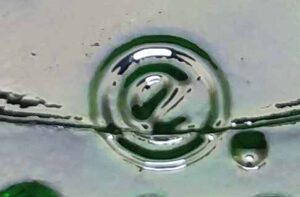
Lower case “e” inside circle trademark/logo on bottom of emerald green Jameson whiskey bottle. This mark stands for Encirc, subsidiary of Vidrala, S.A. - E (oddly shaped lower case “e” inside circle)…………………… here seen on base of emerald green Jameson Irish Whiskey bottle, this recent mark stands for Encirc (founded in 1998) with container glass factories located in Derrylin, Ireland; Elton, Cheshire, England and The Park, Bristol, England. The mark is also used by Corsico Vetro S.r.l., Corsico, Milano, Italy, according to a recently updated Emhart bottle punt mark .pdf file. All of these operations are now [2024] subsidiaries of Vidrala S.A.
- E. B. (on base of mouthblown bottle, circa pre-1900)…………………. uncertain, but probably Edgar Breffit & Company, Castleford, Yorkshire, England. (c. 1844-1913). This firm was the operating company for the Aire & Calder Bottle Company (see A.C.B.Co. mark) for many years. For more info see this article by Bill Lockhart & the BRG: Edgar Breffit & Company – SHA.org
- E.B.& CO. ……………. see above entry.
- E. BREFFIT & CO. ……….. see “E.B.” entry.
- E4 (on milk bottles)…………..Essex Glass Company, Mt. Vernon, Ohio (c.1906-1920).
- E.F.B.CO…………….Elk Flint Bottle Company, Shinglehouse, PA (1904-1912 or 1919). Although most references in bottle/jar related research material state 1912 or 1913 was the end date of this company, information on this webpage on Shinglehouse history indicates this firm was in business until 1919 : Shinglehouse Borough History . Also, this company produced wire bail type fruit jars embossed “TRADEMARK / KEYSTONE / REGISTERED” across the front of the jar.
- EG (along lower heel of soda bottles, embedded within a brief series of numbers, often lightly embossed and hard to read)…………. Graham Glass Company, Evansville, Indiana (see Graham). Often found in conjunction with “G23” or “G26” or similar numbering. These markings are often seen on light green glass soda bottles of the 1920s.
- E.G.Co. ……………. these initials on bottles could stand for any one of at least three different operations including: Everett Glass Company, Everett, PA (three firms with that name operating over the period of 1885-1905); Evansville Glass Company, Evansville, Indiana (1903-1907); or Eastern Glass Company, Cumberland, Maryland (1909-1913). For more background details on these firms, please see this article by Bill Lockhart et al: The E.G.CO. and E. G. Co. Logos – SHA.org
- E G CO (in cursive script, placed inside a horizontal oval)……………….. unidentified, seen embossed on a clear glass urinal of uncertain date. Possibly, the maker was one of the 3 firms listed in the entry above.
- E. H. E. ………………Edward H. Everett (c. 1881-1885). This was the second owner/operator of the Newark Star Glass Works. Officially incorporated as “Edward H. Everett Company” in 1885 (also called “Edward H. Everett Glass Works”). The “E H E” mark may have been used after 1885, concurrently with the E. H. E. CO. mark. Please see next entry, as well as “N next to (or within) a star“.
- E.H.E.CO……………………Edward H. Everett Company (operating company of the Newark Star Glass Works), Newark, Ohio (1885-1904). Plant merged in 1904 to become part of the Ohio Bottle Company and in 1905 Ohio Bottle became part of the American Bottle Company. American was purchased by Owens Bottle Company in 1916, and in 1929 this plant became part of the merger that resulted in the formation of Owens-Illinois Glass Company. Also, see “S. K. & CO” and “N next to or within a star” marks.
- Ekco……………………Ekco Housewares, Chicago, Illinois. Maker of all types of kitchen-related cookware and accessories. Brand name occasionally seen marked on glass cookware, measuring pitchers, coffee carafes, etc. Most of these pieces date anywhere from the 1950s to the present. I’m not positive what glass manufacturer produced these items. I would hazard a guess (repeat: guess!) that some items were made by Hazel-Atlas Glass Company, Anchor Hocking Corporation, Indiana Glass Company, Federal Glass Company and/or Corning Glass.
- E. L. & Co. ……….. Eli Lilly and Company, Indianapolis, Indiana (1876 to date). This mark is seen on a variety of medicine bottles, most often made in amber glass. Bottles bearing this mark on the bottom appear to date from sometime in the 1890-1930 time period. Most, if not all, of these bottles were made by Fairmount Glass Company, located first at Fairmount, Indiana and later in Indianapolis. As a side note, Eli Lilly & Company marketed some amber figural “Fish bottles” in the 1920s that contained cod liver oil (which were patterned after similar-looking handblown bottles originally made in the 1860s-1870s). The Eli Lilly fish bottles were made by Fairmount at the Indianapolis factory, and are typically marked with an “F” on the base.
- Ellenville Glass Works…………….Ellenville Glass Works, Ellenville, New York (1837-1896)
- Emerald (rectangular “Emerald cut” gemstone – embossed design seen on the skirt of glass electrical insulators)……………….. see “PRISM” entry on Page Four. This mark was embossed on insulators made for (and sold by) C.S. Knowles of Boston, MA.
- E. O. Brody Co, Cleveland O. U.S.A…………………….. see more information on the Brody company on this page.
- EP (along lower heel of soda bottles, preceded and followed by various numbers)………….Graham Glass Company, Evansville, Indiana. See Graham. Usually found on pale green glass “crown lip” soda bottles of the 1920s period.
- E. P. JR. & CO. …………..E. Packham Jr. & Company, Baltimore, Maryland (c. late 1890s-1900s?)
- E.R. & Co. (on base of “MASON’S PATENT NOV 30TH 1858” fruit jar)………………… Ely, Reed & Company, Clyde, NY (c.1874?-1880). ER&Co were successors to “Southwick, Reed & Company”. The exact year of transition from S.R.& Co. to E.R.& Co. is a bit unclear but surely within the 1873-1875 time period. This was just one of the many proprietor firms that operated the Clyde Glass Works factory at Clyde, New York. See “Clyde”, “E. S. & H.” and “S. R. & Co”.
- ES (along lower heel of crown-top soda bottles, preceded and followed by various numbers or letters)………….. Graham Glass Company, Evansville, Indiana. See Graham.
- E. S. & Co………………… Evans, Sell & Company, Pittsburgh, Pennsylvania (1873-1877)
- E. S. & H. …………….Ely, Sons & Hoyt, Clyde, NY (Proprietors of the Clyde Glass Works during part of the time that factory was in operation, initials possibly used circa 1886-1895).
- E Son & H ………… Ely, Son & Hoyt, Clyde, New York (c. 1880-1886). See above entry. Also, see S & R, and Clyde entries.
- E Son & Hoyt / Clyde N.Y. …………………… same as above.
- Evans (T. A. Evans & Co)…………… see “T.A. Evans & Co.” entry on Page Five.
- Everett……………Edward H. Everett Co. (Newark Star Glass Works), Newark, Ohio (c.1881-1904). See “E.H.E.CO.” and “N next to (or within) a star” entries.
- E. W. & CO………E. Wormser & Company, Pittsburgh, PA (c.1854-1875). Later known as Wormser Glass Company (1875-c.1927).
- Exax……………………………Owens-Illinois Glass Company, Toledo, OH (Kimble Glass Company, division of O-I). Trademark used for borosilicate glass formula, used for laboratory glassware, chemical bottles, etc. circa 1950s.
- Eye (Cat’s Eye)………………….occasionally the “Diamond and oval entwined with an I in the center” trademark used by Owens-Illinois Glass Company has been loosely described as an “Eye” or as resembling the planet Saturn. Please see this page on Owens-Illinois Glass Company for more information and photographs of a number of examples of that mark on bottles.
- Eyelash (mark on base of glass articles that may resemble a false eyelash, centipede, feather or fern leaf) . This is a minor defect created during the glass manufacturing process, called a shear mark. Please see the “Shear mark” entry on Page Five.
ADVERTISEMENT
- F…………………Fairmount Glass Works/Company, Fairmount, IN (1889-1906) & Indianapolis, IN (c.1906-1968). Most commonly seen on the bottoms of various machine-made utilitarian bottles and jars, in amber or clear glass, that date from the c. 1920 – 1945 era. For more info see the Fairmount Glass page. Also, see next entry.
- F (on bottom of aqua, handblown, applied lip flask that appears to date from the 1870s-1880s era)……………some shards of these bottles have been reported as found at the factory dump site of the Lyndeborough Glass Works, South Lyndeborough, New Hampshire (1866-1888). However, some bottles bearing this mark might be from an unrelated, unidentified glass works. The exact meaning is unclear but the “F” might have served as a mold identifier or “shop letter”.
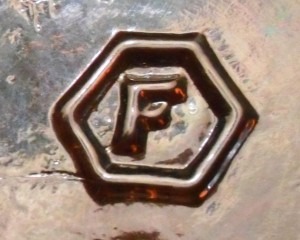
F in a hexagon mark used by Fairmount Glass Company of Indianapolis, Indiana, on base of amber bottle. - F in a hexagon (shown)………………..Fairmount Glass Works/Company, Fairmount, Indiana (1889-1906) & Indianapolis, Indiana (c.1906-1968). For more info on the marks used by this company, please see this page: Fairmount Glass Company.
- F inside a keystone…………………..attributed to C. L. Flaccus Glass Company, Pittsburgh, PA (1879-c. 1927). General offices in Pittsburgh, actual factory locations were at Tarentum, Leechburg, New Brighton, California, Charleroi and Beaver Falls, all in Pennsylvania. The period of usage of this particular mark is uncertain. Although the mark is listed in “Glass Milk Bottles: Their Makers and Marks” by Jeffrey L. Giarde (1980) on page 22, and he dates it as “1900 – 1928”, Giarde might have been copying Julian Toulouse’s info in “Bottle Makers and their Marks” (1971). I have only heard about one milk bottle confirmed to have this mark – but on the heel, not the base. If you have seen ANY bottles bearing an “F in a keystone” mark, please write! Also, see “C.L.F.” and “C L F G CO” marks. Flaccus has a rather complicated and confusing history – here is an article by Bill Lockhart with more background information on this company: C.L. Flaccus Glass Co.
- F in a vertical oval, in cursive script…………Fenton Art Glass Company, Williamstown, West Virginia (1905-2011). Mark first used in 1983, seen on brightly colored handmade upscale glassware.
- F superimposed over a G……….. see “F G” mark (Florida Glass Manufacturing Company, Jacksonville, FL).
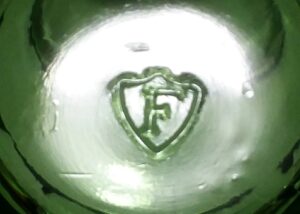
“F in a shield” mark used by Federal Glass Company – here on base of miniature mug in avocado green. - F within a shield/crest (shown) ………………….Federal Glass Company, Columbus, Ohio (1900-1979). This trademark, according to U.S. Patent & Trademark records, was first used in 1932, although the logo was shown in catalogs as early as 1927 according to researcher Marg Iwen. The “F in a shield” may have actually been used on their glassware all the way up to 1979, the year the factory closed down. Federal is well known for having made large quantities of so-called “Depression Glass” in the 1920s-1940s. For more background information, please check out my webpage about Federal Glass Company.
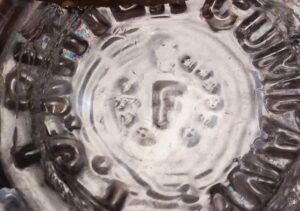
- F and dots (The letter “F” accompanied by, or partially surrounded by dots, often in a circular pattern, as shown above, usually seen on the bottom of clear cylindrical bottles)……………………….. this mark was one of several similar “letter with dots” marks used by Owens Bottle Company for an undetermined number of years – perhaps 1916-1919- before they adopted their standard “O inside a square” trademark that was instituted in 1919. These are machine-made bottles. For more info see this link:
The Owens Bottle Co. Part 2 – Dating Logos and Codes – Nate Briggs & Bill Lockhart. - F & A………….Fahnestock, Albree & Co., Pittsburgh, Pennsylvania (c.1860-c.1872).
- F. A. & CO……….Fahnestock, Albree & Co., Pittsburgh, Pennsylvania (c.1860-c.1872).
- Fahnstock, Albree & Co. Pitts. PA………….Fahnstock, Albree & Company, Pittsburgh, PA. See entry above.
- Faroy U.S.A………………..mark seen on a variety of decorative votive candleholders or “candle cups” – please see FAROY glass.
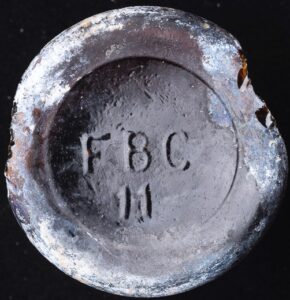
F.B.C. mark used by Findlay Bottle Company, as seen on beer bottle base shard from San Antonio River excavation (photo courtesy of Ansen Seale) - F. B. C. ……………. Findlay Bottle Company, Findlay, Ohio (1888-1893). Occasionally seen variation, not as commonly used as “F. B. Co”.
- F. B. Co. ……………Findlay Bottle Company, Findlay, Ohio (1888-1893) . Most commonly seen on the bottom of aqua “wax sealer” style fruit jars.
- F. B. & F. J. CO……Fairmont Bottle & Fruit Jar Company, Fairmont, West Virginia (1892-1893). This company was dissolved in 1893, and a few months later a new company (located at the same factory site) was organized under the name of “Johns Bros”. See J.Bros. mark.
- F.C.C.CO…………..mis-reading of “F.C.G.CO.”, below. The “G” is often embossed to appear more like a “C”.
- F. C. G…………………see “F G C” entry.
- F.C.G.C……………..Falls City Glass Company, Louisville, Kentucky (1884-1892)
- F.C.G.CO………….. same as above – Falls City Glass Company, Louisville, Kentucky (1884-1892).
- F C W………………. misreading of mark used by Fairmount Glass Works (see F. G. W. entry). Often the mark has a much larger “G” in the middle which does look like a “C”.
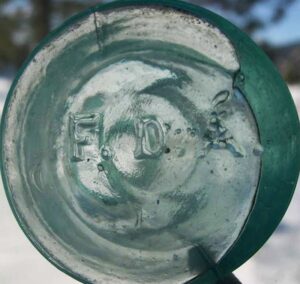
F.D.A. (Fred D. Alling) marking on base of aqua type cone ink bottle. (Photo courtesy of Jim Sinsley) - F.D.A. (on antique handmade ink and glue bottles) …………………. Fred D. Alling, Rochester, New York. These initials stand for Frederick Dwight Alling (sometimes the last name is mistakenly spelled Allings). Alling (1843-1910) was an ink and mucilage manufacturer based in Rochester, NY who started his business in about 1867. He began by selling stationery and related goods and then expanded into manufacturing inks, eventually selling a wide variety of inks and related products for many years thereafter. A number of different types of ink bottles (including cone, igloo, and schoolhouse or carmine types), are known with his name or initials embossed on them.
- “Federal Law Forbids Sale or Reuse of This Bottle”…………..phrase commonly seen on liquor bottles. For more information, please check out this article: Federal Law Forbids Sale or Reuse of This Bottle.
- Fenton within an oval (shown)…………………….Fenton Art Glass Company, Williamstown, West Virginia (1905-2011). This particular mark used since 1970. Fenton has produced large quantities of handmade novelty, decorative and art glassware of every description in many, many colors. For more information, please see my webpage on Fenton Art Glass Company.
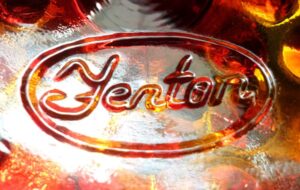
Fenton in an oval (Fenton Art Glass Company). - F.E.R……………..F. E. Reed Glass Company (Reed Glass Company), Rochester, New York (1899-1956). Mark used from c.1899-1927. For more detailed company chronology, see under “Rochester Glass Wks” entry. Also see next entry.
- F.E.R.G.CO…………F. E. Reed Glass Company (Reed Glass Company), Rochester, New York (1899-1956). This and the above mark probably dates from the earlier years, c. 1899-1927. See “Rochester Glass Wks” entry for other marks used by this firm.
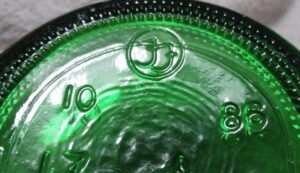
“FF inside a circle” mark used by Foster-Forbes Glass Company, here on base of emerald green soda bottle made in 1986. - FF in a circle (cursive script FF, letters joined, within a circle)……………………. Foster-Forbes Glass Company, Marion, Indiana and (later) several other plant locations. (1929-2000). This particular mark was first used in 1942 and is seen on the bottoms of many kinds of bottles including those made for soda, beer, food, medicine, cleaning products, etc. The exact ENDING year of use of this mark seems a bit uncertain, but I have seen emerald green soda bottles with date codes for 1986 and 1990. Foster-Forbes Glass Co. was merged into National Can Company in 1969 and eventually National Can Company was merged with other interests to form American National Can Company in 1987 (see American National Can Company mark on Page One )- however at least some bottles made at some of the Foster-Forbes plants under this corporation “umbrella” continued to use the “FF in a circle” mark – at least as late as 1990 and possibly as late as 1995. Sometimes the mark is faint and very hard to discern and in some cases the cursive “FF” is interpreted as “33” with the numbers having a somewhat flat top, or as a “JJ connected, inside a circle” ! Some of the former Foster-Forbes glass plants are no longer in operation, and others are part of the present-day Ardagh Group (formerly owned by Saint Gobain, later Verallia). Saint-Gobain Containers products usually have an “SG” on the heel or base (see my page on the “SG” mark used by Saint-Gobain). For an earlier mark used by Forbes ( 1929-c. 1942), see entry under “Z” (Backward Z with a slash through the center) on Page Five. For more background material on Foster Forbes and related glass companies, check out this web article by Bill Lockhart et al: Foster-Forbes Glass Company. ALSO, please check next entry for a similar mark used in Great Britain!
- FF in a circle (cursive FF on bottles made in Great Britain)……………………….. Forster’s Glass Co., Ltd., St. Helens, Lancashire, England (c. 1902-c.1966) . Toulouse illustrated this mark (page 205, Bottle Makers and their Marks) and stated it is “modern”, likely dating no farther back than World War II. The two letter F’s are in cursive font and may be somewhat “tall” and “thin”, slightly more so than the letters in the very similar mark used by Foster-Forbes in the United States. These marks may be easily confused, but if the container was found in Great Britain it is much more likely to represent Forster’s Glass Co., rather than Foster-Forbes. (See FGC mark).
- F. F .& Co……………………Fox, Fultz & Company, Boston, Massachussetts (c. 1894-1911+). (Date range info courtesy of Taylor McBurney).
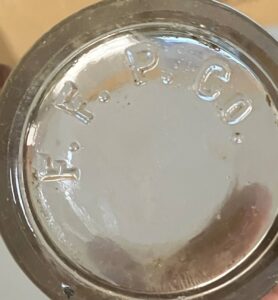
- F. F. P. Co……………………… Unknown meaning. Lettering as seen on the bottom of a clear bottle, cup or drinking glass (from a partial base shard), date unknown but possibly early 1900s. The lettering is embossed in reverse on the base, so it looks correctly oriented only when looking downward into the glass.
- F. F. & W…………Fox, Fultz & Webster, Boston, Massachusetts (c. 1885 or earlier-c.1893). This mark was first reported to me (courtesy of Mark Newton) as seen on the base of a colorless druggist bottle from Greenville, NH, probably made circa 1885. Another web correspondent (Shawn) supplied the full name of that business as the virtually certain source of the mark. Taylor McBurney supplied approximate date range from info found in city directories.
- F G ………………. Florida Glass Manufacturing Company, Jacksonville, Florida (1926-1947). Julian Toulouse (Bottle Makers and their Marks, 1971, page 199) indicates this mark dates from “circa 1930”. Another minor variation is also pictured: F and G entwined (superimposed over each other) which he writes as dating “circa 1940”. According to Toulouse, Florida Glass Manufacturing Company was purchased by Chattanooga Glass Company in 1947 (See “C in a circle” mark) , then leased by Ball for a year, and subsequently sold to Scalise in 1950 who changed the name of the concern to “Tropical Glass & Box Company” in about 1952. This Jacksonville plant eventually became Anchor Hocking’s plant number 7. Some milk bottles marked “F G” also bear the number “60” to the immediate right of the letters. Also, a few half-pint size milk bottles marked “F G CO. 60” (and at least one marked “F G CO 160”) on the lower heel are products of Florida Glass. More background info here from Bill Lockhart and other researchers: Florida Glass Mfg. Co.
- FGC ………………………………………………….. Forsters Glass Company, St. Helens, Lancashire, England (United Kingdom), 1902-1966. Forsters was acquired in 1966 by Rockware Glass, and Rockware eventually became part of Ardagh Glass in 2006. This mark is frequently seen on fishing net floats.
- F.G.CO. (confirmed on lower heel of a few clear milk bottles, mostly from dairies located in the southeastern US)……………… Florida Glass Manufacturing Company, Jacksonville, Florida (1926-1947) . The mark “F. G. CO. 160” has also been seen on at least one half pint milk bottle. (That bottle bears a large “3¢ ” on the base). A few bottles are marked “F.G.CO. 60” on the heel. See “F G” entry, above. Also, see more info on the operation here: Florida Glass Mfg. Co.
- F. G. Co. ……………………….. meaning unclear. (Note – this mark includes a lower case “o” in Co). A very small number of bottles have been found with “F. G. Co.” embossed on the base and there is uncertainty about what those initials actually stand for. They are much older bottles than those known to have been made by Florida Glass Mfg. Company (see F G and F.G.CO. entries above). Although Toulouse (Bottle Makers and their Marks, 1971, page 200) attributes this mark to Fairmount Glass Company of Fairmount, Indiana, claiming it’s use from 1889 to 1898, this seems open to question. (see Fairmount Glass Works page on this site). An amber medicinal flask and an amber “pony” style beer bottle are marked with “F.G.Co.”. Also, a clear handmade ink bottle is known, and that bottle may have been made in Canada or England. Photos of those bottles are shown in this article from Bill Lockhart et al, here: Florida Glass Mfg. Co. – SHA.org
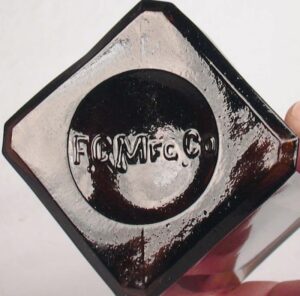
“F. G. MFG. Co.” on base of amber Primley’s Iron & Wahoo Tonic bottle. The initials stand for the Farrall Glass Manufacturing Company of Michigan City, Indiana – 1885-c.1887. (Photo courtesy of Bill Lindsey). - F.G.MFG.Co. ………………..Farrall Glass Manufacturing Company, Michigan City, Indiana (1885- 1886 or 1887). The business address for this works was located in nearby Chicago. This very scarce mark is known on the base of a Primley’s Iron & Wahoo Tonic bottle (photo above) and also on the bottom of an amber PH.ZORN beer bottle from Michigan City, Indiana. Other bottles are possibly out there that I’m not aware of. After many years of being an “unknown mark” , the correct identification of the user of this mark has been uncovered by researcher Josh McIntyre who kindly passed along this information to us [11/2025]. The exact time of closure of the operation is yet uncertain, but Josh is continuing to do more research on this short-lived glassworks. The factory property evidently sat empty for a number of years, and was then purchased and renovated to become a brick manufacturing operation in about 1895.
- F.G.W. ………………………Fairmount Glass Works/Fairmount Glass Company, Fairmount, Indiana (1889-1906) & Indianapolis, Indiana (c.1906-1968). See Fairmount Glass Works page.
- F.H. ……………….Frederick Heitz Glass Works, St. Louis, Missouri (1882-1898).
- F.H.G.W…………..Frederick Heitz Glass Works, St. Louis, Missouri (1882-1898).
- F.H.L. & Co……………….Francis H. Leggett & Company, New York City, New York (1870-c.1959?). This was a wholesale grocery firm, selling both local, regional as well as imported grocery products such as tea, coffee, cheese, etc. Some “MASON’S PATENT NOV. 30TH 1858″ jars are known with the initials on the base. Those probably date from sometime in the 1870s-1890s era, and were made for FHL&Co by an unidentified bottle maker.
- F. I. CO ……………. Franklin Industrial Company, Warwick / Clinton, Ohio. (c. 1906-1915). Seen on base of beer bottles. Franklin Industrial Co. was formed to control a number of related small industries in the Massillon, Ohio area, including sand and gravel companies and the operation of the Warwick Glass Company, which was supposedly founded in 1901 by a Maria Warwick. How long this glass manufacturer actually lasted and whether any other marks were used on the bottles made there, especially in the 1901-1906 time frame, seems open to question. For a bit more info and links, please see the post from “Jim” and my response, dated March 3, 2020, in the Comments section of the WELCOME / Home page.
- FID 2 (seen on milk bottles) ……………..Fidelity Glass Company, Tarentum, Pennsylvania (1895-1916).
- FIDELITY (on the bottom of a milk bottle)………………….Fidelity Glass Company, Tarentum, Pennsylvania (1895-1916).
- 55 FULTON ST (as seen on glass electrical insulators)………………………. this address positively identifies an insulator to be a product of the Brookfield Glass Company (Bushwick Glass Works), at their first manufacturing facility in Brooklyn, New York. The address (a business office address) indicates the insulator was probably made sometime in the 1868-1882 time period. For more information on this glassmaker, please see my page on Brookfield Glass Company.

- Fire-King…………………………… Anchor-Hocking Glass Corporation (1937-to date). This has been an extremely popular line of glassware since introduced in the 1940s. Fire-King glassware has been made in semi-opaque or “translucent” colors, as well as fired-on colors over transparent or white milk glass. Fire-King is made of a heat-resistant type of glass, and many patterns and styles of bowls, cake pans, and other items for oven use have been made, competing with Pyrex-brand cookware made by Corning Glass Works. Large numbers of drinking mugs and cups have been made with the Fire-King brand name logo on the bottom, and these are avidly collected today, especially by the so-called “baby boomers” growing up during the 1940s, 1950s and 1960s, when so many of these items were in popular use in most American homes. Many of the mugs and bowls have surface-applied color decoration, which sometimes begins to wear off, thus washing them in an automatic dishwasher is strongly discouraged. Vintage Fire-King ware has great nostalgic value, and can be seen frequently for sale at antique malls, flea markets and garage sales. Please see “Anchor with an H superimposed” mark on this page: Anchor Hocking Glass Corporation.
- Fire & Light (etched on handmade glassware)…………………. Fire & Light, Arcata, California (1995-2019). Located in northern California (Humboldt County), this independent glass studio operation produced handmade glassware from recycled glass (mostly from crushed bottles), and has gained a devoted following among glass collectors. Many types of products were made including bowls, plates, tumblers, ashtrays, votive candleholders and other novelty items, in a wide range of colors. Many pieces seem “heavy” in weight for their size. Most (although not all) of the pieces, especially the bowls, plates and tumblers, feature a somewhat uneven surface (which might be described as “hammered”, bumpy, corrugated, irregular, or subtly crinkled or pebbly). Only a minority of pieces were signed, usually on the base or edge of the piece. Sadly, the operation ceased glass production and closed down permanently in April of 2019, evidently because of financial issues.
- Fislerville Glass Works………………………. Fislerville Glass Works, Fislerville (now Clayton), New Jersey (1850- c.1863 – although known under the Fislerville Glass Works name unofficially for years afterward). Became Moore Brothers & Company in 1863. Most famous for their Jenny Lind calabash liquor flask produced in the early 1850s. Note: Many reproduction “Jenny Lind” calabash bottles are known, in a range of colors, and are much more plentiful than the originals made by Fislerville Glass. Most of the repro Jenny Lind bottles were made by Clevenger Brothers Glass Works. For info on how to tell them apart, see this page: Have you been fooled by the Clevengers? – RealorRepro.com
- F.L. ……………….Frederick Lorenz & Co, Pittsburgh, Pennsylvania. This mark (and “F. L. & Co.”) was listed by Rhea Mansfield Knittle in Early American Glass (1927:441;444). Some sources give the dates 1819-1840 for the use of one or both of these marks. Knittle notes that “F.L.& CO.” appears on a Union-Clasped Hands pictorial flask, but McKearin & Wilson (1978:651) show that the mark as “L.F.& Co”. In any case that flask would certainly date from the 1860s or 1870s. See “F R L”.
- F.L.& Co………………….see above entry.
- Fletcher’s Castoria / Pitcher’s Castoria ………. See this page: Fletcher’s Castoria .
- Fleur de Lis design/logo (seen on the base of pressed glass vase)……… Unknown trademark. I suspect this may be of foreign origin, perhaps European.
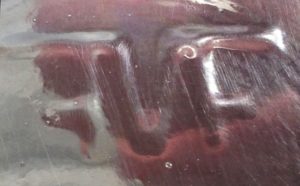
FMF (Photo courtesy of Michael Johnson) - FMF (shown)………..Food Manufacturers Federation. (See post submitted by Jeremy Kemp on 8/27/2017 in the “Comments” section). Seen on clear bottles in the United Kingdom.
- FN 21 ………………. unknown. Reported by Lee Taylor on base of handmade aqua export style beer bottle, probably circa 1900-1920. The initials might stand for a brewer or bottler?
- FORSTERS…………………………………See F.G.C. entry.
- Fort Trumbull Glass Co. ………………………….Fort Trumbull Glass Company, New London, Connecticut (1865-1868) . Mark is known on the base of cylinder whiskey bottle.
- 45 CLIFF ST (as seen embossed on glass electrical insulators)…………………………. this address positively identifies this insulator to be a product of the Brookfield Glass Company, made at their Brooklyn, New York location. The Cliff Street address was a business office address, and indicates the insulator was most likely made sometime in the 1882-1890 time frame. See my page on Brookfield Glass Company for more information.
- Frank Miller’s Crown Dressing……………. a popular type of shoe polish (“shoe dressing”), especially well-known during the late Victorian era, circa 1880s-1890s. For more information, please see this webpage about Frank Miller’s Crown Dressing.
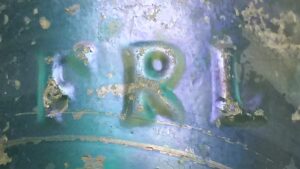
- FRL (F R L) ……………………. Frederick R. Lorenz, Pittsburgh, Pennsylvania (c.1854-1860). Sources disagree on the time period of this particular mark, but empirical evidence from certain blob top soda bottles indicate the mark was definitely in use at least sometime between 1854 and 1859.
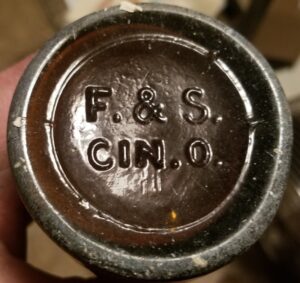
Foss & Schneider Brewery, Cincinnati, Ohio – mark used c. 1877-1884. (Picture courtesy Jimmy Bray) - F. & S. CIN. O. (on base of amber “export beer” style bottle) …………. Foss & Schneider Brewery, Cincinnati, Ohio. Foss-Schneider Brewing Company was in business for many years but the exact business name of the company changed several times and was “Foss & Schneider Brewery” circa 1877-1884, according to this webpage: Foss & Schneider Brewery
- FV-connected (letters F and V connected, as shown below) ………………..FEVISA (Fábrica de Envases de Vidrio S.A. de C.V.), Mexicali, Baja California, Mexico and other factory locations. (1987-to the present). This glass company manufactures large quantities of soda & beer bottles, many of them exported to the US. I’m not sure about the exact span of time this trademark has been in use, but I’ve noticed the mark on a “Mexican Coke” returnable-style bottle code dated 2006, and a Jarritos brand soda bottle with a 2023 date code.
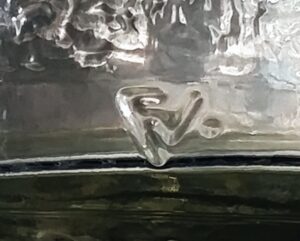
FV-connected mark – FEVISA ( Fábrica de Envases de Vidrio, S.A. de C.V.), Mexicali, Mexico and other plant locations , seen here on heel of Jarritos soda bottle. - FW (F above W)………………… as seen on colored pressed glass novelties – art glass, open salt cellars, candleholders, etc ……………………….Wilkerson Glass, Moundsville, West Virginia (1975 – present). Fred Wilkerson, who had worked at Fostoria Glass Company since 1958, started his own small operation making handmade art glass in 1975. In 1989 his son, Fred, Jr, joined him. Wilkerson Glass was officially incorporated October 1, 1990. This is the first of two different marks used by Wilkerson, this one dating from approximately 1975 to 1989. See next entry.
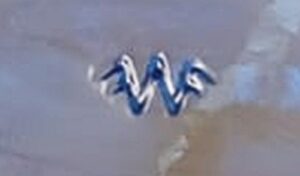
FWF (Winged W) mark used by Wilkerson Glass (Photo courtesy of Joe Stiles) - FWF (Capital letter W, joined with two capital “Fs” – the first one is backward)…………. Wilkerson Glass, Moundsville, West Virginia (1975 – present). This mark was used after the FW mark listed above, beginning in 1989, and is sometimes called a “Flying W”,” Winged W” or “W with wings”. The mark appears on the bottom of pressed glass novelties such as open salts and miniature insulators, made in a variety of colors. Not all glass was marked. Wilkerson Glass has made a wide variety of blown and pressed glass items and their website can be found at WilkersonGlass.com
- FX inside a diamond (on base of small clear glass six-sided jar, shown below)………….. unknown meaning. The jar appears to be of recent manufacture.
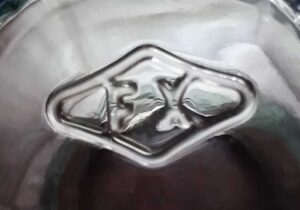
“FX in a diamond” mark – on base of small clear glass jar or shaker. - G (alone, or within a circle)………… On the base of some cobalt blue bottles, such as Phillips Milk of Magnesia Tablets, this “G” stands for Gulfport Glass Company, Gulfport, Mississippi (1955-1970). Gulfport Glass Co. made large quantities of the Phillips M.O.M. bottles. Gulfport was acquired by the Dorsey Corporation in 1968.
- G…………………Gayner Glass Works, Salem, New Jersey (on some bottles especially in the earlier years). See “G in a circle”.
- G…………………Glenshaw Glass Company, Glenshaw, Pennsylvania (1895-2004) on some bottles. Also, see “G in a square” mark.
- G (highly stylized logo seen on upscale tableware including tumblers) ……………. this particular mark is actually an “R” but might be mistaken as an abstract “C” or “G”. Please see the “R” entry on page four showing an actual photograph of this mark which is used by Rosendahl, Copenhagen, Denmark.
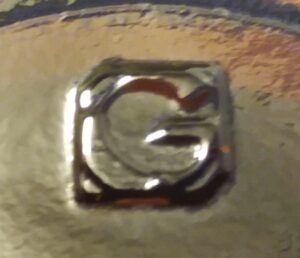
Gamer Packaging ‘G mark’, seen on base of amber glass Fentimans Ginger Beer bottle, made circa 2010. - G (stylized capital G inside a square, as shown in accompanying pic)……………….Gamer Packaging, Minneapolis, Minnesota (1987-to date). Gamer Packaging is a distributor/wholesaler of glass bottles as well as other types of packaging including plastic and metal containers. Some items are manufactured directly by them, others by arrangement with other companies. Gamer currently (2021) has an arrangement with Anchor Glass Container Corporation and O-I (Owens-Illinois, Inc.) to supply many of the glass bottles they sell. They have also used Ardagh Group as a bottle supplier. Other unnamed glass firms might also supply some bottles sold by/through Gamer Packaging, including unidentified glass companies located in Asia. The bottle with this particular mark (shown) was sold by Fentimans – see The History of Fentimans – Fentimansusa.com.
- G in a circle………………..Gayner Glass Works (1898-1937), later Gayner Glass Company, Salem, New Jersey (1937-1975). (The Gayner operation came under control of National Bottle Corporation in 1957 until the plant closed in 1975). It is unclear if Gayner used the “G in a circle” mark between 1957 and 1975. This mark was reportedly used (re Julian Toulouse in Bottle Makers and their Marks) in the c. 1920s on machine-made bottles. Also see “G inside the outline of a jar”. See next entry and “GGW”.
ADVERTISEMENT
- G in a circle…….in some cases, Gulfport Glass Company, Gulfport, Mississippi (1955-1970). This information comes from Toulouse (Bottle Makers & Their Marks, page 210) although how to tell this apart from the “G in a circle” mark used by Gayner (above) is not clear. Toulouse writes that Gulfport made blue and amber containers, and that Gulfport was acquired in 1968 by Dorsey Corporation of Chattanooga, TN although the operation was continued under the Gulfport name until 1970.
- G in a circle (on bottles made in Great Britain)……………….. Garston Bottle Company, Ltd., Garston, Liverpool, England.
- G in a diamond…………….. General Glass Corporation, Winchester, IN (circa 1931-1937). This mark is confirmed to exist on the base of some “Old Mr. Boston” pint size liquor bottles. For more detailed information on this rather obscure mark, please see this webpage: Other G Marks – SHA.org
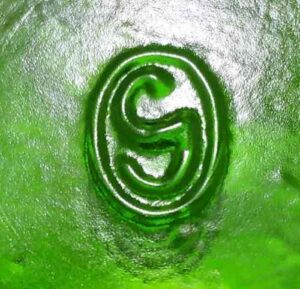
- G inside an oval (shown)…………….Gallo Glass Company, Modesto, California (1958-to date).
Gallo produces large quantities of wine bottles for their products. This “g” is written in a cursive script (with a rather large “gap” on the upper right portion of the letter), and on some of their bottles the mark might be mistaken for an odd-looking capital “S”, especially if the embossing is light. Most often seen on the bottom of heavy green glass bottles. Many of these bottles are made in a strong, bright green colored glass – the green shade having a slight yellowish tint. - G in a shield…………………….. unknown. Seen on the base of clear and aqua cylindrical “packer style” laboratory / chemical / apothecary bottles (with custom-ground inner lip for ground glass stopper). Date range for these bottles – circa 1890 to 1940? I suspect this could represent a glassmaker from Europe, but I have no concrete evidence for that.
- G inside a square……………………..Glenshaw Glass Company, Glenshaw, Pennsylvania (1895-2004). Prolific maker of soda and beer bottles as well as many other types of containers. Mark reportedly used since 1932. Glenshaw Glass Company later became part of the Anchor Glass Container Corporation, but then was bought by Consumers Packaging Inc, of Toronto, Canada. The Glenshaw glass plant was closed in November of 2004. In 2007 the Glenshaw glass plant re-opened after extensive renovation and re-organization, thereafter producing glass containers and other ware under the name Kelman Bottles, LLC. (2008- ) I haven’t been able to found out much info on the company or their products in the last few years, although I am assuming they are still in business (?). A brief news article mentioned a fire that occurred at the factory site in 2011, and manufacture of bottles was still going on at that time. I understand Kelman Bottles is primarily a producer of wine bottles. If anyone has more background info on their bottle production and/or mark(s) used on Kelman’s products, please send me an email!
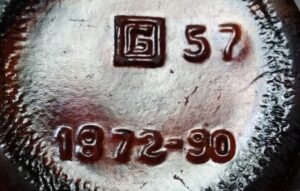
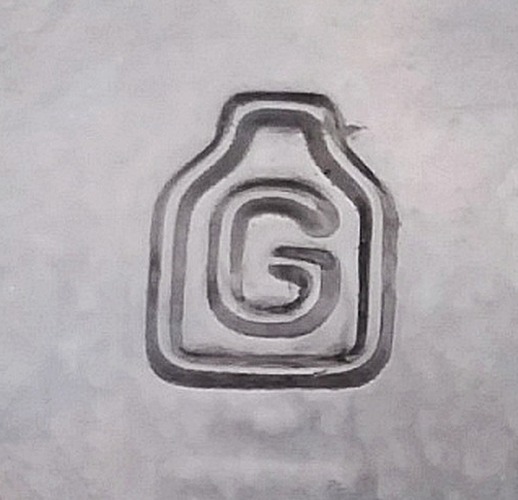
“G in a square” mark used by Glenshaw Glass Company, here on an amber bottle made in 1957. The “1872-90” is a factory code number assigned to the bottle style. - G inside the outline of a jar or bottle (shown below) ………………….Gayner Glass Works/Gayner Glass Company, Salem, New Jersey (1898-1937 / 1937-1975). The time period when this (apparently) very scarce mark was used by Gayner is unclear. Although Toulouse indicated it was used “circa 1920”, I believe it’s actual period of use was much later. It has been documented on a commemorative ashtray (1960s or ’70s?) , a clear wine bottle base shard (circa 1950s -1970s – photo shown here), several “generic” half-gallon and gallon jugs, and a screw-top emerald green prune juice or food bottle with a 1973 date code. The mark has also been noted on the bases of several gallon-size water bottles marked “Drink Purock Water / The Charles E. Hires Co., Philadelphia”. Because of the presence of the rough “stippling” texture on the base, those bottles would surely date after c. 1940, possibly into the 1950s. Those bottles are also marked with a mold style number “227”. This “G inside a bottle” mark might actually be more common than it seems, since if Gayner placed it on primarily “throw away” generic utilitarian containers, most would have been discarded and would not be as commonly seen on ebay or other online selling venues. See “G in a circle” and “GGW” entries. Also, a somewhat similar mark consisting of an upside down bottle superimposed over a capital G is unrelated to this mark, having been used by Graham Glass Company, Evansville, Indiana.
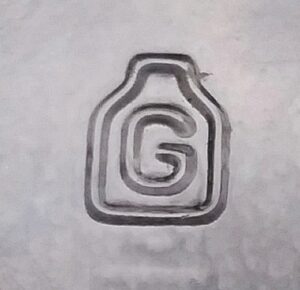
“G inside outline of a jar or bottle”, Gayner Glass Company. This mark appears on a partial base shard from what was probably a wine bottle in clear glass, perhaps 1950s-1970s era. - G 23, G 24, G 25, or similar configuration, embossed along the lower heel area of soda bottles (usually seen in light aqua or light green glass), this number is normally found within a string of several other letters and/or numbers. Graham Glass Company, Evansville, Indiana. See next entry, and also see “Graham”.
- G (capital G with upside down bottle superimposed over the G)……………………. Graham Glass Company, Evansville, Indiana (1912-1929). This mark was introduced circa 1913, ending date uncertain. (See photo of this mark under the “Bottle” entry near the bottom of the listings on Page One. ) Other marks used by Graham Glass include just “GRAHAM” and (on many soda bottles) a series of letters and numbers along the heel including such letter combos as EG, EP, LP, OG, etc. For more info on Graham and their history, see Lockhart et al article here: Graham Glass Company.
- G. A. Berry & CO….George A. Berry and Company, Pittsburgh, Pennsylvania (later Duquesne Glass Co.)
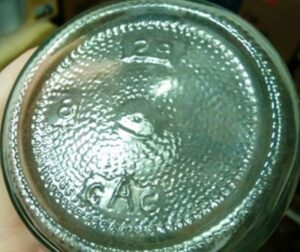
“G A C” mark used by Arkansas Glass Container Corporation, as seen on packer jar (Photo courtesy of Adrya Webb) - g A c (capital A, with smaller, yet upper case, “G” and “C” placed on both sides, as shown) …………………… for several years I had this mark listed as “unknown manufacturer”, but recently (9/2023) have discovered this is an early mark (most likely the very earliest mark) used by Arkansas Glass Container Corporation of Jonesboro, Arkansas (1956- to present). (Julian Toulouse listed a single capital “A” mark as the earliest mark they used, but I’ve not seen it on any containers). This gAc mark has been seen on a variety of utilitarian/packer jars of various sizes, as well as on a syrup dispenser jar. The mark also appears on the bottom of a large jug made for sun tea that came with a yellow plastic lid, probably from the late 1960s or early 1970s. In some cases the “A” is quite large and the “G” and “C” are like two small “footnote letters” positioned to the lower left and right of the “A”. (Thanks to Melissa Alonzo for her help with this mark! She sent me photos of an older cardboard shipping box containing jars that proved conclusively this mark was connected with Arkansas Glass Container). For more information and a photo showing their current mark, please see the “A G C within an outline of the state of Arkansas” entry on Page One.
- Gayner Glass Works ……………… Gayner Glass Works, Salem, New Jersey (1898-1937), later Salem Glass Company, 1937 to 1975. See “G G W monogram”, “G in a circle” and “G inside outline of a jar or bottle”.
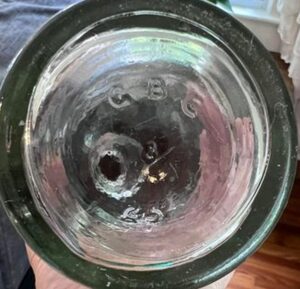
“G B C” on base of liquor bottle made by Garston Bottle Company Ltd. (Photo courtesy of Elka Ray Martin) - G B C ……………………. Garston Bottle Company, Ltd., Garston, Liverpool, England. Beginning date of this company is unclear, but the factory (by that time under the control of Rockware Glass Ltd) shut down production in 1970. I did find an obscure reference in the German language ceramics and glass industry trade magazine “Sprechsaal” (No. 30, July 1915 issue, age 265), which shows they were already in business in 1915. The glass works might have already been operating for years before that time (?) Sometimes the operation was called “Garston Bottle Works”. Their most prolific period of bottle making may have been during the 1950s and 1960s?
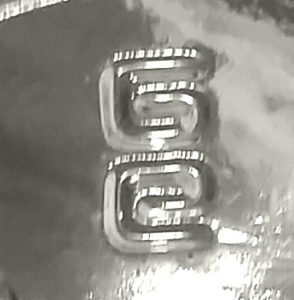
Glass Containers Corporation — G over C mark (Photo courtesy of Jason Carpenter) - GC , G C, G/C, G over C, Angular G entwined with C……………………Glass Containers, Inc., Vernon, CA, later known as Glass Containers Corporation, (1933-1983), main office (after 1959) in Fullerton, California. There were at least two variants of the “G over C” mark used over the years – in the first one the letters have a “sharp” or “angular” look and in the second one (shown above) the letters are more “rounded” and resemble a capital G above a lower-case “e”. Please see the Glass Containers Corporation page for more details.
- GCC, G C C ……………Glass Containers Corporation, Fullerton, California and other glass plant locations. See Glass Containers Corporation page.
- GCCo / G C Co (letters entwined in monogram)…………………. as seen on faces of the “FRUIT KEEPER” and some “MASON’S PATENT NOV 30TH 1858” fruit jars. ………………… Giles-Clough Glass Company, Redkey, Indiana (1893-1897). This works was later known as Redkey Glass Company. For more info and photos showing this particular monogram, please see this article by Bill Lockhart and the “Bottle Research Group”: Giles-Clough Glass Co. and Related Companies
- G. C. CO (as seen on the bottom of machine-made clear glass food containers including a condiment bottle made for Barbeque sauce, and a 10-paneled shaker or mustard jar) ……………………….. Glaser-Crandell Company, Chicago, Illinois. For more information, please see the webpage here on the G. C. Co. mark.
- G. C.O. & Co………………… George C. Ovens & Company, Red Bank, New Jersey (c. 1875- c. 1890). Initials seen on aqua condiment bottles. The bottles were made by an unidentified bottle manufacturer in the New Jersey / New York area.
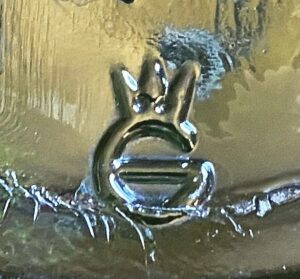
- G with a crown on top…………….Gerresheimer Glas, Düsseldorf, Germany. This mark may have been first used in the 1937-1939 time period, but I don’t have information on how long it was used or when it was discontinued. This photo, shown above, shows the mark as seen on the bottom of a dark olive green “bladder” style wine bottle that looks somewhat similar to the Mateus Rose bottles. The “crown” may be rather difficult to discern, and may appear to look something like three “spikes” sticking upward from the capital G.
- Gemstone (representation of a cut diamond or other jewel/gem). See “Jewel” listing, farther down on this page.
- Gemco……………………………… Gemco Ware, Inc., Freeport, New York, later [after 1999] at Hauppauge, New York (1948-2003), marketed a variety of glass kitchen-related items including salt and pepper shakers, sugar shakers, syrup pitchers, measuring cups, and other items of that nature. The company was acquired by Lifetime Hoan Corporation in 2003. The embossed name “GEMCO” appears on the base of many of the items they distributed / sold. The actual manufacturer of the glassware marked “GEMCO” is unclear. Some of the milk glass items bear a strong resemblance to the “Corelle Ware” line of kitchenware sold by Corning, but the GEMCO items (of that particular line of ware, usually in milk glass) were intended to “coordinate” with Corning Ware, and was, in effect, a competitor to Corning, and not a product of that company. Contrary to some information on the web (including info I have put on my site in the past), this Gemco is evidently unrelated to another “GEMCO” brand name, a chain of department stores (in business from 1959 to 1986). If anyone knows for sure what glass manufacturer (or manufacturers) actually made the glassware marked “GEMCO”, please write! Also, please see “G W with three dots” entry farther down on this page.
- Geo. W. Robinson (North Wheeling Glass Works, Wheeling, West Virginia). Please see “Robinson, Geo. W” entry, page four).
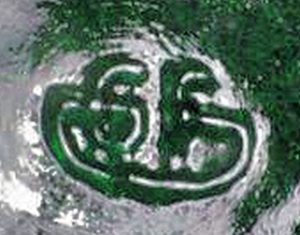
GF mark used by Gijon Fabril. (Photo courtesy of Michelle Marie) - GF or G F (Letters are connected by a downward arching underline which curves underneath them, somewhat creating the appearance that the letters are seated in a small boat). …………………. Gijón Fabril, La Calzada, Gijón, Asturias, España (Spain) —– (1915-2016). I’ve been told this mark has been used since 1915, although on earlier bottles the mark can be very indistinct. The beginnings of this enterprise date as far back as 1844. In 1900 Gijon Industrial was formed, which was superseded in 1915 by Gijon Fabril. Bottles and other glassware were made in large quantities until 1982 when the factory became a mold-making facility. The most well-known bottles made by this company, of green glass, were made for cider, a very popular beverage produced in Gijon. (This is an alcoholic apple cider, known as “hard cider” in the United States). The company finally went bankrupt in 2016. (Thank you Michelle Marie for info on this company).
- G. G. Co. (seen on the heel of a few hutch or crown top style soda bottles)……….. Graham Glass Company, Evansville, Indiana (1912-1929). For more info, see page 435 of this extensive .pdf article on Graham, by Bill Lockhart et al: Graham Glass Company.
- GGG (3 letter Gs, arranged in a triangular formation) as seen on the bottom of florist vases………………….. Garcia Group Glass (Garcia Group, Inc.) based in Atlanta, Georgia. Vases for the floral industry appear to be products of the 1980s-2010s era?
- G G W (monogram, with the second “G” somewhat larger and overlapping the first “G” and the “W”). Gayner Glass Works, Salem, New Jersey (1898-1937), later Gayner Glass Company (1937-1975 – but under National Bottle Corporation ownership 1957-1975). Monogram, accompanying this glass manufacturer’s name and city, seen on an advertising paperweight, reported to me by Bob Berkley, date of manufacture unknown. See “G in a circle” and “G inside outline of a jar or bottle” entries. For more background information on Gayner and their marks, please see this PDF article by Bill Lockhart and the Bottle Research Group: Gayner Glass Works.
- G & H …………… Gray & Hemingray, Cincinnati, Ohio / Covington, Kentucky (1848-1856). See Hemingray & H.G.CO. marks.
- G. H. R. (on base of Porter’s Pain King” bottles)………………………. George H. Rundle Company, Piqua, Ohio (1871-1969). The “Porter’s Pain King” patent medicine was made until the early 1920s, when Prohibition began and the company switched to a liniment salve product. The company officially went out of business in 1969 but the rights and formula for the liniment were sold to Bill & Dave Toecker, of nearby Covington, Ohio. The “Porter’s Liniment Salve” is still being sold on the internet (as of 2022). The bottles with the mark “G H R” on the base could date from the late 1800s up to the early 1920s. One of these bottles is also marked with an “O inside a square” logo which indicates it was made by the Owens Bottle Company. (Thanks to David Weaver for calling my attention to this mark).
- G I (monogram)…………………. see “I superimposed over a G” entry, used by Imperial Glass Company, below.
“G J Co” monogram on face of Gilchrist fruit jar. (Photo courtesy of Mary Ann Pike) - G J Co (monogram) on the face of fruit jars……………….. Gilchrist Jar Company, Elmer, New Jersey (1898-c. 1901). Jars with this monogram were made by several firms including Elmer Glass Works (S. M. Bassett Glass Company at the “Upper Works”), Gilchrist Jar Company, and some jars were also evidently made by Atlas Glass Company and later, Hazel-Atlas Glass Company, up to about 1906. Other Gilchrist-related marks seen on fruit jars include the “R A G” monogram (for Ruth A. Gilchrist) and “Doolittle”. For more history and background information on this mark and others used by the Gilchrist firms, check out this extensive article by Bill Lockhart et al: Gilchrist Jar Company.
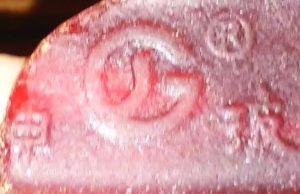
- G with “J” (??) inside (shown)………………… Unidentified mark, as seen on red piece of sea glass. There are also Chinese characters embossed on the piece. Perhaps the bottom of a red jar, bottle, vase? If anyone has information on the origin of this mark, please contact me!
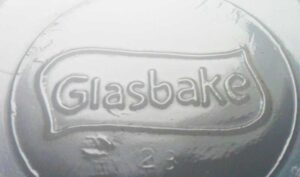
GLASBAKE marking on base of clambroth/white milk glass custard cup - Glasbake…………………………..McKee Glass Company, Jeannette, Pennsylvania. “Glasbake” is a brand name embossed on the bottom of much glassware for household use. This was a popular name introduced and used by McKee for their high-quality, heat-resistant ovenware, serving bowls, and other kitchen ware. The Glasbake line was introduced in 1917, and competed with Pyrex (made by Corning Glass Works) and Fire-King (Anchor Hocking Glass Corporation). The glass formula was changed (after a lawsuit was filed by Corning) and re-introduced in 1919. The Glasbake brand was used more or less continuously throughout the succeeding years, under Thatcher Glass ownership (1951-1961), and later by Jeannette Glass Company until 1979. See McKee Glass Company page for a little more general information on this operation.
- Glassblower design/logo (trademark showing the figure of a man holding a glass blowpipe upward, blowing into the pipe). In some instances, the design might be mistaken for a man blowing on a musical instrument …………. this trademark was used by MacBeth-Evans Glass Company, Pittsburgh, PA; Charleroi, PA; Toledo, OH; Marion, IN – 1899-1936), and later by Corning Glass Works, Corning, New York, which acquired MacBeth-Evans in 1936. According to “400 Trademarks on Glass” (Arthur G. Peterson, 1968), this mark was used as early as 1880 by predecessors of Macbeth-Evans. The mark has been seen on lamp chimneys as well as various tableware items.
- Glassy Baby …………………………… Glassy Baby, Seattle, Washington (2001- to present). The words “glassy baby” are stamped (in lower case letters, in a circular formation) on the bottom of colorful art glass votive candle holders made for small tea lights. This company sells their votive candleholder “cups” in a wide variety of colors. The piece is typically made with the base section, perhaps 1/6th of the piece, showing clear (transparent, colorless) glass and a unique color in the upper portion. All “glassy babies” are handmade, produced by a team of professional glass artisans, and no two are exactly alike. The company donates some portion of the proceeds to a variety of charitable causes. These pieces are in popular demand by an enthusiast crowd of art glass collectors.
- GLOBE………………….. Hemingray Glass Company, Covington, KY & Muncie, IN. Trade name of their best-known fruit jar. Also, see H.G.CO. mark.
- G with the letter “M” inside. (M inside a G)………………………… Maryland Glass Corporation, Baltimore, Maryland (1907-1980). Please see the “M inside a G” entry near the top of Page Four.
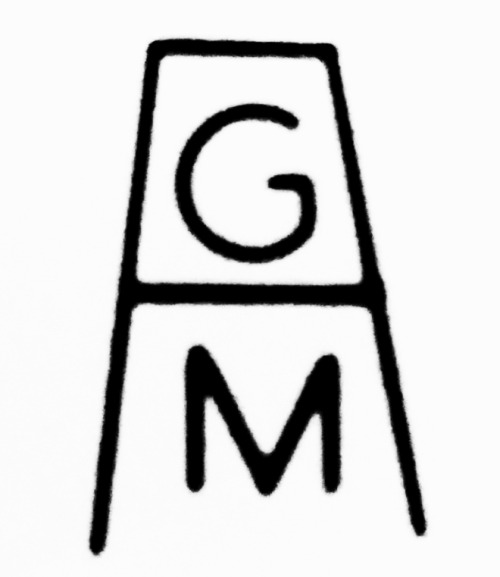
- GM (actually, AGM – the letters “G” and “M”, separated by horizontal line, inside of rectangular “A” monogram, see illustration below) ……………………………………. Australian Glass Manufacturers Company, a virtual monopoly with a number of glassmaking locations in Australia including Kilkenny, Spotswood, and Sydney (mark used c.1934 – c. 1998?) . This mark is seen on a huge variety of containers found primarily in Australia and New Zealand, including a variant of the Vicks VapoRub jars in cobalt blue. The last year this mark was used on glass containers is unclear, as there is conflicting information found online. According to one webpage “In 1939 the company changed its name to Australian Consolidated Industries (ACI). In 1998 ACI Packaging was acquired by Owens-Illinois Inc (O-I).” This is taken from this page: Former AGM Glass Factory – Docomommoaustralia.com.au . The mark is also shown on page 138 of the 2020 Emhart Punt Mark database: ( Emhart Glass Punt Mark Database ) , although the mark is listed there as “Retired”. Presumably, about 1998 and afterward, all molds carrying this AGM mark would have been eventually retooled with the mark used by Owens-Illinois.
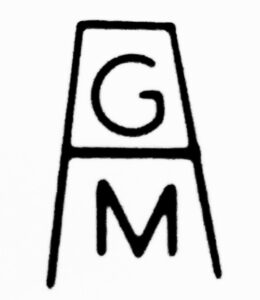
A G M logo used by Australian Glass Manufacturers Co., Kilkenny, South Australia (drawing from Toulouse, BM&TM, 1971, page 563) - Golden Harvest (in lower case lettering, above a representation of a “cornucopia” inside a circle) …………………brand name used for a line of modern “Mason” (screw type lid) fruit jars (canning jars) introduced in 1975 by Glass Containers Corporation based in Fullerton, California. These include “regular” fruit jars in several sizes, as well as “drinking mugs” (drinking jars) in the same form of the jars but with an attached handle. The line of jars also includes jelly glasses and small “handled mini jars” used as shakers. The jars were manufactured for years by GCC as well as its successor incarnations including Container General Corporation (1983-1985), Diamond-Bathurst (1985-1987) and then Anchor Glass Container Corporation (1987-to present). “Golden Harvest” Mason jars made by Anchor Glass may be marked with either the Anchor Glass “Mirrored Gs” mark (1987-c.2014) or their “stylized anchor/ downward pointing arrow” trademark (c.2014- ) or the Ardagh Group “upside down Omega” logo (see that logo in the “U” listings). Some items are marked with a simple diamond outline on the base which would indicate production at the Diamond Glass Company plant in Royersford, PA (as Diamond-Bathurst). See more here on the Anchor Glass Container Corporation page. In August, 2012, Anchor Glass Container Corporation was purchased by Ardagh Group, based in Luxembourg, Europe. In 2014 six of the Anchor Glass plants were acquired by KPS Capital Partners, and then in late 2016 KPS sold the six Anchor Glass plants to CVC Capital Partners and BA Glass, although Anchor Glass Container Corporation, based in Tampa, FL, continues to operate under its own name. Their site is at Anchor Glass . Golden Harvest along with Kerr and Ball are the most popular brand names seen on modern clear glass canning jars sold in the United States. Apparently most of them are still (as of 2020) produced within the US. Please see my entries on “Anchor” , “Kerr” and “Ball”.
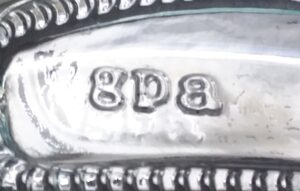
GPA – GPA Global – as seen on base of clear flask - GPA……………….. GPA Global, headquartered in Mansfield, Massachusetts (2007- to present). This is a packaging solutions company with manufacturing / distributing center locations on several continents. Mark as seen on the base of a spirits flask made for Jose Cuervo, probably made in Mexico.
- GPD (G P D)…………………..Glass Products Division, Arrowhead Puritas Water Company, Los Angeles, California (c. 1956- 1987). Seen on the bases of 5-gallon water bottles (carboys) typically made of medium blue aqua glass. Year date codes from the 1950s- 1970s (possibly into the 1980s?) are usually embossed on the bottom. The Arrowhead plant was purchased by Nestle in 1987. These bottles were made at Gardena, California, at the former McLaughlin glass plant where these same types of large water bottles were handmade, but those earlier ones are marked “McL” on the base. For more information, see the reference “Dreams of Glass: The Story of William McLaughlin and his Glass Company” by Fred Padgett (1996), page 85. Also, Bill Lockhart and the Bottle Research Group includes some information on the Arrowhead water bottles here: Other A Marks.
- Graham………………….Graham Glass Company, Evansville, Indiana; Loogootee, Indiana; and Okmulgee, Oklahoma (1912-1929). Another plant location also was operated at Chekotah, Oklahoma until 1923. Graham was owned by Owens Bottle Company after 1916, plants became part of Owens-Illinois in 1929. For more info, see this article by Bill Lockhart: Graham Glass Company.
- Granite Glass Co. / Stoddard, N.H. ………………………. Granite Glass Company, Stoddard, New Hampshire ( 1846-1862). Lettering is embossed across the face of whiskey flasks. One type features an eagle above an oval “frame” with the embossed lettering placed inside. More in-depth info on this glassworks in this peachridgeglass.com article: Stoddard Glass.
Also, Bill Lockhart et al has an article here with information on Granite Glass Company and the New Granite Glass Company, both of Stoddard: The Granite Glass Companies – SHA.org.
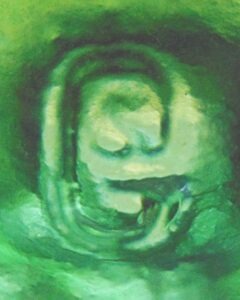
- G with a small S inside (this mark appears to be an upper-case “G” with a smaller “s” positioned within the upper part of the letter, see photo) …………….. Currently unidentified. This mark appears on a dark green hourglass-shaped bottle that may have held an alcoholic beverage, perhaps a product of a glass company from somewhere in Europe. The base of the bottle is marked with the number 348. Any info on accurate attribution is invited!
- GW (G superimposed over a W, seen on upscale tableware, opaque glassware, etc)………………..Westmoreland Glass Company, Grapeville, Pennsylvania (1889-1984). Westmoreland made large quantities of white milk glass tableware and decorative ware including many of the older “hen on nest” dishes. Please see “W superimposed over a G” entry on page five.
- G.W. (on the base of handblown bottles)……………….see Great Western Glass Company, St. Louis, Missouri (1874-c.1887?) .
- G W and 3 dots (see next entry).
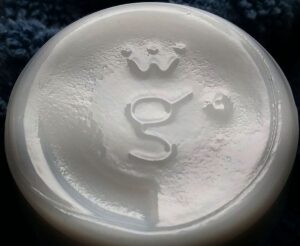
Lower case “g” with crown and three jewels trademark used by GEMCO - G and W with three dots (lower case “g” with “W and three dots” placed above the “g”, seen on the bottom of kitchenware items such as salt and pepper shakers, sugar shakers, syrup pitchers, etc)………………. Gemco Ware, Inc., Freeport, New York, later at Hauppauge, New York (1948-2003). Gemco Ware was a distributor, not a glass manufacturer. This mark was registered on December 11, 1962, and the trademark number is #741,771. The “W” which floats above the letter “g” is often mistaken to stand for Westinghouse, but this is incorrect. Many item listings on ebay, etsy and other sites repeat this mistaken belief. Actually, the “capital W with dots” almost certainly represents a “Crown with jewels” and is merely part of the entire trademark as used by Gemco. It is not clear what glass company (or companies) actually manufactured the items marked “g W & 3 dots” and “GEMCO”. Please see the trademark information at this page: Gemco ware – from Justia trademark site. Also, see “Gemco” entry, above. (Thank you to J. T. S. for help with research on this mark!)
- G. W. C. CO. ……………….. initials seen on the bottom of a few aqua and amber utilitarian bottles. The initials might stand for the G. W. Cole Company (later known as “3- in One Oil Company”). If this is the correct attribution, the bottles so marked would probably date from the 1899-1905 time period.
- G.W. & J. …………….. unknown meaning. Initials, arranged in a circular formation, seen on the base of black glass (very dark olive green or dark olive amber) ale or brandy bottles of British origin. The “G” may appear to be a “C”. Also, the order of the letters could also be construed as “W. & J. G.” From the general appearance of these bottles, (rather heavy, crude, with very dark glass color), I’m assuming they date from sometime in the 1850-1880s period.
- G W K & Co. Z O…………………George W. Kearns & Company, Zanesville, Ohio (c.1860-1869). Seen on the front of a strap-side whiskey flask. See also “K” and “K H & G Z O” marks.
- H………………….. this letter was used by several glass companies, and the maker of many bottles with just an “H” on the bottom is uncertain. On flint (clear) medicine bottles, usually indicates W. H. Hamilton & Company, Pittsburgh, Pennsylvania (1863-1898) and Charleroi, Pennsylvania (1898-1918). An “H” is shown on the base of bottles illustrated in their 1898 bottle catalog (cut shown on page 251, Glasshouses and Glass Manufacturers of the Pittsburgh Region, Jay W. Hawkins, 2009). Other possibilities include Hemingray Glass Company, Muncie, Indiana (See Hemingray); H. J. Heinz Glass Company, Sharpsburg, Pennsylvania (c.1893-1946); and Hagerty’s Glass Works, Brooklyn, New York. Also, please see next several entries.
- H (on the base of bottles originating from the western region of the US)……………..uncertain, but possibly Abramson-Heunisch Company. Most earlier researchers, copying info from Julian Toulouse’s Bottle Makers and their Marks (1971) credited Holt Glass Works of Berkeley, California as the source of these bottles. That attribution is now under considerable doubt. More recently (2016), archeologist and glass historian Bill Lockhart has gathered evidence to indicate some of these bottles found in the western states, typically with a number (one, two, or three digits) accompanying the “H”, may have been manufactured by Abramson-Heunisch Company, San Francisco, CA (1893-1902 – and perhaps extending into bottle production during the early years of Illinois-Pacific Glass Company, up to circa 1907, when Adam Heunisch was the president of I-P G CO) . See this link: The Great Holt Glass Myth: A Study of Misidentification for more background explanation on Holt and Heunisch. In most cases, the number is placed above the “H”, although in some cases is may appear either below, or positioned to the right of the letter. Please keep in mind that positive attribution of a bottle with an “H” mark to any definite glasshouse is often very uncertain. Please see next two entries.
- H ……………… marked on the base of certain mouthblown bottles in shades of aqua (and similar in shape to “Jamaica Ginger” and oval generic bluing bottles of the late 1860s to the mid/late 1880s era, but with a square-band style lip)………….. those bottles shown to have been used for Reuben P. Hall’s “Hall’s Sicilian Hair Renewer” because of labels found intact. They are found with just a capital “H” embossed on the base, and in these cases the “H” almost certainly stands for “Reuben P. Hall”. The “H” varies in appearance and may be offset, not positioned directly in the center of the bottom. Those bottles are found in both “applied lip” and “tooled lip” versions. The Hall’s company was based in Nashua, New Hampshire. From information relayed to me by glass collector, digger and researcher Mark Newton, most, if not all of these bottles were likely made for Hall by the Lyndeboro Glass Company, South Lyndeborough, New Hampshire (1866-1888). Also, see next entry.
- H (verified on the base of certain machine-made liquor bottles)…………….. Hart Glass Manufacturing Company, Dunkirk, Indiana (1918-1938) . This particular “H” mark is infrequently seen, but within the context of machine-made liquor bottles with the “Federal Law Forbids Sale or Reuse of this Bottle” phrase on them, a few Old Quaker brand whiskey flasks have been confirmed that bear a base code including “70 H” along with a date code of 7 [1937] or 8 [1938] placed to the right of the “H”. The “70” was the liquor bottle permit number assigned to Hart – that code was also used for a short time by Armstrong Cork Company (Hart’s Dunkirk glass facility was acquired by Armstrong in 1938), perhaps in the 1938-1940 time frame. Other Hart Glass bottles may exist, but this is one example of a bottle bearing an “H” which can be strongly tied to Hart.
- H-28 (or w/other 2-digit number)…………….. Hemingray Glass Company, Muncie, Indiana (used c. 1924-1935). Information proven to be correct from Hemingray historian/researcher Bob Stahr. However, this doesn’t rule out the possibility that a mark similar to this one could be seen on products from other glass factories. Type of bottle, age, color, and other characteristics must be taken into account to decide if this would be a Hemingray product. NOTE: If the number consists of either one or three digits, it is not Hemingray. On Heinz bottles, a number (which may consist of one, two, or three digits) which accompanies an “H” on the base refers to a particular design or style of bottle made by Heinz, and is not Hemingray-related. See the other “H” entries above.
- H in a circle…………Hemingray Glass Company, Muncie, Indiana (mark used c.1924-1935).
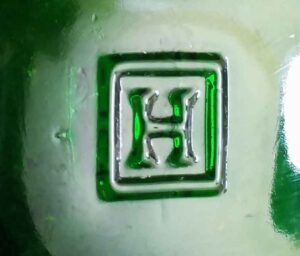
“H in a square” trademark as it appears on the base of an emerald green beer or soda bottle made by Hemingray Glass Company, Muncie, Indiana in the 1924-1935 period. - H in a square…………Hemingray Glass Company, Muncie, Indiana. The “H inside a square” mark was used on several styles of bottles made by Hemingray during the circa 1924 to 1935 period, according to collector and researcher Bob Stahr. The photo above shows the mark as it appears on the bottom of an emerald green (“seven-up green”) crown-lip style bottle that contained beer, mineral water or some type of lemon-lime or ginger ale soda. The bottle is unmarked except for the base.
- H in a triangle……….J.T.& A. Hamilton, Pittsburgh, Pennsylvania (1884-1943). Mark reportedly used approximately 1900-1943.
- H in a horizontal diamond (on the bottom of colored “slag” or marble glass / opaque milk glass “Hen on Nest” and other animal dishes) – this mark is attributed to Hsinchu, Taiwan – sold to the US via A A Importing Company in the 1950s or later. Please see next entry!
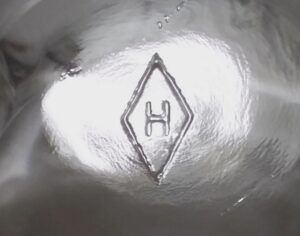
“H in a vertical diamond” logo, on bottom of clear glass punch cup made by A. H. Heisey & Company. - H within a vertical diamond (on elegant pressed and blown glass tableware, but not utilitarian container ware, or hen on nest dishes)………………….. A. H. Heisey & Company, Newark, Ohio (1896-1957). This company produced handmade pattern glass tableware, stemware and other high quality elegant and decorative glass. Several types of perfume bottles were also made. NOTE: This mark (or a very similar mark) has also been seen on the bases of several types of glass covered animal dishes (hen-on-nest dishes or “HONs”) in opaque “slag glass” and other colors, but those items are imports from Asia and were not made by Heisey. There is confusion regarding what that mark stands for, but some sources attribute it to “Hsinchu Glass” in Taiwan, with some items imported to the US through the distribution company known as AA Importing Company (or AA Imports) based in St. Louis, MO. The “H” in those instances is placed in a horizontal diamond, not vertical. They are said to date from the 1950s (according to a post on reddit.com in which the poster claimed to own 1950-era catalogs proving this info) or possibly later. Some of the hens look to be more recent – such as 1970s or 1980s? Hsinchu is actually the name of a city in Taiwan, and a number of glass factories have operated there since the 1920s. Another mark that in some cases might look similar is the “I in a diamond” mark used by Illinois Glass Company, Alton, IL, which was used primarily on utilitarian and commercial types of bottles. Also see “Diamond……” entries on Page Two..
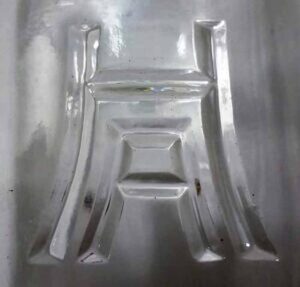
Hazel-Atlas “H over A” trademark on the front of clear Atlas Mason jar. - H over an A ………………………….Hazel-Atlas Glass Company, Wheeling, West Virginia; started operations at Washington, PA; later plants included Clarksburg, WV; Zanesville, OH; Ada, OK; Montgomery, AL; Oakland, CA; Pomona, CA and other locations (1902-1964). This trademark is often confused with the “H superimposed over an Anchor” mark used by Anchor Hocking Glass Corporation. For more information on this mark, please see my Hazel-Atlas page.
- HA, H A, H/A ………………………………see Hazel-Atlas Glass Company .
- H superimposed over an Anchor (see “Anchor entwined with letter H”, on page one)……………. Anchor Hocking Glass Corporation / Anchor Hocking Company, based in Lancaster, Ohio (1937 to date).
- Hagerty’s Glass Works……..Hagerty’s Glass Works, Brooklyn, New York (c.1849-c.1900). Glass factory name seen spelled out in a circle on the base of blob-top soda bottles. This factory was known as “Hagerty’s Glass Works” until at least 1875, later became “Hagerty Bros & Company”, with perhaps other slight variations on the name. Hagerty might have used some other marks, but if so, it is not certain what they were.
- Hair (mark that sometimes looks like a small, short curly hair embedded onto the surface of the glass, seen on the base of drinking glasses)…………………….actually the letter “L” in cursive script. For more information, see this page on the “L” in cursive mark used by Libbey Glass Company.
- Hamilton Glass Works, Hamilton, Ontario, Canada (c. 1864-c.1898). Hamilton Glass Works was purchased/absorbed by Diamond Glass in 1893 or 1894. Hamilton made fruit jars as well as electrical insulators. Many of the fruit jars are marked across the front “HAMILTON / No 1 / GLASS WORKS” (and other numbers such as No. 2, No. 3 or No 4). Some jars were made for a cork closure, others are to be fitted with a glass lid and metal clamp-style closure.
- Hamilton Glass Works / N.Y. …………………… Hamilton Glass Works, New York City, New York (actually located in Brooklyn – 1851-c.1854) . This works evidently was the same location as the later “Brooklyn Green Glass Works” and “Hagerty Glass Works”. This marking appears on some blob top soda / mineral water bottles with an iron pontil mark on the base. (This “Hamilton Glass Works” has no relation to the Canadian firm listed above). See this page from Tod Von Mechow that has some more info on Hamilton:
Beer & Soda Bottle Manufacturers – Tod Von Mechow. - Hawley Glass Co / Hawley, PA……………………Hawley Glass Company, Hawley, Pennsylvania (1882- c. 1928?) Seen on the base of fruit jars and a few soda bottles. This was not the same company as the Harloe Insulator Company (c.1902-c.1906) which produced glass electrical insulators marked with an “H I CO” monogram placed above “HAWLEY PA/ U.S.A.”. (See “H I CO” monogram, below on this page). Hawley Glass Company produced a variety of glass containers but did NOT make electrical insulators. For a brief rundown on the Hawley Glass Company, including an old photograph of some of the factory glassworkers in the 1880s, see the article at this link (although please note that the info there about insulator production is incorrect): The Hawley Glass Company – article on RiverReporter.com.
- H-B………..unknown.
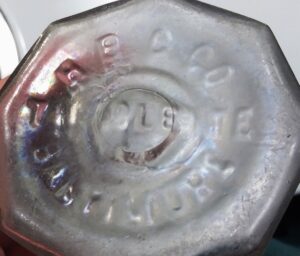
“H B G CO / TALCOLETTE / BALTIMORE” on base of eight-sided cosmetic jar – Henry B. Gilpin Company, Baltimore, MD - H. B. G. CO. / TALCOLETTE / BALTIMORE (on base of eight-sided off-clear cosmetic jar) …………The Henry B. Gilpin Company, Baltimore, Maryland (1904-c. 1970s or later). The Henry B. Gilpin company was organized in 1904, according to a brief mention in American Druggist and Pharmaceutical Record, June 1913 issue, page 64, column 1. The brand name “Talcolette” was evidently applied to their line of cosmetic products, primarily scented talcum powders. The jars appear to date from sometime in the 1910s-1930s.
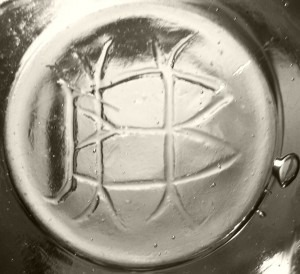
Unknown monogram HB (?) mark on base of leech bowl or fish bowl. (Photo courtesy of Steve Wilkerson) - H B, or possibly B H (letters entwined– monogram)………………..Unknown manufacturer. This mark (pictured above) occurs on the base of a clear/off-clear fish bowl or leech bowl. “Older” looking glass with bubbles, possibly 1890-1930 era? Hagerty Bros. & Company comes to mind, but this is only a possibility, not a definite attribution! Ideas from readers on correct ID of this mark are solicited!
- H inside a C………..See “C with an H inside it” mark.
- H.C.&T. (on base of “MASON’S PATENT NOV 30TH 1858” fruit jars) …………………..Holz, Clark & Taylor, Salem, New Jersey (1866-c.1872). Most if not all the HC&T base-marked jars have a mold number (such as 2, 3, or 6) placed between “MASON’S” and “PATENT” on the front of the jar. Although “HOLZ” is the correct spelling of the surname, in a few sources the name was spelled “HOLTZ”.
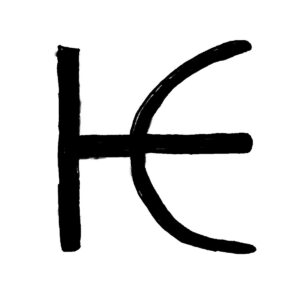
HE mark used by Health Enterprises, as seen on glass eye bath (eye cup) - H E (monogram, letters entwined/connected)………………. This mark appears on the base of an off-clear eye bath (eye cup) made for Health Enterprises, North Attleboro, Massachusetts (1975-2016), a distributor of health care-related supplies. In 2016 the company was acquired and became a division of “Apothecary Products” which is still in business currently (2023). The mark is a stylized monogram of the letters “H” and “E” and may be hard to decipher at a quick glance, resembling a Greek numeral or ancient hieroglyphic symbol. When turned to the left, it might be described as a highly simplified stick figure of a menorah. This mark is mentioned in the reference book “Eye Baths – An Illustrated Survey” by George Sturrock (2012) and the logo is also shown in a 2016 news article webpage on the site of Apothecary Products. According to Sturrock, the eye baths made for HE were produced by a glass company in Hong Kong. The Health Enterprises company sold eye baths beginning in 1990. (Many thanks to Lianne McNeil, Etsy seller MarchAir, for her kind assistance with research on this mark and photos of the eye bath).
- Heart-shaped logo (shown)………………. seen on base of dark olive green square-based “case gin” bottle, possibly a product of Holland, circa 1840s-1870s? The heart
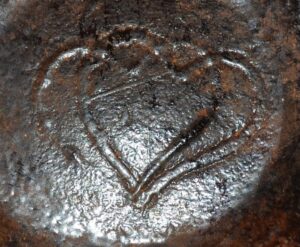
Heart shape- on base of case gin bottle (pic courtesy of Caroline Rogers). embossing is slightly “ghosted” (bearing a “double strike”) on this example. If anyone has information that could help identify the maker of this bottle, please write!
- Heart inside a circle (seen on the lower side area of hobbleskirt style Coke bottles)………….this mark is actually supposed to be the letters V and M (entwined) inside a circle, and was one of the logos used by Mexican glass company Vidriera Monterrey, based in Monterrey, Mexico. Detailed information on this mark and others from Mexico are shown in this PDF file article written by Bill Lockhart: Mexican Marks – SHA.org.
- HEINZ ………………………. please see H.J. Heinz Co., below on this page.
- Hemingray……………………………..Hemingray Glass Company, Muncie, Indiana (used on base of refrigerator bottles, c.1924-1935). Hemingray was most widely known for their glass electrical insulators, which are marked with the company name, or with “H.G.CO” and/or other markings. For more discussion on Hemingray, please see this webpage: Hemingray Glass Company.
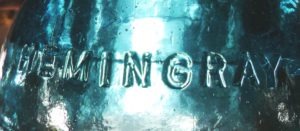
“HEMINGRAY” embossing on Hemingray-42 insulator - HEMINGRAY-42 // MADE IN U.S.A. ………………… this marking is seen on the most commonly found glass insulator type ever made in the United States (and probably in the world) – by the Hemingray Glass Company of Muncie, Indiana (and Owens-Illinois Glass Company which acquired the Muncie plant in 1933). The “42” is a model / style number (not a year date). This insulator style was typically used for telegraph and long-distance telephone lines, and was introduced in 1921. The style was manufactured almost continuously for at least 41 years, as one example has recently been confirmed bearing a 1962 date code. Hemingray- 42 insulators have been found in clear, aqua, blue aqua, “Hemingray Blue”, true green and a few other much scarcer glass colors. For more information on this style, and the Hemingray company, see my webpage on Hemingray Glass Company.
- H.F.J.CO…………….Letters are placed in the four arms of a cross (similar to a formée or Maltese cross) which appears on fruit jars with the “Mason’s / Patent/ Nov 30TH /1858” embossing. Hero Fruit Jar Works, Philadelphia, Pennsylvania (1883-1908). Hero subcontracted some of their jar orders out to other glass companies, such as Findlay Bottle Company, Findlay, Ohio (1888-1893); Marion Fruit Jar & Bottle Company, Marion, Indiana (1888-1904); and Cumberland Glass Manufacturing Company, Bridgeton, New Jersey (1870-1900), so there is a possibility that any individual jar could have been made at one of those other factories. Please see Mason’s Patent Nov 30th 1858 fruit jars page.
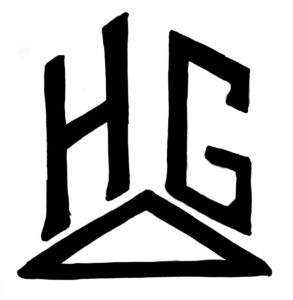
Hillsboro Glass Company, Hillsboro, Illinois – HG over Triangle logo - H G over triangle (above) ………………….Hillsboro Glass Company, Hillsboro, Ilinois (1961-1997)……………… please see this page: Hillsboro Glass Company.
- H. G. CO……………………. Hemingray Glass Company, Covington, KY & Muncie, IN (used on bottles c.1870-1895; insulators until about 1915). See more info on Hemingray Glass Company.
- H G Co/ HGCo (letters entwined in a monogram)…………….Hemingray Glass Company, Covington, Kentucky (monogram seen on reverse side of certain “MASON’S PATENT NOV 30TH 1858” fruit jars- most likely made circa 1870-1885).
- HGW (monogram)…………On fruit jars with the “Mason’s Patent/ Nov 30 1858” embossing, this monogram stands for the Hero Glass Works, Philadelphia, Pennsylvania (1869-1883) and Lockport, New York (1869-1872). The monogram may be difficult to decipher. HGW became Hero Fruit Jar Company in 1883 (see H.F.J.CO.)
- H. Heye………………Hermann Heye Glasfabrick [Glass Factory], several locations in Germany. Bottle with mark “GLASS WORKS/H.HEYE/HAMBURG” on base is confirmed, and probably dates from the 1880s or 1890s. I believe this company is still in business.
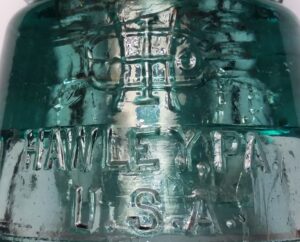
H I CO (monogram) on skirt of aqua Harloe Insulator Company glass electrical insulator, CD 145 beehive type. - H I CO (monogram/ logo shown above) …………………. this stands for “Harloe Insulator Company” based in Hawley, Pennsylvania (c.1902-1906?) with some production at Elmer, New Jersey (Mar 1903-Oct 1903) . The monogram, with “HAWLEY, PA. U.S.A.” placed below, appears on the skirt of a variety of electrical telephone and telegraph insulators made by Harloe. The most common type found is their version of the telegraph line “beehive”, classed as a CD 145 in the system of identification used by collectors. On some examples the “S” is embossed backwards. (Contrary to information that continues to be repeated online and in glass reference publications, these insulators were NOT made by Hawley Glass Company, also of Hawley, Pennsylvania – Hawley produced glass fruit jars and bottles of various types but NOT insulators).
ADVERTISEMENT
- Hitchins……………… the lettering “GLASS FROM F. HITCHINS FACTORY, LOCKPORT, N.Y.” is embossed in a circle on the base of spring water bottle made for Oak Orchard Acid Springs. Francis Hitchins operated the Lockport Glass Works of Lockport, New York from 1850 to 1866. See Lockport Glass Works entry.
- H. J. HEINZ CO ……………………………….. H. J. Heinz Glass Company, Sharpsburg, Pennsylvania (c.1892-1946). Heinz (started by entrepreneur Henry J. Heinz) is best known in the United States (and worldwide) for their iconic brand of ketchup, as well as a wide variety of other condiments, sauces, soups and other food products. Bottles marked “Heinz” or “H. J. Heinz” and other variations were made for many years, possibly dating back to the first incarnation of Heinz’ company circa 1860. From c. 1860 to about 1892, bottles with those markings would have been manufactured by unidentified glassmakers. Heinz acquired a glass factory in Sharpsburg for his own products, evidently beginning production sometime in late 1892 or early 1893. Several years later he built a new, larger glass factory at Sharpsburg for producing bottles for his products. After 1946, many of Heinz’s bottles were again made by other glass manufacturers such as Hazel-Atlas (H over A) and Owens-Illinois Glass Company. Please see “H” and “H-28” marks. Note: for a discussion on Heinz, with pictures of dozens of the older HEINZ-embossed food bottles that have been found, check out Betty Zumwalt’s ground-breaking reference work Ketchups, Pickles, Sauces (1980). For much more background information the complicated history of Heinz and various HEINZ markings found on containers, please see this article from Bill Lockhart and the Bottle Research Group: The H.J. Heinz Co. and the H.J. Heinz Glass Co. – SHA.org.
- H L / NY …………………Unknown. Initials seen on base of tooled-lip crown-top beer bottle (circa 1900-1920?) from Quandt Brewing Company of Troy, New York. Bottle reported by Jake Smith.
- Holz Clark & Taylor / Salem N.J (on front of fruit jar)……………….. Holz, Clark & Taylor, Salem, New Jersey (c.1866-c.1872). Also, see “H.C. & T.” entry.
- HOMCO (Home Interiors and Gifts, Inc), based in Carrollton, Texas (1957-2008). Mary C. Crowley, a struggling single mother with two small children, scraped up all her savings, and along with some other borrowed money started up her own small business in 1957, selling a selection of home decor items. The business model was somewhat similar to others such as Mary Kay, Tupperware and Amway, with much of the merchandise sold at “house parties”. Total sales grew rapidly and had reached into the millions of dollars by the 1970s. A wide variety of home decor items were sold including porcelain Victorian Lady figurines, glass candle holders and other home decor. Much of the merchandise sold by HOMCO was manufactured in Asia, although apparently at least some percentage of the glassware sold by Homco was made here in the United States- by Indiana Glass Company of Dunkirk, Indiana (in business 1907-2002). The mark shown at right appears on the inside bottom of a clear votive candle holder or toothpick holder also marked “MADE IN USA”, and probably dates from the 1980s or 1990s.
- Honesdale Glass Works………………..Honesdale Glass Works, Traceyville (near Honesdale), Pennsylvania (1847-1861). Factory name seen on base of soda bottles, embossed in a circle. This factory, located along the Lackawaxen River, was destroyed by a flood when a dam gave way in 1861. James Brookfield worked at this factory before moving to Brooklyn, NY to become involved in the Bushwick Glass Works (later known as the Brookfield Glass Company). Several years passed until in 1865 the Honesdale property was purchased and a new glass factory was built, variously known in later years as “Honesdale Glass Works”, “White Mills Glass Works”, “C. Dorflinger & Company” or “Wayne County Glass Works”. Cut glass was their specialty.
Rockware Glass Ltd “rectangle” mark, as seen on heel of ACL milk bottle, possibly circa 1960s-1970s (Photo courtesy of Joelle A) - Hooks (a mark that might be likened to two interlocking squared “hooks” that form a horizontally-oriented rectangle) ……………. Rockware Glass, Ltd, originally based in Greenford, Middlesex (London), England (1919-2006) . Julian Toulouse (Bottle Makers and their Marks, 1971) illustrated this mark on page 434 and only notes “Modern”, with no date range shown. So, obviously we can be sure it was used at least as early as 1971, but not sure how long it had already been in use at the time he published his book. The photo at right shows the mark on the heel of a Canadian milk bottle of uncertain date, but possibly from the 1960s or 1970s. The Greenford works closed in 1973, but several other Rockware factories continued in production. Rockware was purchased by Ardagh Group in 2006. Some info on timeline is at this link: Rockware Glass – Gracesguide.co.uk . Rockware also used the “R in a circle” trademark. In recent years [2020] the rectangle mark is still shown, accompanied by location code letters/numbers positioned to the left of the mark, as still in use at four Ardagh Group manufacturing locations in the United Kingdom, as shown in the Bucher Emhart punt marks database here: Emhart Punt Marks Guide – Emhartglass.com.
- Hoosier Glass…………………….. Trademark used by Syndicate Sales, Inc, of Kokomo, Indiana (1949- present), distributor of a wide variety of products relating to the floral industry, as seen on the bases of emerald green and clear florist vases. The “Hoosier Glass” line was introduced in 1979, and was sold for several years afterward (not sure of the last year those two words were embossed on the bottom of products, but possibly sometime into the mid-to-late 1980s or early 1990s). I was told by a company official that the HG vases were first made by Foster-Forbes Glass Company, as well as, later, several other (unnamed) glass companies here in the United States. I am guessing some of them might have been made by Indiana Glass Company or Anchor Hocking Corporation, but I don’t have any documentation to confirm that.
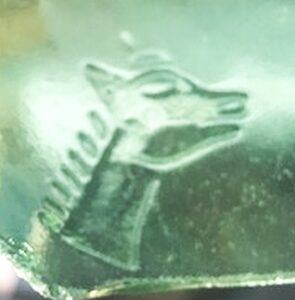
Horse Head emblem – Rolling Rock beer bottle shard (Photo courtesy of Denise Shor) - Horse head emblem………….. embossed image as seen on light green “beach glass” shard, found along the coast of North Carolina. This is a trademark design seen on green glass “Rolling Rock” brand beer bottles. Although Rolling Rock was introduced in 1939, I don’t know how long the horse head design has been embossed on their bottles.
- Horseshoe (logo on heel of modern bottles that resembles a horseshoe, the letter “U” or an upside down Greek letter “Omega”)………. Ardagh Group. Please see entry under “U” on page five for more info.
- Horseshoe and Star, as seen on the bottoms of small jelly glasses and tumblers. Please see this page with more information: Horseshoe & Star.
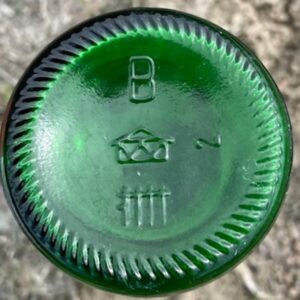
- House, or building (emblem resembling the outline of a house, with “W” or “V V” inside)………………….. logo used by Nienburger Glas GmbH, Nienburg / Weser, Niedersachsen (Lower Saxony), Germany. Nienburger Glas became part of Ardagh Group in 2007. Exact period of use of this mark is unclear. The mark is also illustrated in Toulouse (Bottle Makers and their Marks, 1971, page 580) and he attributed it to “Himly, Holscher & Co, Glasfabrik, Wilhelmschutte”, Germany, and stated in use as of 1965. The “W” inside the emblem presumably stands for Wilhelmschutte. The operation is now known under the name Ardagh Group GmbH – Nienburg. Note: if you have info on the meaning of the logo directly below the “house” logo ( in the “6 o’clock” position) on this bottle base, please let us know!
- Houze, HouzeX…………..L. J. Houze Convex Glass Company, Point Marion, Pennsylvania. Makers of lenses, art glass, rolled sheet glass, signal semaphores, perfume bottles, glass for lighting fixtures, mirror blanks, automotive glass, multi-colored slag glass ashtrays and lamps, etc. Website with more information on Houze: Houze Glass Museum.
- H. & P. D. CO………….Hazeltine & Perkins Drug Company, Grand Rapids, Michigan (c. 1890-1910). Info courtesy Bob Davidson.
- H superimposed over an anchor emblem……..Anchor Hocking Glass Corporation, Lancaster, Ohio, Monaca, Pennsylvania and other plant locations. (Mark used 1937-to date). See Anchor Hocking Glass Corporation page with several marks shown.
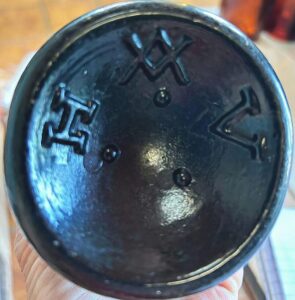
“H XX V” mark on base of dark amber blob top bottle made by either Høvik Glassverk, Hurdal Glassverk, or Hadeland Glassverk, Norway. (Photo courtesy of Fadia Chipman). - H XX V ………………… uncertain meaning (see photo above). This mark appears on the base of a mouthblown, very dark amber, three-part mold ale or stout bottle with applied lip, evidently of western European manufacture, most likely circa 1870s-1880s. A bottle with a similar mark has been attributed to a glassworks in Norway during the late 1800s: “H XX V” Black Glass bottle – digitaltmuseum.no (Norwegian website) . The “H” mark probably stands for one of three glass factories in Norway, either Høvik Glassverk, Hurdal Glassverk, or Hadeland Glassverk. The “V” on the base may stand for “Verk” (Works) in Norwegian. (The Hadeland glass works, located in Jevnaker, Norway, is still in business and dates from 1762). This bottle was found while diving in the Caribbean islands region. (Thanks to researcher Bob Brown for his help with this mark!)
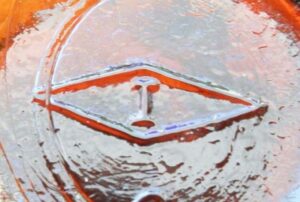
“I inside a Diamond” mark on base of small amber chemical bottle – made by Illinois Glass Company - I within a diamond (shown above)………………….Illinois Glass Company, Alton, Illinois (1873-1929). This mark is seen on the bases of millions of machine-made bottles of all types dating from the 1915-1929 period, and is one of the most common glass manufacturers’ marks seen on glass bottles found in early-20th century bottle dumps, landfills and other trash dumping areas in the United States. For more information, please see the “I within a diamond” and LYRIC pages.
“I inside an O” trademark used by Owens-Illinois, here on the base of a Seven-Up soda bottle, made in 1959 at their Streator, IL factory (plant #9). - I within an “O” or oval (shown above) ……………………………………………………… see this page with more info: Owens-Illinois Glass Company. Owens-Illinois, formerly headquartered at Toledo, OH, now Perrysburg, Ohio (1929 to present), has used three major trademarks over the last 90+ years. (“Diamond and oval entwined with I in the center“; “I inside an O“, and presently simply “O-I“). Approximately 25 glass manufacturing factories are located in the US and Canada, with the most recently opened plant at Windsor, Colorado. This mark was used beginning in 1954, up to quite recently, being gradually replaced (over a period of several years) with the “O-I” mark (the current mark used by O-I) on most bottle molds. The diamond was removed from the “old” mark beginning in 1954, although a few bottle molds apparently didn’t have the diamond eliminated (i.e., the mold retooled) until years later, even as late as 1966. After c. 1958 the great majority of O-I bottles carried this simplified mark of just an “I inside an O”. On recent bottles, this mark may be small, faint, and not always easily discernible, usually seen embossed on the heel of the container. O-I is presently (2024) the largest glass making corporation in the world. A wide variety of glass containers are made, many especially for food and beverage products. For more information on this mark and several others used by Owens-Illinois over the years, see this page: Owens-Illinois Glass Company.
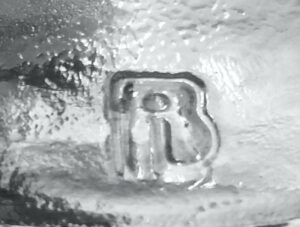
- IB (BI)………………. stylized monogram used by Ball-Incon Glass Packaging (1987-1994).
- I.B.& G.CO……..Indiana Bottle & Glass Company, Cicero, Indiana (1905-1909)
- I C (monogram)…….. sometimes the “I and G entwined” mark used by Imperial Glass Company of Bellaire, Ohio can be interpreted as “I and C entwined”. Please see the “I superimposed over a G” entry on this page.
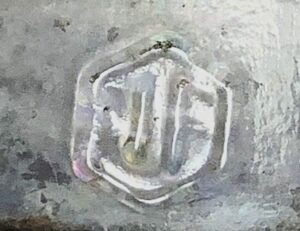
“IF inside a hexagon” glassmaker mark on heel of colorless Corona Extra bottle with possible 2004 date code. Currently this logo is unidentified. (Photo courtesy of Mikhael Phelps). - I F inside a hexagon (pictured above)…………… Unidentified mark, possibly that of a bottle manufacturer in Mexico or another Central or South American country? This mark appears on the heel of a colorless Corona Extra beer bottle along with an apparent 2004 date code. Information on the correct identity of this mark is requested!
- IG, I G (monogram) ……………….. See “I superimposed over a G” entry (Imperial Glass Company), below.
- IGCO (monogram)………Illinois Glass Company, Alton, Illinois (1873-1929). This monogram which is seen most commonly on the “MASON’s PATENT NOV 30TH 1858” fruit jars may also indicate, in some cases, other unidentified glass companies, but most of these jars are presumed to be products of Illinois Glass. See the next 3 entries.
- IGCO monogram within brackets [ ] …………… Intermountain Glass Company, Midvale, Utah. Mark seen on the base of “Mountain Mason” fruit jars. Exact period of operation of this company is not clear, but the jars are believed to date from about 1935-1936, per data from Alice Creswick (The Fruit Jar Works-Volume 2, 1987).
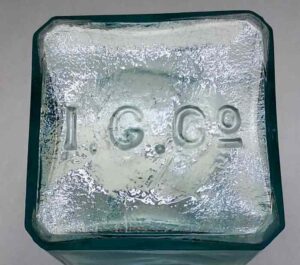
“I. G. Co.” mark on base of mouthblown aqua square “cabin” or “schoolhouse” ink bottle made by Illinois Glass Company. - I.G.CO……………….. Illinois Glass Company, Alton, Illinois (1873-1929). This mark was used possibly as early as the mid-1870s to around 1900, and may appear on either the base or the heel of various bottles, and was also used for several years after 1900 primarily on the lower heels of their soda bottles (since the base would frequently be reserved for the logo or initials of the bottling company a bottle was made for). The “O” in “Co” may be either upper case or lower case. Use of the mark on certain soda bottles is known to have extended at least to 1909, perhaps 1911. Please see “I.G.CO.L”, “IGCO within a diamond” and “I within a diamond” marks. Illinois Glass Company merged with Owens Bottle Company in 1929 to form the Owens-Illinois Glass Company. Also, please see next entry.
- I.G.CO.L…………..Ihmsen Glass Company, Limited, Pittsburgh, Pennsylvania (c.1876-1900). Also listed as Ihmsen Window Glass Company. Pittsburgh directory listings show this company included the “Limited” in their name from 1876 to c.1896. Bottles bearing this mark can definitely be attributed to this company, although some bottles from the Pittsburgh and surrounding area with an “I.G.CO.” mark (no L), might also be Ihmsen Glass Co. products. However, I am increasingly skeptical about this claim, as I’ve recently seen more evidence that points to Illinois Glass Company as being the much more likely source for the “I.G.CO.” mark. Attributing any bottles with an I.G.CO. marking to Ihmsen is definitely fraught with uncertainty, and I feel more confident attributing them to Illinois Glass Company at present. Perhaps future research will uncover the facts on this matter once and for all. Any bottle collectors or researchers that have info on this question are invited to contact me at anytime. NOTE: The comprehensive reference work Glasshouses and Glass Manufacturers of the Pittsburgh Region by Jay W. Hawkins (2009, on pages 272-284) has a lot of detailed information on the Ihmsen group of glass companies, with various mark variations not listed on my site, along with background info. Several of the Ihmsen family members were involved in a number of separate enterprises over many years time in the Pittsburgh region, and their full history is rather complex.
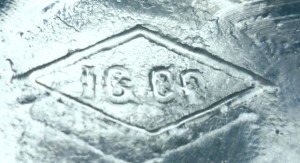
I.G.CO. within a diamond ~ on base of light aqua square pickle bottle. - IGCO within a diamond………….Illinois Glass Company. Alton, Illinois (1873-1929). This mark was used from approximately 1895-1915. Please also see the “I within a diamond” and “LYRIC” pages.
- I.G.W.Co. …………….. probably Indianapolis Glass Works Company, Indianapolis, Indiana (1870-c.1876). This mark has been reported on an amber ale bottle from Dayton, Ohio. The word “Company” was part of the name of this factory as listed in city directories of the period, although fruit jars and flasks are found with just the wording “Indianapolis Glass Works” embossed on them.
- Ihmsen & Son, C. ………….. see C. Ihmsen & Son, on page two.
- Illinois…………………… Illinois Glass Company, Alton, Illinois (1873-1929) and its successor Owens-Illinois Glass Company. The mark is typically seen embossed on the bottom of prescription / druggist bottles. The mark was a “brand name” assigned to a line of druggist bottles called “Illinois Ovals”, evidently used c. 1910s-1929 by Illinois, but continued in production by Owens-Illinois until 1949. Many of those bottles made after 1940 also carry the DURAGLAS brand name on them. Also, see the I in a diamond page, and Owens-Illinois Glass Company.


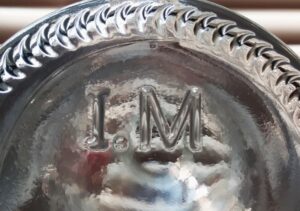
- I.M (seen on base of food bottle)…………………. I. M. Packaging, based in Montreal, Quebec, Canada. I.M. Packaging is a wholesaler/distributor/supplier of a wide variety of packaging products including metal, plastic and glass containers. The actual manufacturer(s) of the glass bottles and jars sold by I. M. P. is unknown, but presumably they are made by unnamed glass makers in China, Canada and/or the United States. This company was apparently incorporated in 2013. I have no information on when this mark was introduced on their container glass.
- Imperial (IM /PE /RI /AL), the letters inside 4 small squares arranged to form one larger square, or in 4 segments inside a Maltese cross or “plus sign”………………….. Imperial Glass Company, Bellaire, Ohio (1902-1984). Found on tableware. This particular mark believed to date from approximately 1904-1951. Also, see “I superimposed over a G” entry, located farther down on this page.
- Indiana Glass……………. Indiana Glass Company, Dunkirk, Indiana & Sapulpa, Oklahoma (1907-2002). Producer of a huge variety of glassware … drinkware, all types of tableware, decorative glass, floral container glass, candle ware, Carnival glass, EAPG (Early American pattern glass /pressed glass) etc for nearly a century. Almost all Indiana Glass glassware is unmarked, although I have seen a candy dish marked on the base “Indiana Glass/Made in U.S.A.” with an “LCC” mark. (Indiana Glass Company was purchased by, and became a subsidiary of, the Lancaster Glass Corporation, based in Lancaster, Ohio, in 1957. That company expanded to become Lancaster Colony Corporation [LCC] in 1961.) The Dunkirk, IN plant shut down production of glass in 2002, and for a time afterward served as a warehouse and/or mold repair facility. Some glass was continued to be made under the Indiana Glass name at Sapulpa, Oklahoma (the former Bartlett-Collins Glass Company facility) until that plant was purchased by Anchor Hocking Company who closed it down in June 2008. For more info on Indiana Glass, try this website here . Also, check out this page discussing the “Hen-on-Nest” covered dishes made by Indiana Glass.
- Indianapolis Glass Works……….Indianapolis Glass Works (Company), Indianapolis, Indiana (1870-c.1876). Seen on the base of wax sealer fruit jars and across face of whiskey flasks, probably other types of bottles also exist with this marking. See “I.G.W.Co.”
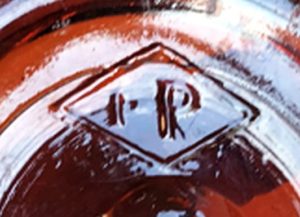
I-P in a diamond (Photo courtesy of Garrett Trask) - I-P inside a diamond (shown)…………. Illinois-Pacific Glass Company, San Francisco, CA (1902-c.1925). This mark is very rare, but confirmed to exist on the base of an amber beer bottle.
- I.P.G.CO…………..Illinois-Pacific Glass Company, San Francisco, California (1902-c.1925). Plant locations also at Los Angeles, and later, Oakland, CA, Seattle, WA & Portland, OR. Bottles bearing this mark are most often found in California and the Western states of the US.
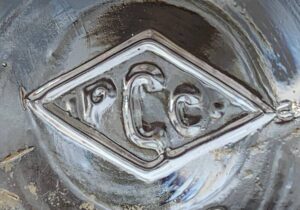
“I P G Co inside a diamond” mark on base of clear glass bottle- made by Illinois Pacific Glass Company (Photo courtesy of Shane Belson). - IPGCo inside a diamond…………………..Illinois-Pacific Glass Company, San Francisco, California (1902-c. 1925). See photo and entry above.
IPG inside triangle-used by Illinois-Pacific Glass Corporation – as seen on heel of amber Clorox bottle. - IPG in a triangle (as shown above)………………………Illinois-Pacific Glass Corporation, San Francisco, California (c.1925-c.1930). (Name change of company above). Glass plant locations at Los Angeles; Oakland, CA; Seattle, WA; & Portland, OR. Usually has a tiny triangle inside the larger triangle, squeezed in above the letters. The mark is sometimes poorly embossed and very difficult to make out.
Illinois-Pacific – a West Coast Phenomenon Part II – Illinois-Pacific Glass Corp. - I-R & CO ……….. This mark has been recorded on the base of two beer bottle variants (from F. Bernhard, Canal Dover, Ohio; and Bruckman Brewing Company, Cincinnati, Ohio). Recently [10-2023], a reader informed me that the “I” is actually a “1” (one) and this is a case in which the mold number “1” was placed to the left of the glassmaker’s initials, instead of below, which is the ordinary placement. Thus, this mark is actually that of Reed & Company (R & CO) of Massillon, Ohio. Please see the “R & CO” entry on Page Four. (Thanks to Gregg Wilson for this correction!).
- Isabella Glass Works…………………………………..Isabella Glass Works (also known as New Brooklyn Glass Works), New Brooklyn, New Jersey (1848-c.1868). Pictorial flasks bearing this inscription along with an anchor on the front, and a representation of the glass factory on the reverse, are found which were made here. This glassworks is briefly discussed in Adeline Pepper’s reference work The Glass Gaffers of New Jersey (1971) which I heartily recommend for anyone interested in early American glass making, and New Jersey glassware in particular.
- I S G CO…………..Interstate Glass Company, Kansas City, Missouri (1901-c.1903). Information on mark ID first sent to me courtesy of Tom Neff. This mark is occasionally seen on soda bottles, including a few Coca-Colas. For more extensive background information on this short-lived glass company, please click here for an article written by Scott Willoughby about the Interstate Glass Company.
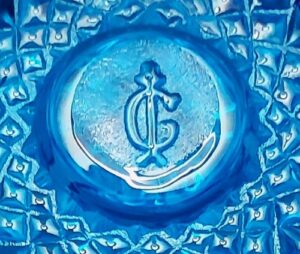
Imperial Glass Company ~ “I superimposed over a G” trademark, as seen on the bottom of a blue “Octagon” toothpick holder. - I superimposed over a G……………….Imperial Glass Company, Bellaire, Ohio (1902-1984). This particular “I and G, intertwined” mark was used from 1951-1977 on upscale tableware and novelties including milk glass, carnival glass, and other glassware of many patterns and in many shapes, forms and colors. For more information on Imperial Glass and their history and marks that were used, please check out this site: Imperial Glass Company history – Imperialglass.org . On many items, the mark is small, lightly embossed, and can be rather difficult to make out. At a quick glance it might resemble a “cents sign”, “dollar sign” or treble clef sign in sheet music. Sometimes the letter “I” looks somewhat like an ornately designed number “1”. The letter “G” is often mistaken for a “C”.
- I X L …………….I X L Glass Bottle Company, Inglewood, California (1921-1923)
- J . . (two periods or raised dots)………………… seen on base of heavy, crude black glass ale, beer or wine bottle, sand pontil, probably British or possibly American, looks circa 1820s-1850s. Unknown maker. There is also a small “D” along base rim. Bottle posted on ebay in November of 2017.
- J in a diamond………..Uncertain. Seen on base of crown-top Coca-Cola bottles from Chattanooga, TN. There is a possibility this might stand for Johns Bros, Fairmont, WV (1893-1907) but there is no proof that this is so. Johns Bros made crown style soda bottles.
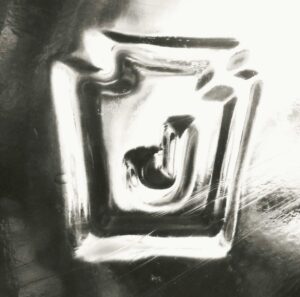
“J in a keystone” mark, as it appears on base of a clear generic “Boston Round” packer jar. - J in a keystone………………… Knox Glass Bottle Company, used on containers made at their Jackson, Mississippi factory location (1932-1953). See “K in a keystone” entry.
- J in a square………… Jeannette Glass Company, Jeannette, Pennsylvania (1898-1983). Exact period of use of this mark is unclear …….. perhaps 1920s-1940s. Jeannette Glass Company was the successor (purchaser of the factory) of the Jeannette Bottle Works (or Jeannette Bottle Company) that had began operation in about 1888.
- J in a triangle……………. probably Jeannette Glass Company, Jeannette, Pennsylvania (1898-1983), although there is a possibility this mark was used by D. C. Jenkins Glass Company of Kokomo, Indiana (1906-1933), a producer of pressed and blown tableware and glass novelties. Jay Hawkins, in his book on Pittsburgh region glass factories (2009), states that the mark was seen on a clear glass restaurant creamer.
- JB (B superimposed over J)………this mark is rather indistinct and appears to be a “B” with the lower loop of a “J” hanging down from underneath it. Probably Johns Bros, Fairmont, West Virginia (1893-1907). Seen on heel of amber slug-plate crown-top soda bottle made for H. Epping, Louisville, KY.
- J. Bodine & Sons………………… Bodine & Sons, Bridgeton, New Jersey (1846-1855).
- J Bros…………….See Johns Bros, below.
- J D S (letters arranged in a triangular formation, usually with a mold number placed between the “J” and the “D”, on the bottoms of Lea & Perrins bottles)…………………. John Duncan’s Sons, at first, distributors (later, makers) of Lea & Perrins Worcestershire Sauce that originated in England. The Salem Glass Works, of Salem, New Jersey are believed to have made most, if not all, of the bottles marked “J D S”. These bottles are mouthblown (handmade) and were produced beginning sometime in the 1877-1880 time period (sources disagree on exact year) and were made in very large quantities until at least the 1910s, before a switch was made to machine-made bottles. Many mold numbers are seen, ranging from “1” to at least “105”, possibly higher. The bottles are nearly always in shades of light aqua or light green. Some more background information on Lea & Perrins is here: Lea & Perrins – Baybottles.com
- Jewel (embossed representation of a rectangular cut jewel / gemstone on the skirt of glass electrical insulators)…………..see “PRISM” entry on Page Four.
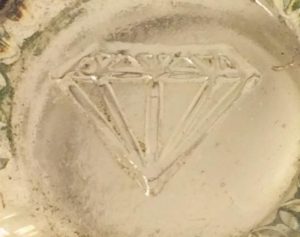
Emblem of a cut diamond or some other type of jewel, as seen on base of shot glass. (Photo courtesy of Patti Moreno) - Jewel (representation of a cut gemstone such as a diamond, photo shown at right)………………unknown meaning. This embossed emblem appears on the base of a clear shot glass with green and white “Applied color label” type graphics, perhaps from sometime in the 1940s-1960s?? If anyone has information about this mark, please let us know!
- J. G. Co………………..Jeannette Glass Company, Jeannette, PA. (1898-1983). These initials were seen on the base of a Curtice Brothers ketchup bottle, reported by Taylor McBurney.Jeannette Glass Company made bottles and fruit jars earlier in their history. See “J in a square” entry on this page, also see this web page with more detailed info: Jeannette Glass Company – SHA.org.
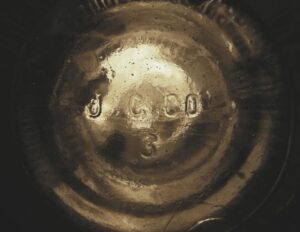
- JIM DAVIS (impressed signature mark on base of bird paperweight)………….my site doesn’t delve much into art glass, which is a very wide field in itself, but recently I came across a small bird paperweight with this mark and it piqued my curiosity. Doing a little research on the name “Jim Davis” I find there seems to be two
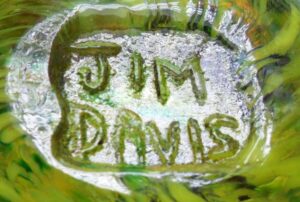
“JIM DAVIS” signature as impressed on base of yellow bird art glass paperweight different glass artisans who made handmade glass articles. The mark pictured is apparently that of James E. Davis (1932-2017) who was affiliated with the “House of Glass” art glass studio in Elwood, Indiana and made paperweights in the 1970s, 1980s and 1990s (perhaps later?). I recently received information and some base photos showing that he made bird paperweights until at least 1997, as they were marked with the year “1997” placed underneath his signature. The other “Jim Davis” (James C. Davis – 1930-2007) specialized in art glass marbles, was the father of 6 sons who also made art glass, and was based in Pennsboro, West Virginia for many years. If you have more detailed info on these two men and the marks they used, please contact me.
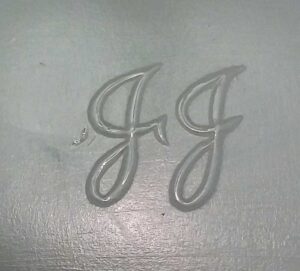
JJ (J & J) in cursive mark, on base of white milk glass Johnson & Johnson’s Baby Cream jar - J & J (J&J) ………… Capital letters, in cursive script (shown above)…………………… Johnson & Johnson, headquartered in New Brunswick, New Jersey (1886 to present). The “J&J in cursive” mark is seen on the bottom of glass jars and bottles that contained products marketed by Johnson & Johnson. In some cases the “&” symbol may vary in how clearly it is delineated. The mark is most commonly seen on the bases of white milk glass cosmetic-type jars made for Johnson & Johnson’s Baby Cream. The jar features five horizontal raised bars on two opposite sides, and is easily recognizable even with the label missing. The photo here shows the mark as it appears on one of those jars, of uncertain date but possibly from the 1940s or ’50s. According to the Justia trademark site, this particular mark was first used in 1913.
- JJ inside a circle (this mark may resemble two cursive script letter “J”s, each with an additional crossbar, placed inside a circle)……………… please see “FF in a circle” entry, above on this page – Foster-Forbes Glass Company. This mark is sometimes rather indistinct and hard to interpret correctly.
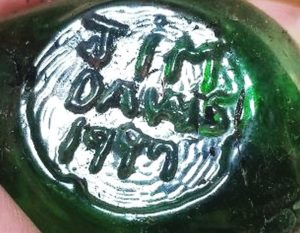
Base of 1997 green bird paperweight (Photo courtesy of Kurtis Runyon) - J. J. G. …………………..Unknown. Initials appear, in a circular formation, on the base of a handmade aqua pickle bottle, 7 & 1/4th inches in height, distinctly American, of a type generally made circa 1865-1895. This might stand for a food/dry goods distributor instead of a glass company? The order of the letters may also be interpreted as “J. G. J.” or “G. J. J.”
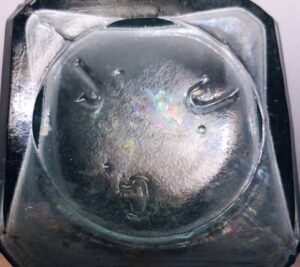
“J. J. G.” on base of aqua pickle bottle. Unknown glassmaker or distributor. - J.K. …………………John Kilner & Company, Castleford, Yorkshire, England. Years of usage of this mark is uncertain. See next 2 entries.
ADVERTISEMENT
- J.K. & Co. …………….John Kilner & Company, Castleford, Yorkshire, England. From Julian Toulouse’s “Bottle Makers and their Marks“, confusion reigns as to the exact stretch of years this mark was actually used – if it even existed. He stated “1842-1844” which seems doubtful. The company evidently existed, in various incarnations, for many years after 1844. (The particular mark has evidently not yet been confirmed to exist).
- J K & S ………………… John Kilner & Sons, Wakefield, Yorkshire, or Thornhill Lees, Yorkshire, England. Similar to the mark “J K & Co” (above) confusion on the actual dates of use continue. Toulouse (Bottle Makers and their Marks) stated “1844 to 1857” but also related that this same firm name was applied to a glass manufacturer still in business as late as 1928. Dates of usage for this mark are unclear and I would propose a very wide possible date range extending from the 1860s into the late 1920s. (Most likely, perhaps 1880-1910). Also, see K.B.Ld. and K. B. Ltd. marks. For much more detailed research on this and other Kilner-related marks, please see this article by Bill Lockhart et al: The Kilner Glass Companies .
- J. K. W. or J. K. T……………. John Kilner (Wakefield) ; John Kilner (Thornhill Lees)…………see entries above.
- J. L. & Co. ; J. L. & Co. LTD. …………………John Lumb & Co. (1870s-1905), name changed slightly to: John Lumb & Company, Limited. (1905-1937), Castleford, Yorkshire, England. Became part of United Glass, Ltd, in 1937. After 1937 their mark was “U G B” positioned over an “L”.
- Johns Bros. W. Va……….Johns Brothers, Fairmont, West Virginia (1893-1907). This company was a successor to the Fairmont Bottle & Fruit Jar Company which was incorporated in 1892. Johns Bros. operated up to about 1907, at which time it became known as the Fairmont Bottle Company (1907-1912). See JB.
- J.P.F……………..Pitkin Glass Works, Manchester, Connecticut (1783-1830). Appears on flask probably made circa 1815-1825. Initials presumably stand for Joseph P. Foster, manager at Pitkin.
- jP monogram (see “vP” monogram listed on Page Five. This mark appears on a modern packer jar and was made in Germany.
- J. R. Watkins Co. ………………………… Please see J. R. Watkins Co. page here for more information: J. R. Watkins Co.
- J. W. & B…………………………John Wyeth & Brother, Philadelphia, PA, later based in New York (1861-1943). The business was sold to American Home Products in 1931. In 1943 the drug portion of that company was renamed “Wyeth, Inc.” Wyeth was eventually purchased by Pfizer in 2009. Many types and sizes of pharmaceutical, druggist and chemical bottles made for this huge drug firm are known. They might be found with the J.W. & B. mark, or “WYETH”, or “John Wyeth & Bro” markings. Most of the bottles with these embossings probably date from the 1880s-1910s era. The actual glass manufacturers of the various Wyeth bottles are not identified, but probably a number of companies made them. Whitall Tatum Company would be one probability.
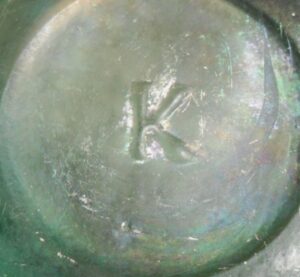
‘K’ mark on base of green-aqua glass antique ringed pepper sauce bottle, possibly product of Kearns, Zanesville, Ohio. - K (on base of early handmade American bottles and jars- as above)……………………. probably George W. Kearns & Company, Zanesville, Ohio (c.1860-1869) and/or Kearns, Herdman & Gorsuch, Zanesville, Ohio (1869-1886). Examples include wax sealer fruit jars and “ringed” pepper sauce bottles. (Also, see “K. H. & G. Z. O.” entry on this page). In the case of some black glass ale, beer or wine bottles of apparent British manufacture, which are sometimes marked with a single letter on the base, the “K” might stand for one of the Kilner glass companies. Julian Toulouse attributed the “K” on some British-made bottles to Kinghorn Bottle Company, Kinghorn, Fifeshire, Scotland (1907-1920).
- K (on the base of modern-era clear laboratory, pharmaceutical & scientific glassware including serum bottles, beakers, etc)……………… Kimble Glass Company, later Kimble-Kontes, later, Kimble Chase Inc. (part of the Gerresheimer Group), Vineland, New Jersey. Kimble-Chase was later acquired by DWK Life Sciences in 2016. Kimble produces borosilicate glass under the trade name KIMAX (similar to PYREX). See “K in a hexagon”, below. In some cases the “K” may be rather small and unobtrusive on the base of bottles, and accompanied by a group of raised dots. (The dots, in this case, are numeric mold codes that can be scanned or “read” by high speed electronic inspecting machines – to capture information that identifies the exact mold in which a particular bottle was made).
- K (on upscale tableware, novelty glass, pressed glass, some reproduction pattern glass, but not utilitarian bottles)………….John E. Kemple Glass Works, see next two entries.
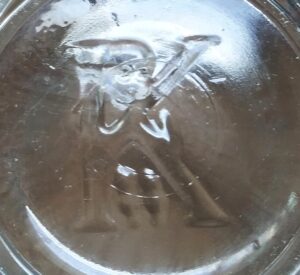
Kruger Glass – K with baby logo. (Photo courtesy of Heather Myers) - K – capital letter K with image of a baby / toddler or small child peering from behind the letter…………… as seen on the base of clear glass jars/canisters with baby-related motifs. (Supposedly, these were given away to newly adoptive parents by orphanages in Germany, to hold cotton, pins, etc.). Attributed to Kruger Glass, Germany, circa 1930s-1950s? I don’t have detailed info on this company, but if you have information on this mark, the company and the products they made or distributed, please write and tell us!
- K9 or K-9……………………….Knox Bottle Company, originally based in Knox, PA. Mark seen on milk bottles. See “K in a keystone”.
- K over a “W”…………………..Wheaton, mark appears on various items made by Wheaton, Millville, NJ, after they purchased the molds previously used by John E. Kemple Glass Works. See next entry.
- K in a circle………..Seen on ornamental and reproduction glassware, novelties, tableware: John E. Kemple Glass Works, East Palestine, Ohio (1945-1956) & Kenova, West Virginia (1956-1970). See next entry.
- K in a circle…………… As seen on glass lenses, lamp globes, airport runway light covers and other industrial glassware: Kopp Glass, Inc., Pittsburgh, Pennsylvania (1926-to date).
- K in a diamond……………. Kopp Glass Company (Kopp Glass, Incorporated), Pittsburgh, PA (1926-to date). I don’t know what years this particular mark was used. If you have info on date ranges for this mark and the “K in a circle” mark they used, please advise.
- K in a diamond (seen on the base of an amber blob lip beer bottle marked “Consumers Brewery Company, Erie, PA)…………..unknown meaning. That bottle likely dates from the 1890s, and the mark is not related to the one above attributed to Kopp.
- K in a hexagon…………………… Kimble Glass Company, Vineland, New Jersey (1905-to date). Plant was purchased by Owens-Illinois in 1946. Kimble acquired Kontes Glass Company to form Kimble/Kontes circa 1982. Later known as Kimble-Chase Inc. and in 2016 Kimble-Chase was acquired by DWK Life Sciences, headquartered in Wertheim, Baden-Wurttemberg, Germany. The K-in-a-hexagon mark was first used beginning in 1947, according to U.S. Patent and Trademark records, and the last re-issue was in 1990…….no ending year date is given. The “K” may appear above the hexagon. Most (if not all) recent glassware (specialty laboratory glassware such as beakers) made by Kimble Chase may carry a plain K instead of a K inside a hexagon. (See “K” entries).
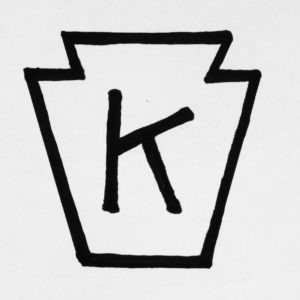
Knox Glass Bottle Company – K inside a keystone logo, used from 1932 to 1968. - K in a keystone……………… Knox Glass Bottle Company/Knox Glass Associates, Knox, Pennsylvania and other plant locations (1917-1968). This mark was introduced in about 1932. Knox operated a number of glass manufacturing plants over many years during the 20th century, producing tremendous quantities of glass containers of many types during that time. Sometimes there is no discernible letter inside the keystone shape. Originally, the main Knox glass plant at Knox, PA used the “K in a keystone” (c. 1932) and most, if not all, of their other factory locations instead used a different letter inside the keystone at that time. However, most of the Knox factories are believed to have switched over to using the “K in a keystone” mark after about 1953, continuing on up to 1968 when Knox was bought out by Glass Containers Corporation. For much more in-depth information on the Knox family of plants and the marks they used, please check out this article by Bill Lockhart et al: Knox Glass Bottle Company.
- Karl Hutter / New York………..see “K H” mark.
- K B Ld……………Kilner Bros. Limited, Thornhill Lees and/or Conisbrough, Yorkshire, England. (c. 1895-1937).
- K B Ltd……………Kilner Bros. Limited, Thornhill Lees and/or Conisbrough, Yorkshire, England, United Kingdom (c. 1895- 1937). For more detailed information on this and other Kilner-related firms, please see this article by Bill Lockhart et al: Kilner Glass – SHA.org.
- K.C.G.W. (On glass electrical insulators) …………………………..King City Glass Works, Fairmount, Indiana (1890-1897).
- KEENE (lettering placed inside an oval frame on Masonic-themed historical / pictorial flasks)………………… Keene Glass Works / Keene-Marlboro Street Glass Works, Keene, New Hampshire (1815-1842). Keene is located in Cheshire County, in southwestern New Hampshire. This glassworks operated under a number of firm names (partnerships / business names) over the years, including Twitchell & Schoolcraft (1815-1816); Justus Perry (1817-1822); Perry & Wood (1822-1826); Perry & Wheeler (1826-1830); Perry, Wheeler & Company (1830-1835); and S. & Q. Wheeler (1835-c. 1842). Subsequent operation was sporadic and reportedly lasted until around 1850. There is a commemorative historical marker / plaque erected in the city of Keene that dates this particular glass works as “1815-1842”. (Another glass factory in Keene made mostly window glass, not bottles. It was located on Washington Street). Most of the output of the Keene Marlboro Street factory was not marked. It made a wide variety of bottles. However, a few Masonic flasks were marked, including GIV-17 (the McKearin figured flask classification number) which is embossed “KEENE”, and 3 variants of that general type that are lettered “KCCNC” – the mold engraver neglected (either accidentally or purposely) to place a central bar in the “E”s. The embossed letters are sometimes faint or indistinct and hard to discern. The three variants lettered “KCCNC” are catalogued as GIV-18, GIV-19 and GIV-20. Most of these bottles were made in shades of amber-colored glass. The front of the flasks feature Masonic symbols and the reverse bears a representation of an eagle, with the oval “frame” placed below the eagle. There is confusion and conflicting date ranges given for the years when the “KEENE” and “KCCNC” marked flasks were actually produced. The most likely date range (in my opinion, and you can take that with a grain of salt) is from circa 1822 to 1835. Several other flask variants, also believed to be products of this glassworks, include examples marked “IP”, “HS”, “H-P”, “P & W” and “J. K. B.” in an oval frame. The “I-P” is actually “J P” and stands for Justus Perry. For more details on this factory, check out this article from Bill Lockhart: Keene-Marlboro-Street Glassworks – SHA.org.
- Kensington Glass Works Philadelphia ………………… Kensington Glass Works, Philadelphia, Pennsylvania (c.1816-1833) and (1842-1846). Full name seen embossed on a number of early figural / historical flasks. Flasks made at the Kensington works include GI-14, GI-16 and the GI-90 through GI-96 variants. Glass researcher and author Helen McKearin dated those, in general, as having been made beginning around 1824 with production continuing for an undetermined stretch of years thereafter. Dr. Thomas W. Dyott was either part-owner or full owner and manager of this works by around 1821. This factory (or, more accurately, factories – by 1833 there were four or five separate factory buildings) was later known as the Dyottville Glass Works (see “Dyottville Glass Works” entry on page two) . Some of the early flasks made by the Kensington Glass Works were marked “T.W.D” (for Thomas W. Dyott). T. W. Dyott went bankrupt in about 1839 and there would be a succession of other operating firms that ran the glassworks over several more decades, with some intervening periods of inactivity. NOTE: a number of pontiled soda bottles from the 1840s are also known with the marking “KENSINGTON GLASS WORKS” [no “PHILADELPHIA”] but these were made in the c. 1842-1846 time period after chemist Henry Sybert re-opened the idle Dyottville glassworks to make mineral water bottles for Eugene Roussel. The works were then sold in 1846 to Benner’s Smith & Campbell, who ran the plant as “Dyottville Glass Works” (source: research by Tod Von Mechow). An overview of the Kensington Glass Works and Dyottville Glass Works (by Bill Lockhart et al) can be found here: Dyottville Glass Works
- Kerr………………see webpage on Kerr Glass Manufacturing Corporation.
- Key (outline / representation of a KEY, with the letters R E D superimposed over it) as seen on the face of certain MASON and MASON’S PATENT NOV 30TH 1858 fruit jars……….These jars were made by Redkey Glass Company (1897-1902), of Redkey, Indiana. Redkey Glass (originally named Giles-Clough Glass Company ~ 1893-1897), was purchased by Ball Bros Glass Manufacturing Company and some of the later jars with this marking were evidently made by Ball – perhaps in the 1900-1902 time period.
- Key below the shape of a Castle (please see “Castle” entry on page two).
“Key Mold” type base, here as seen on aqua “Nerve and Bone Linament” [sic] antique glass bottle, circa 1860s. - Key mold (keyed base, keyed mold, keymold)………………… a type of mold associated with handmade (mouthblown) antique bottles, typically characterized by a “line-semicircle-line” mold mark on the base of the bottle. The mold mark may or may not be easily discernable, and sometimes may be partially obscured by a pontil mark. Although it is difficult to pin down a specific age to such bottles, in general, this type of mold was most often used with bottles made in the c. 1845 to c. 1875 time period in the US. For more in-depth information on this type of bottle mold (as well as others), check out this page on Bill Lindsey’s site: Bottle Bases – Historic Bottle Information Website.
- Keystone shape with a letter inside (such as K, L, J, M, T, etc). Most, although not all, of the “letter inside a keystone” marks were used by glass container factories owned/controlled by the Knox Glass Bottle Company. Please check entries under the individual letter, such as “J in a keystone” or “K inside a keystone” on this page.
- Keystone shape (no letter), shown below …………………. Some bottles and jars carry a keystone mark which appears to be completely “blank” – empty of any letter. Those containers in most cases were also made by Knox (see K in a keystone, above). (NOTE: a large empty keystone mark placed on the front of a number of types of antique -usually aqua – handmade fruit jars is not related to Knox -most were probably made by the Keystone Glass Works / Mason Fruit Jar Company of Philadelphia). The keystone mark as seen on glass containers has sometimes been described by ebay sellers and casual observers as resembling the outline of a wide-mouth jar, a bean pot, urn, crock, vase, jug or other storage vessel of some type.
Outline of keystone – this geometric shape is sometimes seen on the bottoms of glass bottles and jars – most, but not all, are products of the Knox Glass Bottle Company. - K-G ……………….Kearns-Gorsuch Bottle Company, Zanesville, Ohio (1886-1937). Years this mark was used are not completely certain, but perhaps circa 1910-1937. See next entry, also see “K” entry, above.
- K. G. B. CO…………..Kearns-Gorsuch Bottle Company, Zanesville, Ohio (1886-1937). Monogram seen on fruit jar. Initials also appear spelled out and are known embossed on the base of a pickle bottle. A number of Hutchinson-style soda bottles are found with this mark, and they generally date in the 1890s-1910 period. This mark presumably dates before 1920, when Hazel-Atlas bought the plant. Also, see “K” and “K-G” marks.
“K. G.CO.” on base of aqua ammonia-type bottle, circa 1890s. - K.G.Co. ………………… uncertain meaning, but possibly Kentucky Cooperative Glass Company, Louisville, Kentucky (1897-1898). On some bottles, these initials may stand for another company. Kentucky Cooperative went into receivership in 1898 and was reorganized to become the “Louisville Glass Company” (also called the Louisville Bottle Manufacturing Company), a short-lived venture that ceased by 1901 (and not to be confused with the much earlier Louisville Glass Works (1855-1873). The “K. G. Co.” initials are seen on the reverse heel of a small number of mouthblown soda bottles (most of which are of the “hutch” style) including bottles marked “M. Bochart / Jeffersonville, Ind”; “F. & P. Bochart / New Albany, Ind”; “American Bottling Works / Louisville, KY”; J. I. Marsh / Portsmouth, O”; “H. C. Kunkel / Michigan City, Indiana” and Cartens Bros. / Cincinnati, Ohio”, all, except for the Michigan City bottler, are located on the Ohio River. Two “outliers” include “A. Weber / Union City, Conn” and “Enterprise Soda Works / S.F.” . Also – a light greenish-aqua “champagne blob top” style beer bottle is marked “H. Neiman / Bottler / Chicago” in a slug plate and “K. G. Co.” on the heel. The maker (in my opinion) of the bottles made for the bottling outfits located along the Ohio River is most likely Kentucky Cooperative Glass Company, even though the extra “C” in the name does cast some doubt on that attribution. Louisville, New Albany and Jeffersonville are all located very close to each other. And all of those bottling firms were operating in the late 1890s. The bottles from Connecticut and California may be totally unrelated. A tall narrow “ammonia type” medicinal bottle in aqua (which also looks 1890s) is marked on the bottom with “K G CO” (see photo). Researcher Bill Lockhart writes that the K G CO mark was most likely used by Kanawha Glass Co, of Cedar Grove, West Virginia – an obscure bottle company that operated circa 1913-1914 (no relation to the much later Kanawha Glass Company that made tableware 1955-1989) – but I feel that company was too late to produce the hutch sodas that were more typical of late 1890s production. Perhaps more research will uncover what these initials stand for – for sure!
- K.G.W.CO………………Kentucky Glass Works Company, Louisville, Kentucky (1879-1887). Another minor variant of the “KY.G.W.CO.” mark. See KY.G.W. entry.
- K H (with various numbers)……….Karl Hutter, the inventor of the “Hutter porcelain stopper” patented in 1893 which was used on many beer bottles (and still is, using plastic instead of porcelain, on several modern bottles such as Grolsch), evidently had large numbers of bottles manufactured for him during the c. 1880s-1910 era. These bottles were made by one or several unidentified glasshouses in the New York/New Jersey area. A good possibility for one source would be Brookfield Glass Company (Bushwick Glass Works).
- K.H.& G……………..Kearns, Herdman & Gorsuch, Zanesville, Ohio (1869-1886). See next entry, as well as the “K” mark.
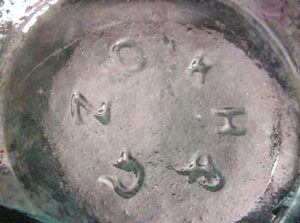
Kearns, Herdman & Gorsuch, Zanesville, Ohio glasshouse mark : K H & G Z O - K. H. & G. Z. O……………………….Kearns, Herdman & Gorsuch, Zanesville, Ohio (1869-1886). The lettering is usually arranged clockwise in a circle on the base of aqua-colored hand-blown fruit jars and bottles. On a few bottles the lettering has been reported with the “K H & G” clockwise, but the “Z O” counterclockwise. Sometimes the mark is misunderstood to be “Z. O. K. H. & G.” or “O. K. H. & G. Z.” or a similar string of letters – if the observer “starts off” with the wrong letter. Confirmed on the bottom of strap-sided and “coffin” or “shoofly” type whiskey flasks as well as “wax sealer” type fruit jars, and other utilitarian bottles of the period. Also, please see “K” mark. Much more background information on the confusing series of Kearns-related glass companies based in Zanesville can be found in this .PDF article by Bill Lockhart and the Bottle Research Group:
The Kearns Glass companies of Zanesville, Ohio. - Kilner Bros…………………… Kilner Brothers, London; Thornhill Lees; or Conisbrough, England. This marking and others have been seen on various food jars that could have been produced over a very long time span, theoretically from around 1857 to 1937. For more info on this series of confusing marks, see this article: Kilner Glass – SHA.org.
- KIMAX………………trade name for borosilicate glass bottles and laboratory ware manufactured by Kimble. See “K in a hexagon”.
- Kimble…………………. see “K in a hexagon”.
- Knoxall………………..brand name used by Knox Glass Bottle Company for a line of druggist / pharmaceutical bottles. The “Knoxall” brand name was trademarked by Knox in 1924, with “first use” said to have been in 1918 – according to the records published by the U.S. Patent & Trademark Office. See “K in a keystone”.
- Knox………………………………Knox Glass Bottle Company. See “K in a keystone”.
- Knox & McKee……….Knox & McKee, Wheeling, Virginia (now WV) (1824-1829). Full name seen on very rare historical flasks. Initials “K & M” were reported by Knittle, but are not confirmed to exist on any bottles.
- KOPP or KOPP GLASS………………Kopp Glass Company, (officially Kopp Glass, Inc.) , Pittsburgh, Pennsylvania (1926-to date). Manufacturer of a wide variety of industrial glass items such as signal lenses, railroad lantern globes, colored glass light covers (airfield boundary lenses), etc. Also see “K in a circle”.
- Kosta Boda………………………….. Kosta Boda, Kosta, Småland, Sweden (1742 to the present). A wide variety of handmade art glass and fine tableware has been made by this firm for many years. Most items found today are more recent production. Pieces may be engraved or etched, or bear labels lettered “Kosta Boda”. More research is strongly encouraged on any particular piece, as some items have been made by other glassmakers that closely resemble Kosta Boda production. Large quantities of Kosta Boda glassware (and items by other glassmakers that are made in very similar styles) are listed on ebay and other online sales sites. https://www.kostaboda.com/history The Kosta Boda Story https://swedishglass.com/how-to-date-kosta-boda-glass/
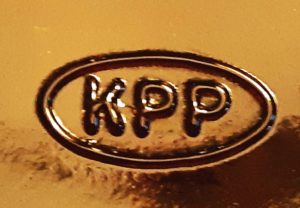
KPP mark on base of amber Budweiser beer bottle, date coded 1972 (Photo courtesy of Shannon & Dawn Brown) - KPP inside an oval (above)…………………… Kerr Glass Manufacturing Corporation (Kerr Packaging Products Division). This mark is most familiar to glass telephone insulator collectors, appearing on a few insulators (such as the CD 155 style, marked “Armstrong DP 1”) that were made in the 1969-1973 period at Millville, NJ. However, also seen on the bottom of a flat clear glass liquor flask. Recently a reader sent me pictures of a typical Budweiser non-returnable “stubby” type beer bottle in amber glass bearing this mark on the base along with a “72” date code. Thanks Shannon & Dawn!
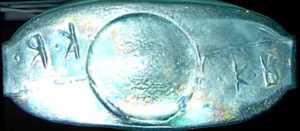
“K-R” embossed backwards (twice) on the base of an aqua handblown Strap-side type liquor flask, unknown maker, circa 1860s-1880s. - K.R. (backward letters, embossed twice, crudely marked on base of aqua “strap-side” whiskey flask, circa 1860s-1880s era; an example was dug in the Louisville area)……………… unknown manufacturer. There is a chance the initials could have stood for Krack & Reed (1866-1868), one of the business firms that operated the Louisville Glass Works, but there is no proof of this. The lettering is very crudely done, almost as if lightly “scratched” into the mold.
- K.R.& Co. (seen on base of MASON’S PATENT NOV 30TH 1858 type fruit jar)……………… Krack, Reed & Company, one of the seven business firms that operated the Louisville Glass Works. Judging by this exact firm name, the jar probably dates from the 1868-1871 period. (Advertisements for Krack, Reed, & Co. first appeared in the Louisville Courier-Journal in late 1868). The mark is very scarce. (See “Louisville Ky Glass Works” entry on this page, and also my page on Louisville Glass Companies).
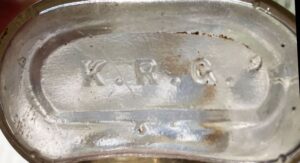
“K. R. G.” on base of clear druggist bottle (Photo courtesy of Miles Burke) - K. R. G. (on base of clear, mouthblown druggist/medicine bottle)…………….. Unknown meaning. These initials are embossed on the base of a bottle found in the Louisville area. The bottle is plain with no lettering on the front, and is similar to the “Philadelphia Oval” druggist bottle types especially popular in the 1875-1895 period.
- KY.G.CO…………… Kentucky Glass Works Company, Louisville, Kentucky (1879-1887)
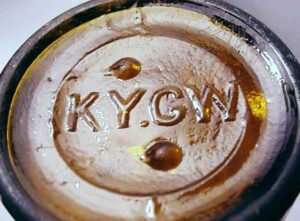
KY.G.W. mark on base of amber beer bottle made by Kentucky Glass Works Company of Louisville, KY. - KY.G.W. ………………. Kentucky Glass Works Company, Louisville, Kentucky (1879-1887). Maker of many types of utilitarian containers, usually found in aqua or amber glass. Base photo of a beer bottle is shown above. For more info on this company, please check out this article: Kentucky Glass Works Company, Louisville, KY.
- KY.G.W.Co. ……………………… Kentucky Glass Works Company, Louisville, Kentucky (1879-1887). Another variant of the above mark, seen on quite a few bottles and jars of various types.
- K X ………………………seen on an amber jar base shard, circa 1960s or 1970s. No info on maker, though it might stand for one of the Knox Bottle company plants, or maybe it is just a mold letter (mold identifier).
- K Z (Letter “K” positioned above a larger “Z”, on the base of handmade glass paperweights)……………….. Zimmerman Art Glass Company, Corydon, Indiana (1963 to present). This mark indicates a piece handmade by Kerry Zimmerman, one of two sons of company founder, owner and chief glassblower Joe Zimmerman. The KZ mark probably dates the piece to after 1983, the year that Kerry and his brother Bart joined his father in the family business. (See “Z” and “B Z” marks).
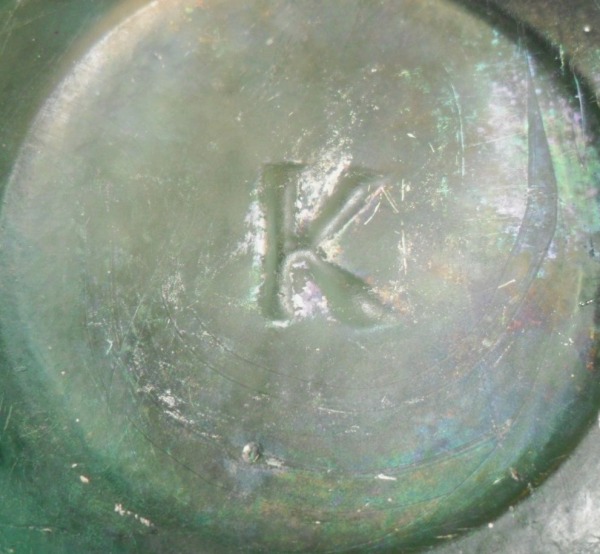
ADVERTISEMENT
- L (crudely formed letter, on the base of handmade beer bottles, circa 1880s-1890s)………… unidentified manufacturer.
- L…………………. Latchford Glass Company, Los Angeles, California (this mark used c.1957-c.1989). Julian Toulouse, in Bottle Makers and their Marks, published 1971, on page 314 writes the plain L was used “Possibly 1925 to 1938, definitely 1957 to date”. I have doubts that the W. J. Latchford Glass Company used the “plain L” in the earlier period, but perhaps they did so. Latchford eventually became part of Anchor Glass. See also “L in a circle” and the next entry on the “L” used by Laurens Glass Company.
- L (often accompanied by numbers to the left, right, or both)………………Laurens Glass Works, Laurens, South Carolina (1910-1996). Although Laurens more commonly used an “L G W” on many of their glass containers, in some instances they used the single letter “L” as their identification mark along with a mold number and/or date code. Notable examples are on Coca-Cola bottles of the 1934-1951 period, wherein the L appears on the side of the bottle, placed between a mold number and a date code. This “L” is also seen on the base of “Longlife Mason” jars. The “L” identification mark is also believed to have been used on many of their bottles after around 1970. For more information on Laurens and the marks they used, see this article by Bill Lockhart and the Bottle Research Group: Laurens Glass Works.
- L (on the base of some clear LAMB MASON fruit jars)…………… Lamb Glass Company (1921-c.1971). Lamb Glass was acquired by Dorsey Corporation (owner of Chattanooga Glass Company) in 1963.
- L-52 or L52………………….Lamb Glass Company, Mt. Vernon, Ohio (1921- c. 1971). This mark seems to be found only on milk bottles. On most containers the “52” is seated on the “lap” of the capital letter “L”. Lamb Glass made many of the earlier “Babyface” milk bottles in clear glass, which are now being reproduced (usually in brightly colored glass such as cobalt blue) by factories in China & Taiwan. The Lamb Glass Company factory was purchased by the Dorsey Corporation (owners of Chattanooga Glass Company, Chattanooga, TN) in 1963. After 1963, the “L52″mark was evidently continued on milk bottles, but some other types of containers made at the Mt. Vernon plant bore the “C in a circle” mark used by Chattanooga Glass Co. The L52 mark on milk bottles was probably continued in use until around 1971. The exact year of ending of the L52 mark is rather “fuzzy” as Lamb usually didn’t place date codes on their containers – or, at least, date codes that were easily interpreted as such. See “L” and “L G Co.” entries. See also L.G.CO. mark: Lindell, Lyndeboro, Lockport and Lamb Glass Companies.
- L in a circle (as seen on the base of a modern, square-based dark amber steak sauce bottle)………………………………. unknown maker, possibly European and of recent manufacture (2010s or later).
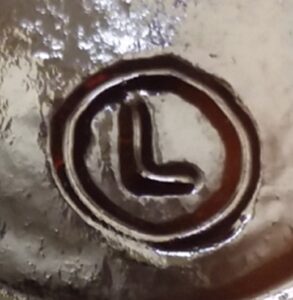
“L inside a circle” mark on base of dark amber sauce bottle. - L inside a circle (or an oval), as seen on vintage bottles……………………… W. J. Latchford Glass Company, Los Angeles, California (1925-1938); this became the Latchford-Marble Glass Company (1938-1956); and finally Latchford Glass Company (1957-c.1989). Mark was first used approximately 1925, although during the “Latchford-Marble” era, the mark “LM in an oval” or “LM in a circle” was used instead. This mark tends to be seen more frequently on containers made for companies in the Western states of the US. See next entry. For more background on the marks used and the confusing series of changes in the Latchford operation, see this detailed article by Bill Lockhart and the Bottle Research Group: Latchford Glass.
- L in an oval (seen on glass telephone insulators, not bottles)……………Lynchburg Glass Corporation (1923-1925).
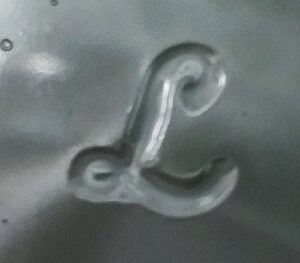
- L (capital L, in cursive script, sometimes resembling a cursive capital Q , fancy numeral “2” or in some cases, a short curly hair embedded on the surface of the glass)…………………………… Libbey Glass, Inc., Toledo, Ohio (1888-to date). For more information, see this page: Libbey Glass Company.
- L (what appears to be a “cursive L” with a horizontal slash in center)…………….. on glass electrical insulators, this is the “Sterling” (British Pound) sign, and stands for Sterling Glass Company, Elmer, New Jersey (1902-1903). Four different styles of insulators have been found with this marking on the skirt, with or without the actual word “STERLING”.
- L in a keystone…………………….Lincoln Glass Bottle Company, Lincoln, Illinois (1942-1952). Plant was sold to the Obear-Nester Glass Co. in 1952.
- L in a shield……….W. J. Latchford Glass Company, Los Angeles, California (1925-1938). Seen on base of Puritas water bottle.
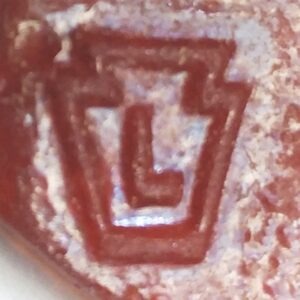
“L in a keystone” mark used by Lincoln Glass Bottle Company (1942-1952), here on a base shard from an amber bottle. - L in a square………………… Lincoln Container Corporation, Lincoln, Illinois (1953-c.1978). Originally called “Lincoln Glass Bottle Company” from 1942 to 1952, (see “L in a keystone” entry, above). Plant was then acquired and owned by Obear-Nester Glass Company, but operated under it’s own company name. This glass plant continued to operate for decades under a succession of companies including Indianhead Corporation, St. Gobain Containers, Verallia North America, and most recently under the corporation Ardagh Group, which decided to close the plant in the spring of 2019, causing 150 employees to lose their jobs. Lincoln Bottle plant shutting down – WandTV.com news article.
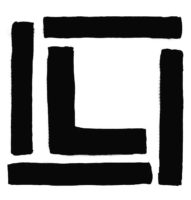
Leone Industries “L in an unconnected Square” - L in an unconnected square (shown)……………….. Leone Industries, Bridgeton, New Jersey (1966-to date). Seen on the heel of modern generic packer jars and other food containers. Leone also purchased/controlled the former Reed Glass Company, later Castle-Hanson Corporation factory at Rochester, New York for some period of time, exact dates unclear. (See “R in a triangle” mark, “C-H” marks). Leone was purchased in 2012 to become part of the Ardagh Group, but is apparently still using their own mark (as of 2015).
- Lalique, Paris, France (1888- to present). Glass factory has been located at Wingen-sur-Moder, Grand Est, France since 1921. Glassware was first made by Lalique in about 1902, as previously the company primarily sold jewelry. Maker of extremely high end, exquisite handmade art glass such as perfume bottles, vases, paperweights, etc. Signatures on authentic pieces were lettered “R. Lalique” from 1905 to 1945. After 1945, the “R” was removed from the signature. There is considerable variability in how the signatures look. This is a VERY specialized field of art glass collecting, and requires careful research. There are many pieces out there that bear fake signatures. Here is a webpage that pictures a number of authentic signatures seen on Lalique glassware: Information on Lalique signatures – rlalique.com
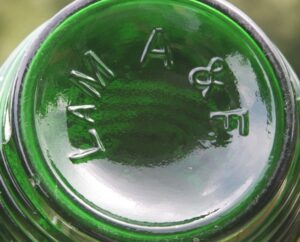
“LAM A & F” on base of green barrel-shaped bottle. - LaM A & F (on the base of handmade green barrel-shaped food / pickle bottles)……………these bottles were evidently imported to the US from France, although the exact meaning of the initials is not yet known as far as I can tell. For many years these bottles were considered to be a mystery, but recently an example was found with an original paper label, indicating the bottle contained “imported capers”. Though this one label doesn’t prove ALL of those bottles contained capers, we can be reasonably sure most, if not all, contained some kind of pickled food product. The bottles probably date from the 1880s to around 1910, although some examples, apparently older, are known with pontiled bases. They have been seen in a range of true green shades including olive green and emerald green. Possibly other colors exist. They are found in three different sizes. Note that many of the bottles are unmarked, so only a percentage of them bear these initials. These barrel-shaped bottles are mentioned in the classic reference book Ketchup, Pickles, Sauces – 19th Century Food in Glass by Betty Zumwalt (published in 1980) on page 264. A very good web article, written by Eric Richter in 2013, with lots of beautiful photos, can be found here: LaM A & F bottles – Eric Richter
- Lamb Mason …………… fruit jars made by Lamb Glass Company, Mt. Vernon, Ohio (1921-c.1971). The jars may be marked with an “L” on the base. See “L-52” on this page for more info.
- Lancaster Colony Corporation, based in Columbus, OH (1961-to date). Holding company, “umbrella” corporation over a number of manufacturers of various products. See Indiana Glass, LCC mark.
- Lancaster Glass Works………………………Lancaster Glass Works, Lancaster, New York (1849-1904). This glassworks operated under a number of different firm / company names over a long period of time. Their most well-known product would probably be their marked blob top soda and mineral water bottles, many with iron pontil marks on the base, from the 1850s-1870s period that are found in aqua, various shades of blue including cobalt, green and other colors. This factory evidently was idle for several years between 1904 and 1907, and from city directory sources was again in business for a short while in the c.1907-1909 time period, although a historical marker erected at the factory site makes no mention of this. (Note: this works should not be confused with the Lancaster Glass Company of Lancaster, Ohio (1908-1937), an unrelated concern best known for its colored tableware).
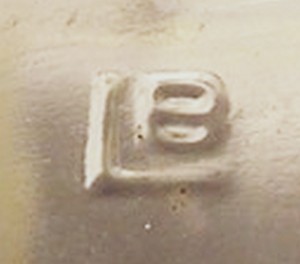
LB mark used by Long Beach Glass Company (Photo courtesy of Glenn Pavlovic) - LB ………………….Long Beach Glass Company, Long Beach, California (1920-1933). This mark appears in the form of a large capital “L” with a smaller upper case “B” sitting in the “lap” of the L.
- LBD (seen on heel of Ed Pinaud hair tonic bottle, c. 1890-1910, reported by Jack Klotz) …………….. Unidentified. The initials might stand for a glass company in France.
- Lbg………………….. Lynchburg Glass Works, Lynchburg, Virginia (1919-1922). See Lynchburg Glass Corporation page.
- LCC (stylized mark)…………………. Lancaster Colony Corporation, based in Lancaster, Ohio. Indiana Glass Company was acquired by Lancaster Glass Corporation in 1957, and with several other glass companies, Lancaster Colony Corporation was formed circa 1961. See “Indiana Glass” entry on this page. Also, see this page for information on the popular Indiana Glass “hen on nest” dishes.
- L. C. & R. CO…………………. Lampton, Crane & Ramey Company, Louisville, KY (c.1894-c.1928). This firm was a dealer in paints, oils and varnishes. They apparently offered lettered glass bottles as part of their product line (many firms of this type offered window glass and glass bottles in addition to their other products), and since they were not an actual glass bottle manufacturer, the LC&RCo bottles were made by an unidentified glassworks. (Just a wild guess……….no proof!…… possibly Illinois Glass Company??)
- Lea & Perrins / Worcestershire Sauce…………….. this is one of the most common earlier handmade sauce bottles found in dumps and privies dating as early as the 1870s and before. The sauce originated in England and was probably sold as early as the very late 1830s, and by the 1840s it was being exported to America. Many of the Lea & Perrins bottles are marked “J D S” in a triangular formation, along with a mold number, on the base. Those initials stand for John Duncan’s Sons, originally a distributor, later an actual producer of the sauce. The bottles marked with those initials are believed to have been produced in the United States by Salem Glass Works of Salem, New Jersey. Please check out my entry under “J D S”, above on this page.
- Leotric……………………………..Brand name embossed across the face of certain fruit jars, these were evidently made by John Gayner/Gayner Glass Works, Salem, N.J. (1885-1898/1898-1937) and Cumberland Glass Works (or Company) /Cumberland Glass Manufacturing Co., Bridgeton, New Jersey (1882-1896/1896-1920). The trademark “LEOTRIC” (#43288) was said to have been in use starting in September, 1903, according to trademark documents. (Info from Alice Creswick’s The Fruit Jar Works, Vol. 1, 1995).
Handmade blue glass “Bluebird of Happiness” paperweight / figurine, this particular example signed (engraved) on base “Leo Ward 1994”. - Leo Ward 1995 (or other year, hand-engraved on the base of art glass bird paperweights)……………………. Terra Studios, Fayetteville, Arkansas. https://usingart.org/. (Birds marked “Ron Ray” were made by another operation in Fayetteville: Phoenix Studios).
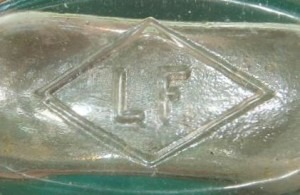
LF in a diamond – on base of tooled-lip “strap side” flask. (Photo courtesy of Jimmy Bray) - L F inside a diamond…………………Unknown. Reported by Jimmy Bray, this mark appears on the base of a light aqua tooled-lip strap-side flask, probably dating from the 1885-1910 time period. There is almost certainly no connection between this and the following mark.
- L. F. & CO…………. Lippincott, Fry & Company, Pittsburgh, PA (1866-c.1867). These initials appear on the front of a “Shield with Clasped Hands” pictorial whiskey flask. That glassworks was also known as “Crescent Flint Glass Company”. This mark was identified by author and researcher Jay W. Hawkins in his groundbreaking reference work Glasshouses and Glass Manufacturers of the Pittsburgh Region 1795-1910, published in 2009.
- LG (along lower heel of soda bottles, always embedded within a brief string of numbers)………..Graham Glass Company, Evansville, Indiana (this code indicates production from their Loogootee, Indiana glass plant). See Graham.
- L.G. ………………Liberty Glass Company, Sapulpa, Oklahoma (1918-c.1995), mark used c.1924-c.1936. Note that periods are used.
- L-G………………..Liberty Glass Company, Sapulpa, Oklahoma (1918-c.1995), mark used c.1934-c.1967. Note that mark includes a dash.
- L G………………..Liberty Glass Company, Sapulpa, Oklahoma (1918-c.1995), mark used c.1955- c.1995. Dash removed. (NOTE: There is a considerable overlap of the time periods during which these three mark variations were used (L.G. / L-G / L G) so careful scrutiny for an accompanying date code is advised. This information on approximate dates of use courtesy of author/researcher Bill Lockhart.) The Liberty Glass Company factory became part of the Ball-Foster Container Corporation in about 1995, Saint-Gobain Containers in 2000, now (after c. 2014) operating as part of the Ardagh Group. Also, check the L.G.CO. mark page for info on other factories that used a somewhat similar mark.
- L.G.CO……………………Several factories used this marking, including Lindell Glass Company, St. Louis, Missouri; Lyndeborough Glass Company, South Lyndeborough, New Hampshire; Lamb Glass Company, Mount Vernon, Ohio; and Lockport Glass Company, Lockport, New York. Please click here for more information: L. G. Co. marks seen on glass bottles and jars.
- L.G.CO. arranged around a star with the words “ACME/Trademark 1893″…………Lamont Glass Company, Trenton & New Glasgow, Nova Scotia, Canada (1890-1898). Seen on the face of fruit jars. Also see the “L.G.CO.” mark webpage.
- L G W………………Laurens Glass Works, Laurens, South Carolina (1910-1996). Plants also operated in Henderson, North Carolina (opened 1957) and Ruston (Simsboro), Louisiana. The Henderson and Ruston plants were later to become part of Saint-Gobain Containers, currently (2020) under Ardagh Group. Laurens Glass Works was a prolific manufacturer of soda bottles. The “L G W” may appear on the heel of a bottle, but is often seen on the bases of soda bottles, along with mold , date, and/or style code numbers. Often, the LGW mark (as used by Laurens) is situated between numbers (date codes) such as: “6 L G W 1”. That would indicate a bottle made in 1961. Also, see the “L” mark entry on this page. NOTE: In some instances certain older (pre-1900) bottles or flasks with the marking “L & W” (indicating Lorenz and Wightman) are misunderstood to read “L. G. W.”, and because of an entry in Toulouse’s Bottle Makers and their Marks, this mark is believed to stand for Louisville Glass Works. I do not believe Louisville Glass Works ever marked ANY items with the initials “L G W”. If you have information that might show otherwise, please feel free to contact me with details. Also, see the “L.G.CO.” mark webpage.
- L. G. WKS…………………… probably Lockport Glass Works, Lockport, New York (1843-1908). An example of this mark is seen on the lower heel of a blue “J. A. Lomax / 14 16 & 18 / Charles Place / Chicago” soda or mineral water bottle, probably dating from the early 1870s. There is a SLIGHT chance this could have stood for Lancaster Glass Works, but Lockport is much more likely since Lomax had previously had other soda bottles made for them (marked “LOCKPORT NY”) that appear very similar in color, shape and embossing.
- Libbey……………… see Libbey Glass (Cursive L mark) webpage.
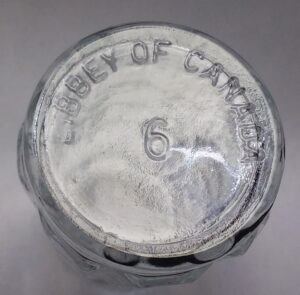
“Libbey of Canada” mark on base of Waffle Block restaurant-style salt shaker in clear glass. “6” is a mold number. - Libbey of Canada……………. mark seen on bases of salt & pepper shakers, bottles and other types of glassware. Information on the history of this glass company and the exact time period when this mark was used is confusing and incomplete, but evidently most (if not all) of the glass so marked was made at Wallacesburg, Ontario, Canada by Libbey Canada Inc. between 1993 and 1999, at which time LCI closed the Wallaceburg factory. Libbey St. Clair had operated there from 1978 to 1993, and was purchased by LCI in 1993. It is unclear if glass was made under the name Libbey Canada Inc. at other glassmaking plants after 1999. Please see the “OOOO” mark used by Libbey St. Clair on Page Four.

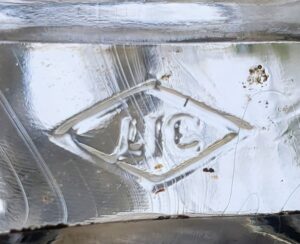
- LIC or LIG inside a diamond (above) …………………. This mark appears on the base of a clear whiskey or bitters sampler bottle, likely circa 1890-1910. Update 9/16/2024: Carol Serr realized this is actually the mold number “317” inside a diamond and we are viewing the mark upside down! Illinois Glass Company produced many styles of bottles with mold numbers placed inside a diamond. This one is shown on page 152 of the 1906 Illinois Glass Company catalog, shown here at Bill Lindsey’s website: Illinois Glass Co. 1906 catalog – page 152 – SHA.org.
- LKYGW or L K Y G W ……………….this is a mark that appears in “Bottle Makers and their Marks” by Julian Toulouse (1971), purported to have been used by Kentucky Glass Works. I don’t believe that it actually exists, as such, and I prefer to brand it as a “fantasy mark” (nonexistent). I think that someone communicated to him concerning a mark they saw, which they abbreviated within their correspondence, thus creating a misunderstanding of the exact appearance of the mark. If you have any info to show otherwise, (as I would actually like to be proven wrong :-), please contact me through this website! Also, please see these entries: LGW, L.G.CO., Louisville Ky Glass Works, KYGW, KYGWCO , and S.G.W. LOU. KY. Also, see webpage on the Kentucky Glass Works Company.
- LM…………………Latchford-Marble Glass Company, Los Angeles, California. See “L in an oval” mark.
- LM in an oval……….Latchford-Marble Glass Company, Los Angeles, California. See “L in an oval” mark.
- Lockport N.Y. ……………………………….Lockport Glass Works, Lockport, New York. Seen on heel of soda bottles probably dating from the late 1860s or the 1870s. One example would be a “J. A. Lomax” soda bottle in light cobalt blue glass from Chicago, Illinois.
- Lockport Glass Works……………….. Lockport Glass Works, Lockport, New York (1843-c.1908). Factory name is found spelled out on the front of historical flasks and soda bottles. Most of the flasks probably date from the 1840s into the 1860s. The blob-type soda bottles most likely date from the 1850s-1870s period. The glass works was operated by several owners/firms over the years. Francis Hitchins operated the company circa 1850-1866, and some bottles made during that time period were marked “Glass From F. Hitchins Factory, Lockport, N.Y”. Alonzo Mansfield bought this factory in 1872 and it then became known as the Mansfield Glass Works, although the factory may have unofficially been called the Lockport Glass Works or Lockport Glass Manufacturing Company for several years afterward, at least into the 1880s if not later. The works continued in operation until about 1908. Note: Another glass factory which may or may not have been related was “Lockport Glass Company”, reportedly in business from c.1900 to 1919. Also, please see the “L.G.CO.” page.
- Loetz…………………………… Johann Lötz (or Loetz) Witwe, factory was located at Klášterský Mlýn, Czech Republic (formerly Klostermühle, Bohemia), (c.1836-1947)………….. celebrated maker of fine “Bohemian” glassware including “Art Nouveau” art glass very popular in the late 1800s and early 1900s. (The ö or “oe” sound is not used in typical English, but one way to describe the vowel sound is to pronounce the name as the English word “lets” but at the same time with the lips rounded into a circle as if you were saying “oo” in “look”). The majority of pieces made by Loetz were not marked. Some glass was engraved “Loetz” or “Loetz Austria” on the bottom, usually in a cursive type script. There are a number of other authentic signatures and marks known. There is considerable confusion with this type of glass, as much of what is sold as Loetz was actually made by some other glassworks, either in the same region or in other countries. Many items, including older glass from other companies as well as more recent production from other firms, have fake etched or engraved signatures on them. There are many websites with more info for the interested collector, but for a basic introduction on this subject, check out this webpage:
Is this really Loetz Glass and should I buy it? – Article on Loetz.com. - Louisville Ky. Glass Works………………Louisville Glass Works, Louisville, Kentucky (1855-1873). Factory name is seen embossed on several types of whiskey flasks, including plain, strap-sided, eagle, scroll (“violin”) flasks, and several vertically-ribbed types. A number of different operating companies ran the Louisville Glass Works over the years. A very rare fruit jar, a type apparently made to be used with a cork closure, is also known with this marking. (Also see “K. R. & Co.” mark on this page). Please see Louisville Glass and my “Louisville Glass Factories of the 19th Century, Part One” article link on that page; and the Glass Insulator Factories information page. The Kentucky Glass Works Company, Falls City Glass Company and Southern Glass Works pages also have some background info on those later bottle factories in Louisville.
- LOU. KY. G. W. ………………….. This embossed marking (interspersed with four crossed lines), is listed as appearing, in a circular formation, on the base of a wax sealer-type fruit jar, according to Dick Roller in The Standard Fruit Jar Reference (1983). He lists this jar as #693.5 which is described on page 195. However, that listing is in error. This jar is not a product of the Louisville Glass Works, as the actual embossing is “S. G. W. LOU. KY.” Because of the placement of the crossed lines, the “S” is either invisible or partly obliterated on examples of the jar, creating confusion as to the exact order and interpretation of the letters. Actually made by Southern Glass Works, Louisville, Kentucky (1877-c.1885), a factory in operation several years after the Louisville Glass Works had ceased production. See “SOU G W”, “SOU G WS”, “S. G. CO.” and “S. G. W. LOU. KY.” and related marks.
- LP (along lower heel of soda bottles, within brief series of numbers)……………Graham Glass Company, Evansville, Indiana. This code represents the Loogootee, Indiana glass plant. See Graham.
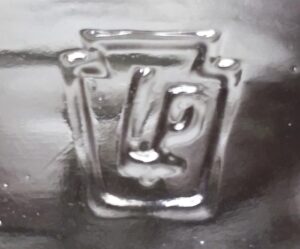
LP in a keystone mark, used by Pennsylvania Bottle Company, Sheffield and Wilcox, PA. - LP inside a keystone (shown above) ……………….. Pennsylvania Bottle Company, with plants at Sheffield, PA and Wilcox, PA. (PBC began in 1926 at Sheffield although this mark reportedly dates from 1940-1952, according to Toulouse). The “L” in the mark stands for Lummis Glass Company, Inc. , a distributing company based in New York, NY that marketed the bottles made by the Pennsylvania Bottle Company. Also, see “V in a keystone” on Page Five.
- LS ……… see entry “LP” above; see Graham.
- LS inside a circle……………….. Lax & Shaw, Ltd, Leeds, Yorkshire, England (started c. 1891, incorporated in 1913). This bottle maker was involved with a series of acquisitions and mergers over the years and now [2025] is operating under the name Verallia UK (see link below). I don’t know the exact date range for the “LS in a circle” mark. If you know, contact us!
About Us – uk.Verallia.com - Luxfer / Patented (along with several patent dates from the 1880s and 1890s)………embossing found on glass prism “vault lights” (triangularly shaped glass tiles) used in various construction/lighting applications, sold by Luxfer Prism Company. See Ian Mackey’s Glassian.org site with more info here: Glassian.org/Prism/Luxfer/ . Apparently these were manufactured by Jeannette Glass Company, Jeannette, Pennsylvania.
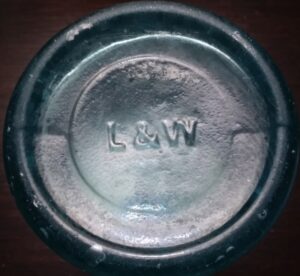
“L & W” – Lorenz & Wightman, Pittsburgh, PA. As it appears on base of blue-aqua “H. Schuckman – Louisville KY” mineral water bottle. - L & W…………..Lorenz and Wightman, Pittsburgh, Pennsylvania (c.1862-1874). A prolific bottle producer. This mark is known on a very large variety of bottles and fruit jars. Toulouse claims the mark was likely used from 1851 to 1860, and then again from 1862 up to 1871, which is the year that Lorenz died. However, Lorenz and Wightman was not officially dissolved until 1874. I know of certain soda bottles that exist with the L&W marking that almost certainly date as late as 1874.
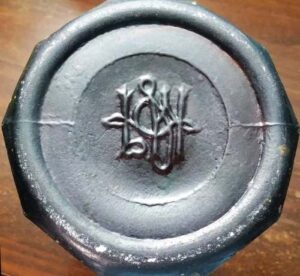
“L & W” monogram mark on base of amber “A. Templeton / Louisville” Cream Ale bottle - L&W (monogram) …………. Lorenz and Wightman, Pittsburgh, PA (same as above). Although “L & W” is often seen on bottles with the letters very clear, distinct and obvious, this monogram has those letters closely intertwined and may be more difficult to interpret correctly.
- L. W. T. & CO / NEW YORK ………….. Unidentified. These initials have been reported on several druggist bottles (including Alex Hudnut, New York City, NY; Sullivan’s Drug Store, Pittston, PA; and L.A. Miner’s Pharmacy, Rutland, VT); nursing/baby bottles, and on a milk glass apothecary jar. Those items appear to date from the 1895-1915 time period. Perhaps the initials of a wholesale distributor / jobber?
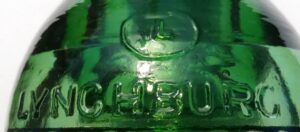
“L in an oval” and LYNCHBURG on green CD 154 style glass insulator made by Lynchburg Glass Corporation. - LYNCHBURG (embossed on glass electrical insulators)…………………… Lynchburg Glass Corporation, Lynchburg, Virginia (1923-1925). For some basic info check out my page on Lynchburg Glass Corporation. For a great site with lots of detailed background history and information on Lynchburg and their glass insulator production, check out this site by Dennis Bratcher: https://www.Lynchburgglass.info
- LYRIC………………….. Illinois Glass Company, Alton, Illinois, Gas City, Indiana and other locations. Trademark seen on the base of clear prescription/druggist bottles. Please see this page on the Lyric bottles.
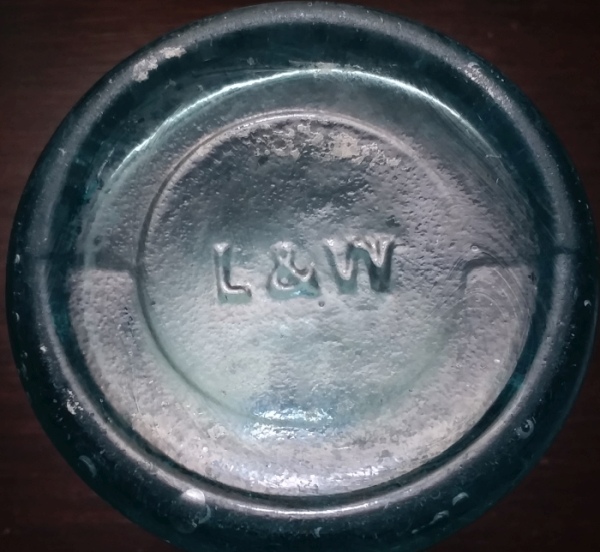
[ A – B ] [ C – D ] [ E – L ] [ M – R ] [ S – Z ]
Please click here to go to my HOME PAGE.
Click here for Complete List (MENU) of ALL Articles on the GLASSBOTTLEMARKS website!
ADVERTISEMENT
F.G.MFG.CO – Is most likely the Farrall Glass Manufacturing Company that was in Michigan City, Indiana. There are photos and documentation proving there was a glass company there. Another bottle marked with the same markings as the Elkhart bottle is a Ph. Zorn Brewer bottle that is embossed Michigan City, Indiana on the front with F.G.MFG.CO on the base.
Hello Josh,
This is superb information! Thank you very much for passing this along. I had never heard of this glass company – an illustration that there were many firms that (for some reason or other) received very little attention and are now virtually forgotten. Using Google Books, I found some brief references – in the “Western Manufacturer” Vol. 13, page 93, 1885, and in the “Inland Architect & News Record” , July 1885, page 97 among others. The latter news item stated that the factory would be in operation by October of that year. Do you have further information to pinpoint when the factory actually first started producing glass, and how long they were in business? Do you know when they closed down? Evidently the business offices were usually listed as “Chicago” instead of Michigan City, Indiana, if I understand this correctly.
Thanks very much for your post. I am sure you are right that this is the correct meaning of the “F.G.Mfg.Co. mark!!
~David
Do you have any more information about the Gerresheimer Glas company? The G with a crown logo? I recently acquired a demijohn with this logo and markings. I am trying to find out the year it was made.
Hi Pam,
No, I am sorry I don’t have any more info other than what is in my brief entry on the mark. Good luck with your search for information!
~David
Hi, I recently found a jar that has the GAC mark on it and I was doing some research. I keep coming across the words Great American Classics. Do you know what this is? I am not sure if it is a glass company or maybe just a type of ware. Is it possible it is connected to the makers mark?
Hi Ab, I am fairly sure there is no connection with the “Great American Classics” line of products and the “GAC” mark as seen on this glass. The mark on the glass looks like it probably dates back at least several decades, possibly from the 1960s-1980s. The “GAC” trademark listed at this site (link follows) is a very recent trademark officially registered in March of 2020, although they claim actual use back to the year 2006. GAC GREAT AMERICAN CLASSICS – uspto.report . If anyone has information on the GAC mark as illustrated in the alphabetical mark listings, please feel free to chime in!
[Edit – updated 4/15/2024]: The “gAc” mark has recently been identified as a mark used by the Arkansas Glass Container Corporation].
David
I found a clear bottle with the GAC mark. It looks like a pint whiskey flask bottle with a screw top. Seams on both sides to the top. No stippling on bottom. It has a simple molded shoulder design that is not a shoulder seam – 2 horizontal lines along the shoulder intersect 2 vertical lines that fade “north” to the top. Hard to explain. Glass overall is uneven, but no bubbles. But it has that same GAC mark where the A is larger than the G or C. Looking at the bottom of the bottle, which is oblong, at the top are the numbers 18-6, on the far left is the GAC, on the far right is the number 6. I found it in on my property in North Dakota near the Canadian border, close to where I found what looks like an amber beer bottle that’s similar in some ways – screw top, side seams, no stippling. (That one has the N in a square and the number 7, so it must be Obear-Nestor.) Not sure if this helps the conversation, but it would be interesting to figure out the GAC thing. I agree that it appears that the A represents the primary name – maybe first (for a company) or last name (person). Let me know if you want to see pictures.
Hello Rob!
I know this reply is several months late, and I apologize for not replying in a more timely manner. I recently found out the identity of the glassmaker who used that “g A c” mark……… it was used by Arkansas Glass Container Corporation of Jonesboro, Arkansas. They are still in business as of 2023. At this time I don’t know the timeline of when that mark was used, but I am guessing it may have been used from around the time the company started (late 1957) and perhaps into the early 1970s or later. I’ll update as I learn more. I’ve sent a query to the company website and hopefully I will hear from them. Thanks for your post!!
David
I have a bottle that is extremely dark olive green, 9 3/4 inches tall, pushed bottom 3 piece mold. From what I gathered its from the 1800’s from Europe. It’s either a wine or beer bottle the only markings on the bottle are on the bottom. There’s a number 3 and kASE on the bottom. It also has a blob lip. I found out more about the bottle from the number 3 finding the same exact bottle online with no manufacturer just that the bottle is from the 1800’s and from Europe. Can any one help.
Daniel, I sent an email to you directly. I was hoping you could email me pics of the bottle. I don’t know what “KASE” could indicate. Are you absolutely sure you are reading the lettering correctly? Thanks!
David
Five inch clear bottle with a 5 and a “boxed N” on bottom along with a 2, any info. Thank You!!
Wendy, all I can tell you is the bottle was made by Obear-Nester Glass Company of East St. Louis, Illinois. The “2” is a mold number.
David
I have the bottom of a brown bottle with the symbol JL and in between the JL is an arrow. Anyone have any history on this. Found on Martha’s Vineyard
I have a 1929-1930 clear Knoxall bottle with the number 6. What does the number 6 mean and what was in it?
Joanna,
The “6” is probably a mold number. I’m not familiar with the Knoxall bottles but an internet search with pertinent keywords such as “Knoxall” and “bottle” might bring up more information.
David
I have a beer bottle with a K in a diamond on the base. The beer bottle is a Baltimore loop Seal finish. Brand is Consumers Brewing Co. Erie, PA.
Hi Seth,
Thanks for your post and the info. I don’t know what the “K inside a diamond” stands for, but presumably it would be a glass bottle manufacturer. Perhaps a reader will have a clue to help us out on identification!
Best regards, David
I have an oblong marble effect glass container,around 12 inches long and around 4 inches wide,and the same in depth,on the underside,it looks like an eagle, and made in USA,under that their is the numbers 652,under these numbers is a number 3,its a cream,light brown marbling, any information would be greatly received, sincerely, peter goodwin
Hi Peter,
Your glass container was made by Akro Agate Glass Company. They specialized in many colors and color combinations of “marbled” glass.
Their main production item was marbles, but they made a lot of other glass items as well.
Their trademark is actually supposed to be “A CROW” (flying through the letter “A”) but it is often assumed to be an eagle. Hope this helps!
David
Thanks, I appreciate the help.
I have a pepper shaker that belonged to my ggparents, handed to my grandparents, then to me. It’s a 1893 FB, down below the B is a 1 . It’s in excellent shape.
I have 3 Jim Davis (I assume James E. Davis) Glass Bird weights. I am from Indiana, as is many generations of my family. These birds all have the date of 1997 on the bottom. I am happy to share photos for reference. I guess he made them past the 80s.
Kurtis, thanks a lot for the pics and information. [He sent them to me directly by email]. I have added one of your glass bird paperweight base pics to the alphabetical listings under “Jim Davis”.
Take care,
David
My husband and I found a few old bottle while mushroom hunting and I can’t find the last one anywhere online. I was able to figure out that the ahk on the bottom stands for a company out of Los Angeles but looking on their website I couldn’t find this exact bottle or any thing like it . It also has the numbers 2010-H below the ahk( I should have mentioned the ahk is on the bottom of the bottle but I would say at one side as the numbers followed by the H are down below on the pther sodeand there is another number number 2 to the right of the other numbers). Does anyone know where I can find some information on it such as what it was used for or how old it is exactly?
Help, I think mark is a diamond with an oval. Also has the number 2, 62 on one end and 1939 on the other. It a large (5 gallon) blue-ish colored glass wide mouth jar with handle and lid.
Lori, it sounds like a pickle jar made by Owens-Illinois Glass Company. The “1939” may be the year the mold for the jar was made, or the jar itself. I’m not sure which would be right.
best regards, David
who can help me identify a pop bottle from Glenshaw with an N and 1500-3 on the bottom
I am trying to find information on Capital Glass Works in Washington PA. I found an ornate soda bottle shaped like a coke bottle that held 5 and 1/2 ounces. I can find not information on the company on the internet. Capital Glass Works is marked label size on the bottle and the City and state Washington PA below that. It has seams marks so it looks to be molded. It is marked in large letters on he bottom J.S. it has a number on the top of he bottle neck 26 and a diamond mark. Thanks.
Tony, I don’t know anything about a Capital Glass Works in Washington, PA. Perhaps a reader has more info??
~David
Hey Dave
Just found a circa 1910 pharmacy with base marking “L W T CO, New York”
As always, any info greatly appreciated.
Thanks, Man
Steve
Steve, that’s a new one on me. Maybe someone with more info will post here.
Take care,
David
I found an old glass bottle it has the markings 64 on the bottom with a line under it and on the front bottom side it has w I think a small D or comma maybe followed by 86G7. Can anybody tell me what this is
The FVF mark is actually FMF, and stands for Food Manufacturers Federation. Established (I think) around 1913, it changed it’s name to the Food and Drink Federation in the 1960s. The mark turns up commonly on the bases of both glass and stoneware jars, especially around the 1920s – 40s.
Jeremy, I really appreciate your input! Thanks a lot for your post,
David
Thanks Jeremy, info a great help
Mike
Hi David, I found a Hazel Atlas jar today. It has an A under H and k 216 on a round bottom then it has 8 flat sides going up to a tapered round top.do you know is this an old ketchup bottle and what year it might be?
Hi Ray,
I’m not positive from your description, but let me attach a link to a typical ketchup bottle.
This one was made by Owens Bottle Company (O inside a square was their mark, embossed on the bottom). Many glass companies (including Owens Bottle Co, Fairmount Glass Company, Illinois Glass Company, Anchor Hocking, and others) made these same general types of glass ketchup bottles, and the style changed very little over a long period of time. They are one of the most frequently found kinds of bottles in old dumps, from the 1900s to the 1950s or later. They usually have either 8, 10, 12 or 16 facets (vertical panels or “flutes”) down the sides.
Photo of “O in a Square” marked Ketchup Bottle made by Owens Bottle Company
Take care, David
Hi there. I love your site and frequently use it to help cross reference information for historical archaeological research. I’ve noticed that you attribute the plain “L” maker’s mark to the more recent Latchford Glass Company. This is in direct contradiction to what Bill Lockhart et.al. of the “Bottle Research Group” has compiled about this mark in their “Manufacturer’s Marks and Other Logos on Glass Containers” article. They attribute that mark to the earlier W.J. Latchford Glass Co. (ca. 1925-1939). I just wondered if you are aware of this and if so what reference has informed you that it belongs to the former? Thanks, and keep up the good work!
Bonnie,
I just re-edited slightly my entry for the “plain L” mark as used by Latchford. Please check that entry. Julian Toulouse (Bottle Makers and their Marks, 1971) stated that the “plain L” (not enclosed in an oval) was DEFINITELY used by Latchford after 1957, but was uncertain if they had also used it in the early (1925-1939) period. I tend to follow his direction on this particular mark. The page you mention
L Logo Table – Sha.org has a slight error (at the time I viewed it), as I believe there is an accidental omission of the plain “L” mark as being used in the later time period (1957-1989). In addition, Toulouse indicated the “L in an oval” was also used in the 1957 to 1989 period concurrently with the “plain L”. Hope this helps!
David
Wow what a mess! Its so hard to find a definitive date range for some of these marks. Thanks for your help!
Hi, I have a clear glass wine decanter with top. There are some flower etching around the base. It has an L in a diamond on the bottom. Looking for info. It probably belonged to my Grandmother who would be 120 now! Thank you.
Nancy, I don’t know anything about the “L in a diamond” mark on your decanter. I did find a brief online reference to a clear glass serving tray with (presumably?) the same mark. That tray looks modern, perhaps 1970s-1990s. Perhaps a reader can help with more info.
David
It is difficult to find where on your site a person can email or message you directly, could not find, So will just leave a comment here.
This is regarding your page on FAROY candle holder items. Something does not make sense, the patent number 204,556 was for patents granted only between 1875-80, not 1975 as your info. claims. I saw your cobalt blue candle holder you show and say it has this patent number. I also have same exact candle holder with same patent number, in vaseline glass. So I wonder how can these be modern items if the patent number is for between 1875-80 only?? I admit the glass has more of a newish look than glass actually made in that time period. I suppose the patent is very old and the glass found today is circa 1960s-70s? Or are the items with that patent number really that old- circa late 1870s? More research.
Hi Richard,
I have mentioned this in many replies posted in the “comments” section, but it bears repeating: My email address is listed on the right-hand bottom corner of every page on this site. [Edit – now listed in the “Contact Information” page]. Perhaps that text isn’t easily visible when viewing on a smartphone? Because of the many queries and comments I get, I cannot reply to all of them. (Not enough time or energy). I actually work a regular job, and this website is just a “spare time” activity in my “other life”.
Concerning the patent number 204,556……. There are some frequent misunderstandings about these patent numbers and I can understand your confusion. Very simple……..there are TWO sets of patent numbers. You are referring to the “regular” patent numbers, also called “letters patent” or “utility patent” numbers. In that case the #204556 would fall in the year 1878 for a vehicle spring invention. Patent number “1” in that list was issued in 1836.
However, the patent number 204,556 is a different type of patent known as a Design Patent. That series of numbers are on a much “smaller scale”. Candle Cup Patent #204,556 – Google Patents
Many of the design patents can be found by searching the “GOOGLE PATENTS” site- but with the letters USD placed in front of the number, i.e. USD204556.
Hope this helps,
David
I found a clear glass bottle, says one gallon at the top A-9 near the bottom and has a keystone with the letter V in it. I’m assuming it’s a Knox bottle but haven’t found any reference to the V and was wondering if you could help. Thank you, Will
William, I don’t know about that mark. Someone wrote to me some years back and asked the same question about a flat wine flask that appears to be marked with a “V in a keystone”. It is marked “ONE PINT” on the lower heel on both flattened sides, and WINE on the base. There seems to be no information on the mark. I was wondering if the letter was actually intended to be a “U” but the mold engraver tooled the lower “notch” a bit too sharply in the mold and it ended up looking like a “V”. Just a thought……..I may be wrong. If you find out anything more, please let me know. Take care,
David
I am trying to identify a bottle with 55 over LOU D2 55 under ( all in a circle) and the I believe the Duralas symbol to the right. The bottle is oval with a flat side ( a liquor bottle I assume ) I only have the bottom. I collect sea glass, make jewelry and “stained glass” window art. I like to identify the bottle bottoms in my art pieces. Any help would be appreciated. Any way to send a photo if needed?
Hi Layne, it is a liquor bottle, made by Owens-Illinois Glass Company (Diamond and oval entwined with I mark). In the case of the markings on that particular bottle, the first “55” is a “liquor bottle permit number” assigned to their Huntington, WV plant. The second “55” is a date code for 1955 when the bottle was made. Please check out my page on Owens-Illinois for more info. Photos can be sent to my email address, which is listed at the bottom right of any page on my site. Hope this helps,
David
Hi David,
Found on my property, we live in an old farmhouse built 1840, a glass bottle down near the water. It is clear and looks like an old drink bottle with no markings except on the bottom it has the letter H in a circle and on the side of the bottom rim it has H103. That is it, looks old. Could this be a Hemingray? We live in the Northern Neck of VA in White Stone. Thanks for your help.
Tom S.
Hi Thomas,
I’m not sure, but I have doubts it is a Hemingray product. Can you email me pics of the bottle and the mark? My email is listed at the bottom right-hand corner of any page on this site.
Best regards,
David
Hi David-
I have a gold-plated (somewhat worn) Coke bottle that was given to my family from a great, great uncle many years ago. Although I’m sketchy on the details, my uncle was a designer at Liberty Glass in Sapulpa, OK. Before his passing (40+ years ago), he gave his personal collection (4 gold-plated bottles) to those close to him. There was something said about these 4 bottles being the first four of a new run. My uncle was James Greenwood and through research, I have found he had a copyright or two on milk bottles years before.
The bottle has the following on the base of the bottle:
“Jackson, Miss.”
“L-G”
“58-68”
No doubt, it appears to have been made at Liberty Glass in Sapulpa, OK. Any additional insight you may have would be greatly appreciated as this is something the family would love to know more about.
Thanks in advance.
Keith
Keith, thank you for your post. Interesting information! I’m sorry but I don’t have any insight on your bottle, although I would assume the “68” is a date code for 1968.
Take care,
David
Hi David, I have a small amber bottle with numbers 1414 on bottom then a 6 under the 1414 with a raised dot to the left. any information will be appreciated. Thank you Debby
Deborah, please check out my webpage on “Numbers on the base of glass bottles”.
David
I am trying to date a bottle from the early 1900s I believe and also find who manufactured it. It is a larger mouth clear rounded rectangular bottle with an early screw top, and the bottom has PL inside what looks like a shield, with a pitchfork and a number 3 under it. I can’t find any information about a PL company.
Thanks, Bethany
Bethany,
I don’t know what the PL stands for. This mark is seen on various bottles and has been reported to me several times over the years. If any readers of this website know, please advise!
Best regards,
David
Hi Bethany & David. I’m not sure I can clear this up, but I can shed some light for you to review. I have a bottle that also has the PL inside a shield with a pitchfork. However, there is not a 3 under it, but rather a 2 outside the shield towards the lower point and off to the left side. The interesting thing about this bottle is it has the words “Hospital Dispensing Unit” on it, and the cap is also present. This is where I hope I can help. On the outer rim of the cap there is “Lithographers In USA” and the H over A mark of Hazel-Atlas. On top of the cap is printed This Bottle Admits a Tablespoon, and in the center says Shake Well. I hope this information helps answer some questions. Best Wishes, Brian
Hi Brian,
Thank you for the information! That info also raises more questions, but I think we can say that the “PL inside a Shield” mark probably stands for the initials of an unidentified pharmaceutical supply company. Of course, your actual bottle was manufactured by Hazel-Atlas, but it wouldn’t surprise me if other bottles found with the PL mark might be products of a different glass manufacturer. Often, large distributors and drug manufacturers switched glass bottle supply companies, depending on the current wholesale prices they were charged for bottles made for them. I am sure someone will come up with what the “PL” stands for!
Take care,
David
Found a clear bottle bottom, not the whole bottle. there is a diamond shape in the center and a 3 below it. Would this have been from Diamond Glass Company?
PK, your bottle was made by either Diamond Glass Company of Royersford, PA OR Illinois Glass Company, Alton, IL. If the diamond is absolutely PLAIN with no trace of letter or number inside, it was probably made by Diamond. Look carefully, as often a letter “I” or a number or letter combo may be just faintly visible which would indicate Illinois Glass Company (See my page on the “I inside a diamond” mark). Sometimes it is very difficult to be sure!
David
I have what looks to be a jelly jar. The bottom of the jar says FRANCE followed by a small oval and then the date 1861 or if read the other way 1981. It also has VMC and then the numbers 32,4c1. The glass has a screw threads and cathedral window design around the glass. I sure would love to know something about this jar. The jar takes neither a wide mouth lid or small mouth lid. It is just a tad under a wide mouth lid.
Lynda, the jar was made in France, and I have no information on it. I am not very well acquainted with French glassware. However I am sure the date is 1981.
David
Thank you so much for such a quick answer. I find your website invaluable.
What glass company made the embossed 1989 Coca-Cola 1923 commemorative bottles? The bottles are all side embossed similar to “89-10-14-JG”, where 89 is the year of manufacture, and JG appears to represent the glass manufacturer. But what does JG stand for?
Roger, I don’t know. Perhaps a glass company outside the United States?
David
Yes, I had considered Mexico, but current Google searches (in 2016) haven’t brought up anything for me. If the company has changed it’s name or trademark, or gone out of business, it’s harder to find that information.
Roger
I found a pair of green depression juice glasses with AKG on the bottom. It is in a half circle similar to a monogram. Any idea of manufacturer?
Kirk, it doesn’t sound familiar to me.
~David
The bottle I have is clear glass, 9″ tall. There are grape clusters hanging from vines with four leaves on two sides of the bottle. The mark on the bottom looks like a ‘c’ connected to another ‘c’ which loops around and becomes the top of the letter ‘P’.
Maryjane, I don’t know anything about the mark you describe.
David
Hello,
I would like to inquiry about a small jar that appears to be an ink well, not sure though.
It is square with a short neck and a metal cap that has a small rim on bottom. 1 and 1/2 inches tall by 1 an 1/4 inches wide both ways. It is clear glass with two rims running around it and has a metallic blue material still inside. It has a stamp on the bottom of it in a circle pressed into the bottom with ” K K ” and ” PAID ” under it.
Can you tell me anything about this or direct me to the correct place? Thank you!
John C.
John, I have no information on it. Perhaps a reader will land on this site who can shed light on it.
~David
I don’t see how to make my own reply, so I will just comment on this one. I have a bottle embossed “Ramey L.C. & R. Co.” on the base. I see it is an unknown glass mark. Does anyone have more information on it by now? If it helps, it is on the base of a bottle embossed “Ingram Drug Co. Thomasville, GA”. (A small prescription pharmacy med).
Hi Weston,
At the present time I haven’t updated my entry on that mark. It was evidently used by Lampton, Crane & Ramey Company, based in Louisville, KY, and that company dealt in paints, oils and varnishes. I believe they also (as part of their array of products offered) sold various bottles with the L.C.& R.CO marking on the base, which they offered as part of their general product line. The bottles would have actually been manufactured by some unidentified glassworks FOR LC&R, probably during the very late 1890s into the early 1900s. (Some paint,chemical and varnish distributors/jobbers of that general time period offered window glass and glass bottles as part of their product line, so in this instance they likely had an arrangement with a glass company to furnish marked bottles for them). Several druggist bottles are known with those initials on the bottom, and they are mostly from states in the South.
~David
Thanks for all the info, I appreciate it!
Hi, I have a 4/5 brown quart bottle that has the Federal Law Forbids Sale, with the markings on the bottom of bottle as follows: D 10 56-46 with some diamond marking.
Very similar to this one:
[Edit ~ Link to ebay item no longer active – removed 4/11/2021]
What can you tell me about this bottle?
Hi Mike, I keep getting queries about these amber liquor bottles made by Owens-Illinois Glass Company. Owens-Illinois made millions of these types of bottles, and the marking “D-10” is a distiller code for Brown-Forman. The “Diamond/oval/I mark was used by Owens-Illinois. The “56” is a liquor permit number assigned to Owens-Illinois (this number indicating production at their plant in Charleston, West Virginia) and the “46” is a date code for 1946 which is the year the bottle was made. Please see my page on OWENS-ILLINOIS GLASS COMPANY, and also please scroll through the comments section (at the bottom of that page) where various liquor bottles and markings are discussed. Best regards, David
David, I have a beautiful amber colored one gallon glass jug with the small handle on tthe side of the pour spout. On the bottom is has a sideways diamond, with what appears to be an “I” with a circle around it. Also has the numbers 4 4 1 around the diamond/circle with the I. I would love to send pictures so you can have a better look!
Hi Tara, that is an OWENS-ILLINOIS bottle, most likely made for bleach or some other liquid chemical. Some of these were also used to contain vinegar, apple cider, soda syrup concentrate, and other edible liquids.
Please see my page on Owens-Illinois Glass Company, and the comments section at the bottom where various bottles made by that company are discussed. You can also get an idea on possible age range by going to the Clorox.com site webpage which disusses the evolution of their own amber bleach bottle types. (Although your bottle probably did not contain Clorox, it may have contained a competing brand of bleach, and the bottle type may be somewhat similar). Their webpage showing various bottles over the years is here: Clorox Bottles Guide ~ thecloroxcompany.com
Best regards, David
I know that some of the Pluto Water bottles were made by the Root Glass Company by the markings on some of the bottles. Does anyone know of any other manufacturers?
I haven’t done any research on this question, but one idea to pass along…..Browse thru ebay auctions for Pluto bottles, and check the auction descriptions for markings seen/described (although some sellers may not include “minor” details such as this). Input from readers?
~David
I have a bottle with “G. G. CO.” on the back heel and “79 / G” on the base. It’s a machine-made bottle for The Connecticut Breweries, but it looks like a blob…. Seams all the way up the finish; ring around base of finish; plate-mold; aqua, bubbles in glass. It confuses me.
Ideas on who made it and when?
Hi Yogi,
No, I don’t know who made it or when. Perhaps Gayner Glass Company? (Don’t quote me!)
~David
I found a small clear glass bottle in the woods. It has a white plastic cap, and rather than being a true rectangle it is a trapezoidal shape with a diagonal angle on both the front and back, on opposite sides. On the bottom is stamped:
3
LENTHERIC
1/2 OZ
Any info would be awesome, can provide photos. Hoping to find out when it was made as I have been able to figure out most LENTHERIC bottles held perfume or cologne but have not found any pics matching the shape. Thank you
Just found this website. What a wealth of information. Luv it 🙂 Thank you so much!
Thanks Linda!
~David
I have what appears to be an old beer or possibly soda bottle, a dark amber color, seam on the bottle but top appears to be applied separately. It has an L and a B on the bottom (L over the B with a line between the two and a dot in the middle of the line). Any ideas on the origin?
Hi Geri,
Sorry I have no ideas on that one.
~David
Hello – I have an old Jelly Jar with just an “I” sans serif or a lower case “l” ??? the glass is an odd ball from my jelly jar collection – the glass itself is full of bubbles and seems cloudy (not etched form dishwasher). could also be a “|” pipe? or “_” underscore? but that seems too modern 🙂
I’m sorry Jeannine, but the “1” (probably was meant to be a mold number) does not give any meaningful info on origin or age. Please see my article “Numbers seen on the base of jars and bottles”. Best regards,
David
Hi, maybe you could help me out.
I have a bottle with the following markings on its bottom:
VE(as one grapheme) A
L58(the ‘L’ is lowercase and in cursive)
Hello Ubu,
I think your bottle was made by Vetreria Etrusca, a glassmaker in Italy. Here’s their website:
Vetreria Etrusca – Italy
Hope this helps,
~David
Yup, your right I can see a couple of their current models that look similar to mine. Thanks so much for your help.
David –
I have a skittle shaped or bowling pin shaped aquamarine-colored bottle. It is definitely a molded bottle (two seams up the sides completely to the lip). It has large and small bubbles. The inside base is tilted and not even with the outside base.
No markings on the body. However, the bottom is marked:
K B (something, maybe G, maybe <o) around the outside base
T (just below)
192
3
Any thoughts as to who manufactured the bottle, what it might have been used for, and possibly the age?
Thanks,
Adam R.
Hi Adam,
Your bottle held some type of soda water or mineral water, was made by Kilner Bros, England, and probably dates from sometime in the 1880s-1920s.
~David
David,
Thank you so much. The bottle was labeled by the seller as JL & Co bottle but, using your site and the markings on the bottle, I knew this could not be the case. This site is amazing with all of the detailed information. I will share this site with a number of my friends that collect both bottles and sea glass to help them identify their finds.
Thank you again,
Adam R.
Thanks a lot Adam!!
~David
I have some blue pieces the only I know on some them there a plastic label. Some trim in gold there no marking on some them. some say made in Poland, and Italy. I have a lot Chinese piece that we gift. Help can not read Chinese or Japanese. HELP……………………………….
Dee, I doubt if I can be of any help. I’m posting your note here in case any readers can offer insight.
Best regards, David
J53S11 over LGW on the bottom of vintage canning jars with a diamond waffle pattern on all sides and on the fourth side a small square patch probably for a canning “label”. I have 4 of these, bought at a farm auction. The others have square patterns as opposed to diamond pattern. Two different ladies at the auction said these very antique. My husband and I are in our 40s and have never seen anything like them.
Hello Crystal,
Your jars, of course, were made at Laurens Glass Works, of Laurens, South Carolina. Those types of square-shaped fruit jars were made by a number of glass manufacturers, including the “giants” Owens-Illinois, Ball, Knox Glass, and others. They were most popular in the 1930s, 1940s and into the 1950s. Not so commonly seen nowadays, but they do show up fairly often on sites such as ebay and at antique malls. They are described with a number of terms including “waffle” and “grid pattern”. Some collectors of so-called “Hoosier jars” also include these in their jar collections.
~David
Thank you found something-The F on bottom of bottle stands for Fairmount Ind.that also had a Indianapolis factory.cool this bottle says trade mark Indianapolis Ind.with the F for Fairmount glass. 1906 -1968.
Hi JJflynn-Gorman, just read your second post. [This is in reply to a post submitted about an amber straight-sided Coca Cola bottle……original question appears indexed with replies/posts under Glass Bottle Marks: Glass Manufacturers’ Marks ]. Glad that you found some info to be useful. So we can assume the amber Coke bottle was probably made sometime between 1906 and circa 1920. I don’t know when Fairmount Glass switched over to machine-made production. As was common to many glass factories for a time, they may have made some of their bottles by machine AND some by hand concurrently.
David
This page has helped me so much. I am a novice and thought I would never be able to find out what company made a bottle. But I just found “I in an oval” and with a date mark of 3 is it 1953 or 1957. I read somewhere to add the no to 1954 to get the correct year. I can see like you said the ground down area under the 3.
Hi Felicia,
I’m not sure where you read that (about adding a number to 1954), or about a “ground down area”… not positive what you are referring to. Perhaps it was something you read on another site, unconnected to GlassBottleMarks.com.
In any case, I’m assuming the “3” is on the right-hand side of the logo, correct? Since the “I in an oval” mark was (in actual practice) phased in by Owens-Illinois Glass Company over a period of years on their bottles, probably from 1954 up to around 1959, (maybe even later on a few bottles since it took some time to re-tool all of the bottle molds in use), the “3” would have to stand for 1963 or later. The date code stands for the very last digit (or two digits) of the year a bottle was made. Theoretically, the “3” could indicate 1963 or 1973. I believe by the 1980s most O-I date codes were 2 digits. If you send me an email with an attached picture of the bottle and the mark (to davidrussell59 “at” att “dot” net), perhaps I can get a better idea of approximate age.
Thanks for writing,
David
It looks exactly like the “FF” script description
Hi Colleen,
I’m not familiar with the bottle, but that type of brand name (“Purity”) has been popular and used for many products throughout most of the 20th century. The actual company that produced the product may have been short-lived with little information to be found. (Unless you had lots of time to search through years and years of earlier Chicago business/city directories, where it is possible you could find the company listed).
In any case, the “FF” mark stands for Foster-Forbes Glass Company, and unfortunately I don’t know exactly when the bottle would have been made. The “1489” is probably an inventory, catalog, or product identification number, or assigned to that particular style of bottle. Just a wild guess, and without seeing the bottle, I would say it might date from the 1940s-1950s. The number codes after the city name (in this case, 2 after Chicago) were used before the institution of zip codes in 1963.
David
Do you know anything about ” purity brand furniture polish” says “Chicago 2, Ill” on the label
Can’t seem to find the company online… Or anything about it. We have a case of them, unopened… Most with original labels in tact, in the original shipping box. The bottom of the bottle (underneath) says “7 1489” in between the 7 and 1489 is a circle with what looks to be two “J’s” intercepting each other…..
We are stumped!
i see you have ” unknown mark ” under the ” G within a diamond ” i do not know if this helps but i found an ” old mr. boston one pint bottle ” with this mark on the bottom . and thank you for this site you have made my life easier knowing that i can go to one place and find all the information i need .
Thank you Brent,
Every bit of additional info can’t do any harm, and might even help shed light on a possible maker, so I will add that to the entry. I am assuming that the “G in a diamond” stands for an actual glass manufacturer, but it is also possible that the “G” could be the initial of a distributor, wholesaler, distiller, product manufacturer, or some other type of company along those lines. Perhaps time will tell.
David
I have also wondered about this W G & J mark for a long time. The example I have seen is black glass, almost certainly of British make, and probably dates from sometime in the 1850s to 1880s period. I am sure there was a glass factory somewhere in England during that timeframe that conforms to those initials……..I just don’t know what the name of the company was!
David
I have a clear quart jar L.G.W on the bottom plus J49S on the bottom. The glass also has a checked pattern. Any information would be appreciated.
Hi Brenda,
Without seeing it, I will assume it is a Laurens Glass Works (Laurens, South Carolina) canning or fruit jar, probably made in the 1940s, 1950s or ’60s.
The jars with the “cross-hatching” or checkered pattern were popular in that time period, and your jar might be related to the jars that are sometimes called “Hoosier jars” or “Hoosier Cabinet jars”. I suppose the J49S would be a mold number but I can’t say for sure.
Take care, David
Massive work… thanks is not enough. J.Hightower
Thank you Joel!! I appreciate the kind words!!
David
Hello!
I have a query. I found a bottle with the letters I b L 6 at its base and I can not find information abaut the manufacturer.
Can anyone help?
love your site! can you tell me when the Northwestern Glass Company of Seattle Washington closed? having trouble identifying a tiny mason type jar with the NW and a star underneath. thanks!
Hi Bob,
I really don’t know the year that Northwestern stopped production. I’m thinking I might have read somewhere that it merged with, or was purchased by, another glass company, thus any marks used would have been changed after that time. I have a vague feeling it might have been in the mid- to late 1970s, but don’t quote me!!! (If any readers out there are familiar with the later history of Northwestern Glass, please help!). Can you send me a pic of the jar and a closeup of the mark? Send directly to davidrussell59 “at” att “dot” net. Thanks! David
[Note – Update on Northwestern Glass Company – researcher Bill Lockhart, in his article on this company, wrote that the NW mark may have been used until around 1987].
David,
Thanks for your resource. I was able to locate the manufacturer of my Carboy via your site. My carboy had an I inside a diamond and I was thrilled to find the information on your site.
Bob L.
Hi Bob & THANKS! Glad to be of help. I sincerely appreciate your work in helping put this website together for me! David