
Whitall Tatum & Company (1857-1901)
Whitall Tatum Company (1901-1938)
Armstrong Cork Corporation (1938-1969)
Kerr Glass Manufacturing Corporation (1969-1983) (last production of insulators was in 1978)
Millville, New Jersey
The first glass factory in Millville was built in 1806 on the banks of the Maurice River by James Lee along with several other men. Thereafter the factory went through a puzzling succession of ownerships, including Gideon Scull (by 1814); Nathaniel Solomon; and Burgin, Wood & Bodine.
In 1838, at which time the glassworks was then known as the “Phoenix Glass Works”, Captain John M. Whitall entered the business in partnership with G.M.Haverstick and William Scattergood. Shortly afterward, the firm name became Scattergood & Whitall after the retirement of Haverstick. Franklin Whitall, John’s brother, then joined the firm in 1845. In 1848 the name of the firm became “Whitall, Brother & Company” after Edward Tatum became involved. In 1857 the name was again changed to “Whitall Tatum & Company”, and finally in 1901, to “Whitall Tatum Company” which was the name used until 1938 when the works were bought by Armstrong.
There were two locations used by Whitall Tatum, first the original site (upper works) located in Millville proper, and later the “lower works” in South Millville (formerly known as Schetterville). Eventually the South Millville site would become the center of activity for the glassworks.
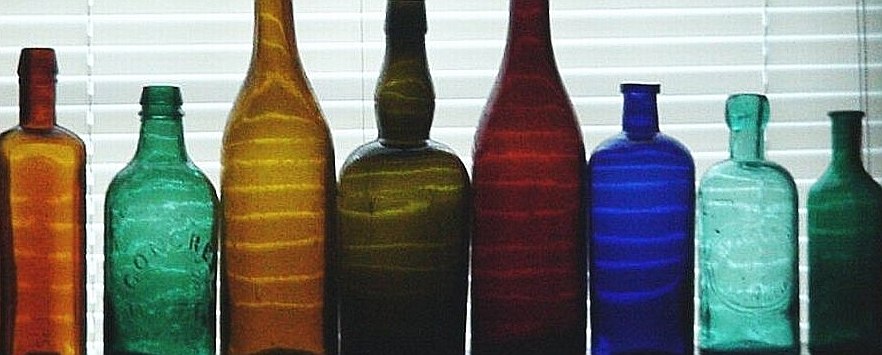
Whitall Tatum produced VERY large quantities of bottles and fruit jars throughout much of the mid- and late 19th century. Pharmacy, druggist, barber, perfume, chemical and other types of bottles in various colors and styles were produced, and some of them are now avidly sought by antique bottle collectors.
ADVERTISEMENT
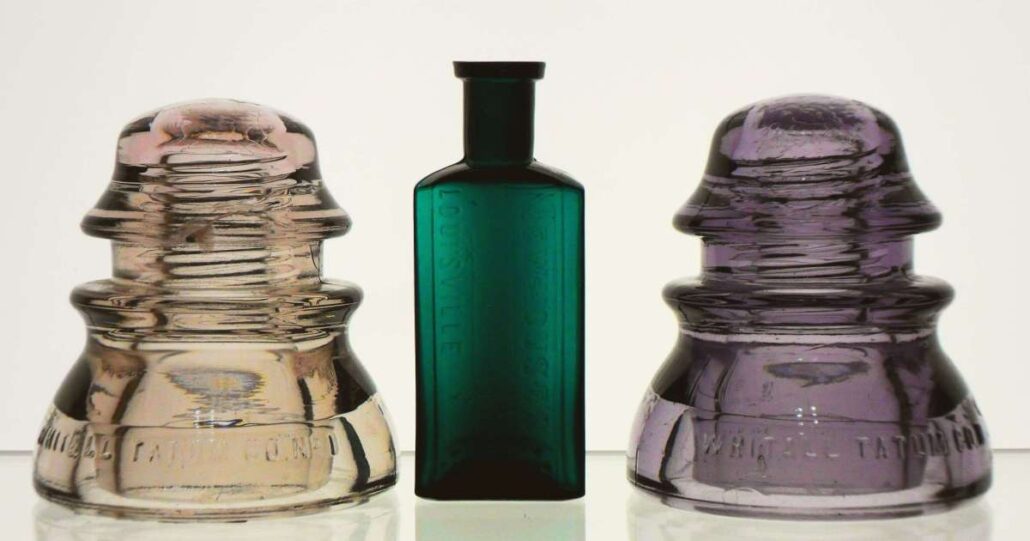
W-T is especially well-known for the production of tremendous quantities of personalized prescription bottles, blown for hundreds (if not thousands!!) of local druggists/pharmacies across the country, embossed with their names and addresses using interchangeable slug plates inserted into the mold. Most of those types of druggist bottles marked “W.T. & Co.” on the base generally date from approximately 1875 to around 1901, and are most frequently found in a good-quality clear (colorless) glass. Less commonly seen are examples found in a beautiful rich teal green glass, as well as cobalt blue and amber.
After the firm name was changed to “Whitall Tatum Company” in 1901, the marking on bottle molds was changed slightly to “W.T.CO.” That marking is estimated to have been in use from about 1901 to approximately 1924, although I am sure there was an overlap of a few years when the new mark was being phased in and the “old” mark was removed/re-tooled on molds already in use.
Many of their pharmacy bottles have a letter or letters embossed (along with the “W. T. & CO.” or “W.T.CO”) on the base which were typically mold identification marks (not date codes). For discussion and possible dating of the many variations (with letters or numbers placed above or below the company initials), see this article from researcher Bill Lockhart and the Bottle Research Group: Whitall Tatum Company – SHA.org
Whitall Tatum glass bottles were made in clear (colorless), amber, teal green, emerald green, aqua and cobalt blue glass. I assume they made other colors occasionally.
The majority of their druggist (prescription) bottles were made in clear glass. Because their formula for making clear glass typically included small amounts of manganese, those clear bottles may turn light to medium shades of purple/amethyst after long exposure to sunlight. This is a normal occurrence with clear glass that contains manganese. (Manganese is an element that saw heavy use as a “decolorizer” by glass factories especially in the 1870s-1920s, and later in some instances).
Normal or “natural” glass is typically of a light aqua or blue-green color – because nearly all sand used for manufacturing glass has trace amounts of iron in it – and the iron impurity imparts the aqua color. The manganese in the glass formula “counteracts” or “masks” the aqua color so the glass comes out (more or less) clear or colorless.
But if the glass bottles are exposed to long continued sunlight, they may turn a light to medium purple color. This is normal if the glass contained manganese.
HOWEVER, some bottles are seen in a very dark purple color , and in most instances that indicates bottles that have been artificially irradiated (“nuked”) many years later (NOT by the glass factory). See this page on Artificially Purpled Glass.
(Confusingly, many Whitall Tatum telegraph / telephone insulators, especially the “WHITALL TATUM CO No. 1” style made during the 1920s (pictured below) are found in naturally-occurring light to medium purple shades. The top of a telephone or telegraph pole is the ideal place to “sun” the glass over many years!)
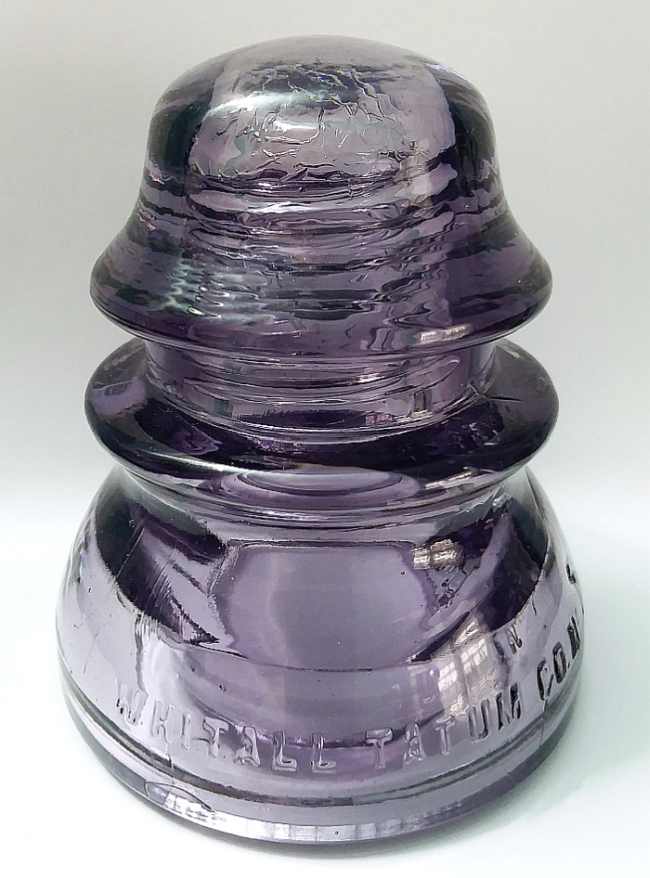
Whitall Tatum didn’t enter the insulator manufacturing market until 1922, not long after Brookfield Glass Company had shut down production. (See Brookfield Glass Company page for more information). However, W-T made up for lost time by producing millions of insulators during the ensuing years. No doubt they supplied insulators to many firms (especially in the Eastern states, but over the entire country as well) that had previously purchased from Brookfield.
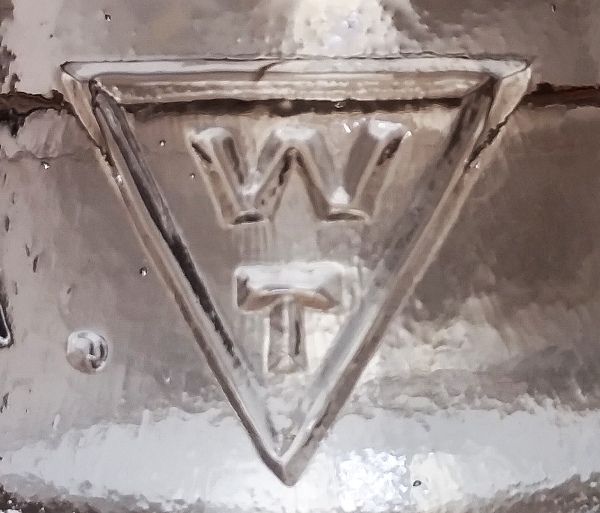
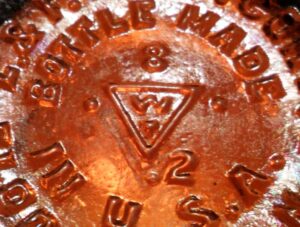
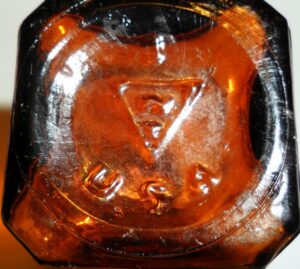
“W over T inside inverted Triangle” mark (c. 1924 – c. 1949)
In the 1900s and on into the 1920s and 1930s Whitall Tatum continued to produce large quantities of bottles of many types, sizes, and colors. W-T manufactured bottles that were sold and used by a large number and variety of product manufacturers, especially those making and packaging “brand name” medicines, remedies, cleaning products, flavorings, chemicals, cosmetics, lotions, etc. Large numbers of amber LYSOL bottles bear this triangle mark.
Many of these bottles, along with many glass electrical insulators, are found with a “W and T inside an inverted triangle” trademark (as shown in photo here, embossed on the side of a CD 154 “Whitall Tatum Co. No 1” insulator). The “W and T” triangle, if present on bottles, is usually embossed on the very base. That trademark is generally believed to date beginning about 1924, and appears on machine-made containers, not mouth-blown bottles. “U.S.A.” or “MADE IN U.S.A.” may or may not be embossed along with the mark. There is some uncertainty on how long the “W over T inside triangle” mark continued to be embossed on containers, but it is unlikely it was used after about 1949.
Whitall Tatum was purchased by Armstrong Cork Company in 1938. Armstrong had already (for years) used an “A in a circle” as their trademark. More than likely, there was a gradual changeover on bottle and jar molds starting around 1938, but that transition probably occurred over several years time. Realizing that a large number of molds were in use, I would suspect it took a while for all of them to be retooled. And some of them may have been allowed to “wear out”, to be replaced with newer molds bearing the “A in a circle” trademark.
From research done on Whitall Tatum insulators (by collector and researcher Richard Wentzel) , as discussed on page 138 of the reference book “Insulators: A History and Guide to North American Glass Pintype Insulators” (McDougald & McDougald, 1990), he indicates that the “A in a circle” was apparently first placed on their insulator molds about 1941 (three years after Armstrong took over), and, meanwhile, the WT in a triangle mark was phased out gradually, over a period of quite a few years, from approximately 1941 to 1949, on their insulators.
I do not know if their bottles followed that same timeline, but I presume they did. I have never seen any bottles with the “WT inside a triangle” mark that appear to date after the 1940s, or possibly the early 1950s at the very latest. One published source that implies that the WT in a triangle mark was still in use as late as 1964 was a bottle makers’ marks chart printed by Owens-Illinois, mentioned in this article by Bill Lockhart and the Bottle Research Group: Armstrong Cork Company
He was referring to a chart copied in an archaeology report by Dale Berge in 1980.
(Simpson Springs Station historical archaeology in western Utah, 1974-1975 by Dale L. Berge – openlibrary.org ) – which can be read online (page 83 on that pdf file).
That chart was published by Owens-Illinois in 1964. I noticed on that same chart there is also another instance of a mark that was presumably no longer in use by 1964: the “LM inside an oval”, by Latchford-Marble Glass Company, which was reportedly discontinued in 1957 (in fact, the name of that glass company had been changed to Latchford Glass Company). To sum up, I think Owens-Illinois Glass Company was either somewhat slack about making sure their chart was up-to-date, or they merely wanted to include certain well-known marks that might still have been encountered on fairly recent glass containers made within the last decade or two of the publication of that chart.
ADVERTISEMENT
Armstrong Cork Corporation purchased Whitall Tatum Company in 1938 (with insulator production continuing at a remarkable rate, and the existing molds being re-engraved with the ARMSTRONG name between 1946 and 1949), and finally Kerr Glass Manufacturing Corporation took over ownership of the plant in April of 1969. Many of the insulators continued to carry the “Armstrong” embossing, until about 1973, by which time all carried the “KERR” embossing.
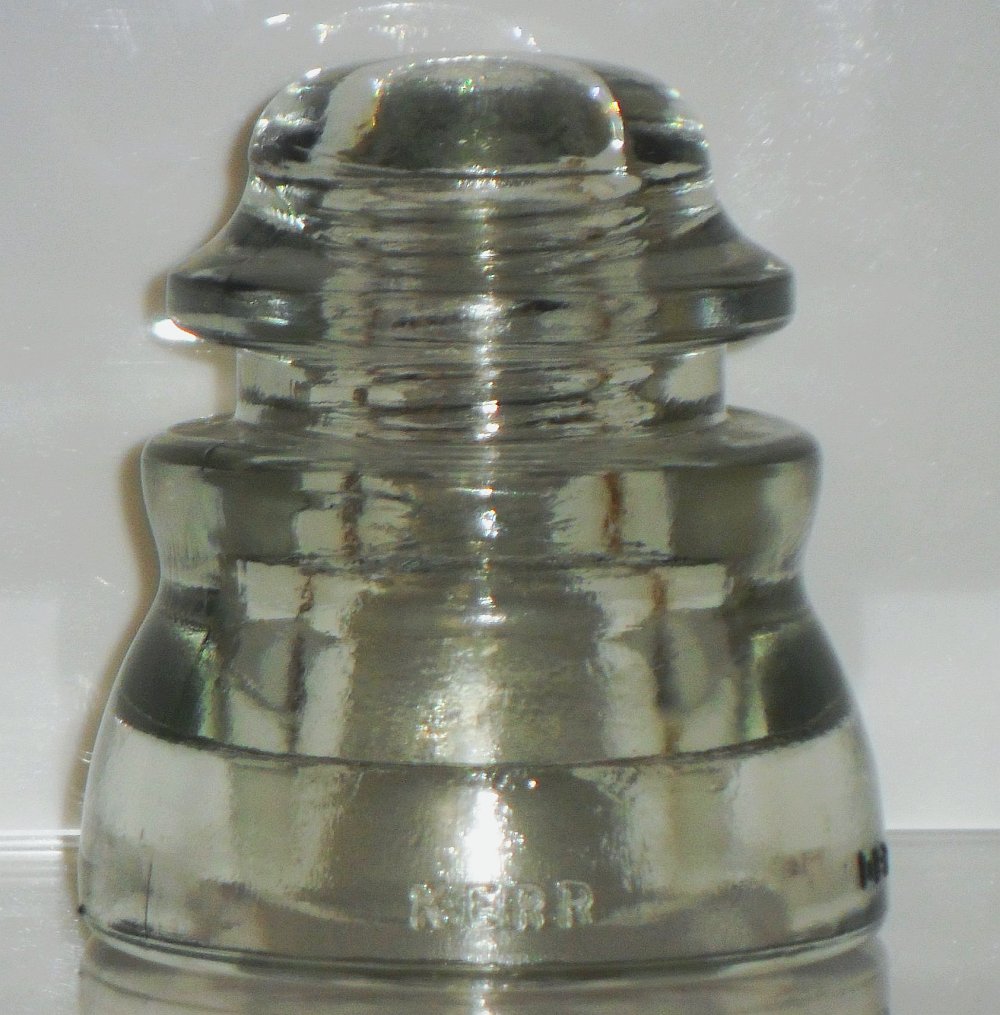
With the rapidly decreasing demand for glass insulators, production at the Kerr plant continued to diminish as the 1970s wore on. From information supplied to me by Richard Wentzel, the last glass insulators made at the Millville plant were produced in late 1975 or early 1976. Soon afterward, the insulator molds and equipment were moved to the Kerr Glass plant located in Dunkirk, Indiana. (The very last “KERR” embossed insulators made at Dunkirk are evidently the ones marked with 1978 date codes, and no Kerr insulators are known with a more recent year date code on them). Those insulators made in 1978 are almost certainly the most recently-made authentic small to medium-sized PINTYPE glass insulators produced within the United States.
Kerr Glass Manufacturing Corporation sold the Millville manufacturing facility in 1983, along with 3 other plants, to the American National Can Company. Ball-Foster took control of the factory in 1995, and in 1999, after 193 years of nearly continuous glass production, the factory was shut down permanently.
An update (posted 2006): I’ve received word that the former Lower Works site is reportedly a self-storage facility, and the buildings that once housed WT’s glass furnaces have been demolished. A sad ending indeed for one of America’s greatest glass manufacturing enterprises.
For a more comprehensive article on the background history and marks used by Whitall Tatum, including a discussion of the many minor variations on the marks appearing on druggist bottles, and info on the early fruit jars made by this company, check out this article from Bill Lockhart et al: Whitall Tatum – Part I – Whitall Tatum & Co. – SHA.org
Note: for a webpage on this site with an extensive list of glass insulator manufacturers, please click here: Glass Insulator Manufacturers
For an extensive list of glass manufacturer’s marks seen on bottles, fruit jars, insulators, tableware and other glassware, please check out my alphabetical list of marks starting here on page one of the Glass Bottle Marks pages.
Please click here to go to my Home Page.
Click here for more info on the Kerr Glass Manufacturing Corporation.
(Sources of info: Richard Wentzel (from his article in McDougald, 1990, and personal communications); also, Adeline Pepper- reference book The Glass Gaffers of New Jersey (1971) and other sources).
ADVERTISEMENT
I have an art deco looking bottle covered in diamonds, its square and the bottom has the D18 mark. It has the inverted triangle with the W T. To the left of the triangle is the D18, to the right is 12-7. Above that is Continental Distilling Corp and below it is Pat.D.97561 Philadelphia PA. The top has the “Federal Law Prohibits…” Is the bottle from the 30’s then likely?
Hello Seth,
Yes, that bottle was made by Whitall Tatum Company, of Millville, New Jersey FOR Continental Distilling Corporation in 1937. The “12” is a liquor bottle permit number for Whitall Tatum, and the “7” is a date code for 1937. The design patent D97561 was officially issued on November 19, 1935. The patent rights were in effect for 14 years. So, theoretically, bottles of that design could have been manufactured between 1935 and 1949. Here is a page from Google Patents showing the patent documentation. Some of the text in the first URL is garbled from the OCR transcription process.
Design Patent for a Bottle – USD #97,561 Google Patents
Patent #97,561 – patent issued Nov. 19, 1935 – .PDF file – Google Patents
Hope this helps!
David
How’s this for a coincidence.
I found a clear bottle with the markings F. Jeffery Chemist by exam Dammevirke. On the base stamp it has 3 stars W.T. & Co. A U.S.A PAT.
DEC. 11. 1894.
My name is Lianne Jeffery and the town next to where I live is called Dannevirke New Zealand.
Pretty amazing.
Have a nice day, Lianne
Hi Lianne,
What an interesting old bottle! This is a good illustration of how Whitall Tatum made bottles for various companies around the world, and not just for those located here in the US.
I did some searches online and found that there were at least two druggists/chemists in Dannevirke, New Zealand that had bottles made for them by Whitall Tatum and Company, such as those illustrated on these two webpages:
E E Prior Chemist Dannevirke bottle – kiwiauctions.co.nz
Cobalt blue Prior-Dannevirke Chemist druggist bottle – lot.art.com
It seems like your bottle must be fairly scarce as I couldn’t find another one from Jeffrey. The links above show
bottles from “E.E. Prior, Chemist”. I assume that Whitall Tatum made apothecary / druggist bottles for several firms in Dannevirke.
Are you saying that the embossed lettering on your bottle is definitely “DAMMEVIRKE” and not “DANNEVIRKE”? If so, that would be an embossing error, and might have happened if the lettering instructions sent to WT&CO from the F. Jeffrey pharmacy (by mail, telephone or telegraph) were misunderstood – so they engraved two letter M’s into the mold instead of letter N’s.
Thanks a lot for your post!
David
Hi David
I recently found a small brown bottle with the “W over T inside inverted triangle” mark. It’s also stamped with “¾ oz.” with “21” opposite. “8” & “40” is stamped below the makers mark. Not really sure what it contained but figured I’d share since I’m guessing it was produced in 1940, so that makers mark was still in use at that time. It was found near Fort Meade, MD.
Hi Sarah,
I’m not sure if the “40” is a date code, but perhaps it is. Thanks for sharing!!
David
Thank you for the detailed information and excellent research. I purchased a large blue green bottle (~4 litres) with a glass stopper and has the triangle with W over T inside a triangle and U.S.A. Stamped on the bottom. If I understand this correctly is this in the time frame 1924-1938? I agree that it seems unlikely the stamp would continue use to be used into the 60s for the reasons you stated. Cleaning it out, and thought I would use it as a water jug. This is addictive, as I am looking for more. They are beautiful, heavy, and I love the history.
Hello Rich,
Yes, I believe that all (or nearly all) glass containers with the “W over T inside a triangle” were made sometime in the 1924-1938 period. I would simply add that some bottle molds may not have been immediately retooled when Whitall Tatum was purchased by Armstrong, so it is possible a few items with that marking could date a little later. I don’t think the mark was used into the 1950s or 1960s, but sometimes I try to present other points of view from researchers who might differ with me on a proposed date range.
Thanks for your post!
David
Thank you so much for this information! I recently found a clear glass bottle in the woods of Gloucester County with the inverted triangle and WT. Didn’t think I would find any info googling, but it led me to your page which has been so informative. I found another bottle which is smaller but heavier and has “williamstown bottling wks” on its side (only a 2 on the bottom). Off to look at the rest of your site in the hopes to find info on that one!
Hello Marissa,
Thanks for the nice words about my site. I don’t have any specific information about the Williamstown Bottling Works bottle, but just for a bit of background info, there have been literally thousands of different soda bottling companies in business over the last 100+ years in the US, and tens of thousands of different bottle variants produced during that time (by many different glass companies) for those companies. I assume your bottle was made for that soda bottling company in Williamstown, New Jersey.
With a search on google, I am sure there is more info to be found on your bottle, or at least about similar bottles. Can you see any marks on the bottle that would indicate a glass manufacturer? There may be glassmaker marks along the lower heel, or sometimes on the base. In some cases there are no glassmaker marks at all. But in any case knowing who the glass maker was (along with the general style of the bottle) can help narrow down the age range of a particular soda bottle. Btw the “2” on the bottom is probably a mold number.
Take care, David
I have 4 CD122 Insulators I think I have the dates figured out on three of them. 1 Whitall Tatum No 2. 34 under Tatum. Made in U.S.A. WT triangle Logo. 40 under U of U.S.A. (1940). 2 Armstrong’s No. 2 Made in U.S.A. with circled A. 1 is 55 49… (1952) and the other one is 61 51.. (1953) are these correct. The one I am not sure about is Whitall Tatum Co No 2 with a 6 under Tatum. Made in U.S.A. with the WT Triangle. From what I have looked up it shows to be 1924 to 1938. Is there something that would narrow the date to a closer year of manufacture?
Dane, on the first two insulators you describe, the numbers are mold numbers, not date codes (34 and 40). You are correct on the date codes of 1952 and 1953. I don’t know of any way to narrow down the exact year of your Whitall Tatum Co. No. 2 insulator. The “6” on that insulator is also most likely a mold number. Sorry about that. (If a reader has better info, please write!)
David
I have a clear (wavy glass most obvious in the section above the embossed lettering) embossed WHITALL TATUM CO. No. 1 THAT ALSO
HAS “29” (minus quote marks) embossed below TATUM as well as MADE IN U.S.A. and Triangle with WT. I also assumed the 29 was a date mark. Apparently not all of these No. 1’s have a number below TATUM while others have a different number even though they have the exact same molded shape. Does it not indicate that it was made in 1929? I have seen a number under Tatum in photos of some insulators, but not all and have seen NO MENTION of these numbers or what they represent. Why would they have different mold numbers when they all have the same shape? Thanks.
Hi Sandy,
Yes, the “29” is a mold number, not a date code. The CD 154 style insulators marked “WHITALL TATUM CO No 1” do not bear date codes. (I am assuming you have a CD 154 style insulator).
There are also some “Whitall Tatum Co” CD 155 insulators, which were made later, and have a slightly different shape. Some of the CD 155s carry date codes, BUT in those cases they are embossed with a mold number and a date code SEPARATED BY A DASH, and also they are marked “WHITALL TATUM” without the “CO”. If you are not sure about the differences in these styles, please study pics on the web closely).
The term “mold number” can have a number of slightly different meanings (such as a “design number” assigned to a particular style) but in this context it is referring to the one or two-digit identification number on any of a number of identical molds that were installed on an automatic insulator-making machine.
A typical machine may have had 8, 10 or 12 “molds” or “mold cavities” installed on one machine. EACH one of the molds were engraved with a different number to identify the mold. After the insulators are made, if any of them should show problems stemming from the mold itself, that specific mold could be easily pinpointed by looking at the mold number embossed on the insulator.
This is the same general idea as seen on many modern glass bottles. Virtually all glass bottles nowadays are made on machines that are fitted with a number of identical molds, all producing bottles of the same exact shape and appearance. The only principal difference (when examining a unit closely) is the mold number.
Here is an old photo of an early Whitall Tatum Company insulator machine, circa 1920, shown on the informative glassian.org site hosted by researcher Ian Macky:
First insulator machine- Whitall Tatum Company – glassian.org photo
Looking at that photo, each one of the round “bucket-like” objects is where an insulator is pressed. More than one machine could have been in operation simultaneously. Thus, mold numbers might range up into the 20s or higher if two or more insulator machines were operating at the same time. I hope this makes sense. If you have other questions or need clarification, please write again.
Best regards, David
I dug up a W.T. co. AM USA bottle embossed in script “Failing”. Any ideas as to where this was from? The top of the bottle is tooled.
I have a small glass jar, painted black on the bottom, steel lid. Mark on jar is: W. T. Co. USA and what looks like B 841. Any idea what it was used for? It’s like a small snuff container.
Thank you for providing your knowledge and sharing your experiences. You mentioned that most question have already been asked and answered. Please forgive me, can you share why and how you got involved? I’m a newbie and have read back as far as my phone will allow without freezing on me. May I assume the higher the number on the insulator the less value? My dad is a retired telephone company worker. For me the insulator symbolizes hard work and sacrifice. It has allowed me to attend college. My dad worked many hours climbing the poles. He remembers being told to throw them away. I recently started to collect them and for a beginner don’t really know what to look for. They all seem beautiful and valuable. However, realistically can you give a brief overview of what to look for if I’m ever at an auction or maybe even a yard sale and happen to see them for sale? Any wisdom you would like to share would be great!
Insulator Expert wanna-be!
Thank you,
Tammie
Hi Tammie, Thanks for your post.
First of all, I should make it clear that there are MILLIONS of potential questions that could be asked about glass, or glass insulators, bottles, etc, and I have answered only a few on this site (and don’t have the time or knowledge to answer many, many others!) It is such a wide field of collecting and study. Many questions concerning glass marks, and glass collecting in general just don’t have an “easy, simple” answer!!
I don’t recommend using a smartphone or tablet to view this site (I prefer a good old-fashioned *large* computer screen and standard keyboard), but I realize many people now go online only via their phone.
“Style numbers” or “model numbers” on insulators can have little or nothing to do with how rare or valuable they are. There were dozens of different insulator-manufacturing companies. Some of them used style numbers (such as #42) on most of their insulators (such as Hemingray, Whitall Tatum, McLaughlin, and Pyrex) but others did not.
In a very general sense, some of the insulators made by Hemingray with lower style numbers (such as their NO. 4 or NO. 5) tend to be earlier, older, less common styles, but that is not a hard and fast rule!! There are lots and lots of exceptions. Some of their newer, larger power styles with larger style numbers (such as #71) can be somewhat harder to find.
Honestly, there are no easy answers to this question.
My advice for you would be to check out theInsulators.info website, and read some of the general articles there. Also, you could join the “ICON” icon@insulators.info discussion forum, where collectors, new and experienced, post questions of all sorts. There are several insulator collecting and discussion forums now on Facebook.
In general, most of the glass insulators you see at a yard sale, flea market, or an antique store will be of the more common variety. However, there are always exceptions here and there, and there is always the chance you could run across a very scarce insulator mixed in with lots of ‘commons’. A lot of telephone and telegraph lines were repaired, renovated and upgraded over the years and so when a line was finally dismantled, a “grab bag” of many different styles, colors and ages might be found.
Some of the most common insulators (which were installed in untold millions around the United States) would include: The Hemingray-42, Hemingray-40, Hemingray-9, Hemingray-10, Hemingray-56, Hemingray-16 and Hemingray-45. And there are others. Keep in mind that an insulator in a more uncommon color will usually have more value than a similar example (of the same style) in a typical aqua or clear color. Most insulators made by Whitall Tatum or Armstrong are common, but again, some exceptions are out there.
I would suggest you do a lot of browsing of the insulator auctions on ebay over a period of time, and note which ones ACTUALLY sell, checking the “COMPLETED ITEMS” lists. (Most casual sellers on ebay do not know the average value of an insulator they are listing, and often try to start an auction at an outrageously high starting bid, and then they get zero interest in their auctions.)
If you aren’t familiar with the so-called “CD system” (Consolidated Design system) of identification used by insulator collectors, I would recommend studying it and learning the most common styles out there. Most collectors who have been “in the hobby” for very long will use those numbers when describing and discussing glass insulators.
Check out the Hemingray.net and Hemingray.info sites that have lots of info on the more common insulators made by that company. Porcelain (“ceramic”) insulators are a whole ‘nuther field and there are sites devoted to the study and discussion of them.
Hope this helps a bit,
David
I have a clear insulator marked WHITALL TATUM (in an arch over..) No 2 (You can faintly see a WH above and to the left of the WHITALL). Back side MADE IN USA (In an arch over) 3 – 41 and then an A A in a circle. Trying to date it, but can’t find information on one with the Whitall Tatum name without “Co” following it. As far as the faint WH, did they “remold” these or ??
Amy, the “3 – 41” means “insulator made from mold #3 in 1941”. The “WHITALL TATUM” embossed insulators (without the “CO”) date from about 1938 to approximately 1949. After Whitall Tatum was purchased by Armstrong in 1938, there was a gradual changeover in lettering configurations as additional/new molds were brought online and older ones wore out and were replaced.
The faint embossed “WH” you see is called “ghost embossing” or “ghosting” and is seen often especially on older insulators. It usually appears to the upper left of the actual embossing. It happens when the hot molten glass is poured into the mold and some of the glass moves against a part of the engraving for a split second, “picking up” a part of the lettering, before it falls into its final place and solidifies in the mold.
This webpage includes an explanation on that phenomenon:
CD 147 — The GROOVY Insulator Part 2 – by Jim Sinsley.
Your insulator is classed as a “CD 122” in the “Consolidated design” cataloging/classification system in use by insulator collectors. You can find more pics and info on that type with an internet search on “Insulator” and “CD 122”.
Hope this helps,
David
I have an aqua Whitall Tatum No 1 but don’t know how to determine the CD number?
It was found near Jim Thorpe, PA. Any way you could shed some light on what I have? Thanks!
Hi Ty,
The Whitall Tatum NO. 1 insulators fall into only 2 different types (CDs). The first type made is the CD 154 (the shape/profile is almost exactly the same as a typical “HEMINGRAY-42” which I think is an easier way to explain it, since the Hemingray-42 is the most common American-made glass insulator in the world). The “skirt area” profile immediately underneath the wire groove will curve inward, then outward, in more of a ‘bell’ shape curve.
HOWEVER, on the later Whitall-Tatum No. 1’s, those have a skirt that is more “vertical” (squared off) below the wire groove, and if you compare them side by side, the difference will be very noticeable. That’s the CD 155. Search ‘Google Images’ with the keywords: Whitall Tatum No. 1 CD 154 and CD 155, and study the pics. Most of the W-T CD 154s are in bluish aqua, greenish aqua, straw, peach, purple, or light pinkish color. MOST of the later ones, the CD 155 style, appear in a clear or off-clear colored glass, some with a dull grayish tint to the glass.
Hope this helps,
David
I found a square brown bottle about a foot tall rectangular in shape with WT in a triangle on the bottom w an A and B on either side any answers on this?
Hi Adam,
Whitall Tatum made thousands of different styles of bottles over the years, so their mark will be found on a wide variety of containers. I’m not familiar with many of them. Sounds like it might be one of many types of amber bottles used for chemicals, cleaning products, etc.
David
My Grandfather worked there, is there anywhere that I can find pictures or list of employees from the 30’s and 40’s?
Hi Denise,
I am publishing your post. Maybe someone who lands on this website will have more info for you. However, I am very skeptical it would be easy to find any such pictures or lists, if they exist. But I would suggest (if you haven’t already done so) to go to the local area libraries (at Millville, or possibly other nearby cities) and check their reference collections for material on Whitall Tatum. If you can find any city directories of the 1930s or 1940s, you might find information in those directories on people who worked at Whitall Tatum. Some geneaology- oriented websites may have city directories in their databases with information that could be helpful. No guarantees, though!
Take care,
David
Hello, hoping you can help me identify a whitall tatum insulator i have. Front skirt is WHITALL TATUM CO.. followed by WT triangle. Back skirt is No.1 MADE IN U.S.A. Above the “E” in the word Made is a 0. Its a light aqua insulator as well. From my minimal research it appears to be an early embossing style that very few were made. Thanks for any info
Bill,
It is a very common insulator, made in the 1924-1938 period. There can be minor differences on individual examples, as far as the exact mold numbers seen (yours has an ‘0’) but the general model type (No. 1) was made in large quantities in light aqua glass. The “Whitall Tatum Co Number 1” style is classed as “CD 154” in the “Consolidated Design” classification system used by insulator collectors. This is the same shape as the HEMINGRAY-42. Hope this helps,
David
Thanks David. Is is possible to post pictures on this site. That would be much better than my vague descriptions.
Sharon, I don’t have the site set up to accept pics from readers. You are welcome to email me pics. My email address is listed at the bottom right of any page on the site. [Edit – now on the Contact Information page].
~David
I have 5 white milk glass pharmacy jars with lids about 6 inches tall with lids on. They are all labeled in black ink with the contents. The names are in Latin I believe. I can’t find any information about them. The bottom of the jars are marked Whitall Tatum Co. Phila & NY
Any info would be appreciated. Are these jars rare?
Sharon,
I don’t have any specific info on them, but they sound like a nice find!! I would guess they are from the 1910-1930 era, but that is just a guess!!
David
Would u sell them
I have 2 Armstrong insulators, same design ( I believe CD128), but the company label on the front differ. One is a large A in a circle, followed by lower case, upright rmstrong, while the other has Armstrong’s in a leaning, almost cursive font (note the ‘s), Can you tell me anything about why they differ? Thanks!
Hi Becky,
Several times during the production of Armstrong insulators, new sets of molds were introduced.
The molds with the word ‘Armstrong’s’ in cursive date from about 1948 to 1960.
The molds with the “A in a circle” Armstrong, as you describe, were made and used from approximately 1957 to 1969. So there was a little “overlap” in the use of the molds. I don’t know for sure why the embossing was changed slightly but I would assume it was because the Armstrong trademark of the “A in a circle” was being made more prominent as part of the later insulators. (Such as seen in this current webpage……same company, but they no longer make glass……….they concentrate on flooring and related products): Armstrong.com
There are year date codes on your insulators………can you please tell me ALL of the numbers (and dots if present) marked on them?
This info on dating the different lettering styles comes from “A History and Guide to North American Glass Pintype Insulators” (1990, compiled/edited by John & Carol McDougald, that particular article on Armstrong written by Richard Wentzel) on pages 138-139.
Hope this helps,
David
I found an insulator with Whitall Tatum No. 2 on the font and with Made In USA 18-46 on the back with an A in a circle with 1 dot on the left and two on the right as well as the number 44 under the A…can you give me any information on this please. Thank you.
Robin, your “Number 2 style” insulator was manufactured by Armstrong Cork Company (who had bought the Whitall Tatum Company in 1938) in 1946. The “18” is a mold number, the “46” is a year date code, the “44” is a date code that the insulator MOLD itself was manufactured. I’m not sure about the meaning of the dots, although they might have been codes for the quarter of the year the insulator was produced………not sure about that. Your insulator is a type generally called a “toll insulator” meaning they were for toll lines (Long distance telephone lines).
David
The dots indicate years.. for example an 8 followed by four dots would be 1912..
Hello Kat (and Robin!),
In some cases, such as on glass insulators made by Hemingray Glass Company (in the c.1934-1967 period) dots after a date code can and do usually indicate years, but in this case those dots represent the quarter of the year in which the insulator was manufactured. I’ve recently received information from Andrew Gibson (an insulator collector and researcher) who emailed me a couple blueprints from the Armstrong company which shows this to be true – the blueprints belong to Whitall Tatum/Armstrong guru / collector Richard Wentzel. (And thank you Richard!)
In any case, the first Whitall-Tatum insulators were not made until about 1922. Armstrong Cork Company acquired the glass plants of Whitall Tatum Company in 1938, and that particular insulator mold was made in 1944. The insulator itself was made in 1946. So, in this case, the 3 dots arranged around the “Circled A” indicate the third quarter of 1946 (presumably July, August and September), sometime during which the insulator was manufactured.
I should also add that in later years of production (after 1949 or thereabouts), Armstrong, and later, Kerr, insulators DO carry dots placed immediately to the right of a two-year date code, and in those cases each dot does stand for an additional year!
I hope this helps clarify the question!
David
Hi, I just purchased at a 90 mile yard sale a Whitall Tatum CO No 1 light purple ( lavender) insulator for $15 ! It has a small chip on the rim but, I like the color & it’s for myself so. 😊
Just wondering what’s a good price for this one about ?
Joyce, my site is not intended as an appraisal site. However, you paid a price which I think is in the typical range for that style of insulator. Check ebay, using the advanced search page, typing in relevant keywords, and search for COMPLETED ITEMS over a period of weeks or months to see what various insulators are actually selling for. This is the best way to get a ‘feel” for the average current market value of insulators.
Any damage will decrease the value of an insulator. Your Whitall Tatum insulator is classed as a “CD 154” style. The “CD numbers” (consolidated design numbers) are part of a system of identification in wide use among insulator collectors, and those numbers are heavily used on ebay auctions and other internet sites.
Best regards,
David
I have possessed a long-handled spoon marked Whitall Tatum Company since I was a kid in the 1950s.
I have what seems to be a 20 gallon water bottle. Markings are W T Co 2. On top is k23. Looks like maybe made for Acme water coolers .
I found a brown bottle with a mark that looks like the ‘WT’ in a triangle on the bottom and what appears to be the number ‘6’. It is 3 inches tall and 1.25 inches in diameter. I am curious to know how old it is, its use and its manufacturer. Thanks.
Hi Joe,
WT in a triangle: Whitall Tatum Company. Please check my Glass Bottle Marks pages under the “W” listings, or see my individual page on Whitall Tatum. Anyone can try a keyword search, using the search box located near the upper right hand side of any page on this site to access articles containing more info on certain marks and companies.
~David
I have a bottle with a capital A on the bottom and a circle around the A….does this alone mean it is from Armstrong cork company (glass division) between 1938-1969? It also has the number 26 on the right hand side of the A and a 66 to the left hand side of the A…what do the numbers mean? The bottle is like an Amber or brown color…no bigger than 6 inches long…. It also says 1/10 pint on it
I’m not sure but I think the “66” may be a date code for 1966. Don’t quote me on that! Not sure on the “26”.
David
I have a clearish bottle I purchased with a light purple color. The seller said it may have mercury in the glass and that is the reason for the color and it is called sunkissed purple? However I’ve researched this and have seen this may be Magnesium used in the glass. The markings (all on the bottom) say:
W.T.
U.D. CO.
40
There is also a vertical “2” next to CO.
There is no triangle. I cannot find any information on what the UD means? And what year and approximate value it may have. Looking at it in the light, it shows as very purple. Can you please help me out in identifying the markings – especially the UD and can you give me an idea of the year and value? Thank you in advance and I appreciate your help.
Mary Jane
Hello Mary Jane,
The purple color you see is not caused by either mercury OR magnesium. (Sorry, but the internet is overloaded with lots of misinformation :-). but it’s caused by the element MANGANESE. Manganese was added to the “batch” (molten glass mixture) to counteract (“mask”) the aqua – light bluish or greenish color- which would otherwise by present – that color being caused by iron which is an impurity that occurs to some extent in nearly all sand. Continued exposure of the glass to sunlight may cause the color to deepen somewhat, but it depends on how much manganese is present in the glass. Higher amounts of manganese will cause the glass to turn shades of purple. This is called SCA (Sun-colored Amethyst).
(Not to confuse this with the increasingly pervasive practice of “nuking” or “irradiating” old glass bottles that contain manganese, thus “activating” the manganese and causing them to turn an artificial, very dark, odd “grape Kool-Aid” purple color. This practice is frowned upon by many bottle & antique tableware collectors and glass historians).
Unfortunately, a lot of unscrupulous flea market dealers and ebay sellers are doing this for a “quick buck”….. selling nuked bottles as decorative “window bottles” (at highly inflated prices) because ‘pretty purple’ sells to the uninitiated.
More information on Artificially Purpled Glass / Irradiated Glass / Altered Glass glass is posted here ).
If the color is fairly light to medium purple, your bottle may be naturally “sun-purpled” by exposure to ordinary sunlight. The “nuked” bottles are usually a very dark purple that tends to lean to a blue-purple.
“U.D.CO” stands of United Drug Company. The bottle was presumably made by Whitall Tatum (for United Drug Co.) probably sometime in the 1900s, 1910s or 1920s. No specific “blue book” value can be assigned to this bottle, but typical prescription / pharmaceutical bottles (if there are NO MARKINGS ON THE FACE OR SIDES, BUT ONLY ON THE BASE!) of this general type and age are quite common. Best regards,
David
I read somewhere that most of the manganese used in bottle manufacture came from Germany prior to WW1.It was no longer used as stocks of manganese diminished and any bottle made after about 1916 or so wont turn purple`
Greg,
There are a lot of misunderstandings and misinformation on this topic. The general story told is that during World War I, supplies of manganese were cut off (by German blockades) from Russia, so glass makers resorted to other ingredients to use as decolorizers, especially selenium, which tends to cause a faint yellowish-straw tint to the glass. However, since it is known that manganese was widely used to make purple glass of various types in later years, it is apparent that the “cut off” was only for a few years, and probably some time after World War I ended, supplies resumed being exported around the world, and perhaps from other sources other than Russia.
Large numbers of Whitall Tatum glass insulators contain manganese and many of them have turned shades of purple as a result, such as the Whitall Tatum No. 1 style. All Whitall-Tatum insulators date after about 1922, and, of course, this is after World War I had ended in 1918.
In general, I would say that MOST old bottles that will, or have, turned amethyst/purple from sun exposure (or being “nuked”), date from the period of 1890 to around 1920, but, as with most general rules, there are sure to be some exceptions here and there.
Hope this helps a little,
David
Thank you David. A very informative reply.
Hi David,
Thanks for the great info on these neat insulators! I am having a hard time identifying one that I have: Whitall Tatum Co. No 1 with a 37 below Tatum, Made In USA on the other side with WT in the triangle. I see that it was made between 1922 &1938, but how much is it worth? I am guessing it’s a 154 CD. Thanks for your help!
Esther
Hi Esther,
In general, I try to avoid discussing values on this website, but I can say that the Whitall Tatum Co. No. 1 style insulator was made in very large numbers, and so the most common colors (clear, bluish aqua, light greenish aqua, light straw) are typically valued at around $1.00 to 2.00 in VNM condition. (Peach, pink, purple shadesare less common and will be higher in value). Although insulators such as these are often priced much, much higher in venues such as antique shops or flea markets. “VNM” (very near mint) is a term used commonly in insulator collecting, and describes a very respectable example with only slight damage (perhaps with a few very small ticks here or there). The CD 154 was the earlier type of WHITALL TATUM CO. NO 1 insulator, the same shape as the very common “Hemingray-42”. In 1938 a “new improved” style was introduced, the CD 155, also marked Whitall Tatum NO. 1 (most examples have the “CO” removed, although not all). The main difference: The CD 154 shape has a more pronounced curvature immediately underneath the lower wire ridge on the “skirt” (underneath the wire groove). On the CD 155, the lower ridge is more “squared off” (with more of a clean vertical drop) and this is easily apparent comparing a CD 154 and CD 155 side-by-side. The CD 155 feels noticeably heavier. A search of Google Images with “CD 154” and “CD 155” will show this difference. On your insulator, the “37” is a mold number. Btw, there are insulator price guides available, both online and in hardcopy. An online search with keywords “Insulator Price Guide” will bring up more information.
Hope this helps,
David
I have a little bottle on bottom W T. CO., under that is D under that is USA then on front just below shoulder has the pharmacy style 3i. Wonder how old it is.
Hi Tammy,
As listed on my site, the “W T CO” marking on Whitall Tatum Company bottles dates after 1901. However, I am not sure exactly when it was discontinued. Most W-T bottles after around 1924 are marked with “W over T inside a triangle”, and that mark was used until 1938. Therefore I am guessing (with no proof) that the “W T CO” mark was phased out probably around 1924. Circa 1901 to 1924. I might also mention that the pharmacy bottles with the “fancy pharmacy style 3” seem to have come into popularity in the 1910s. In any case, I cannot give you a specific year on the age of your bottle. Thanks for writing!
David
[Edit – also the “weird 3” is an old apothecary symbol that stands for “Ounce”. The small Roman numeral to the right stands for the number of ounces in the bottle. So your bottle holds 1 ounce. – David]
I have a 10 gallon glass jug it has W T.CO with a 2 on the bottom